

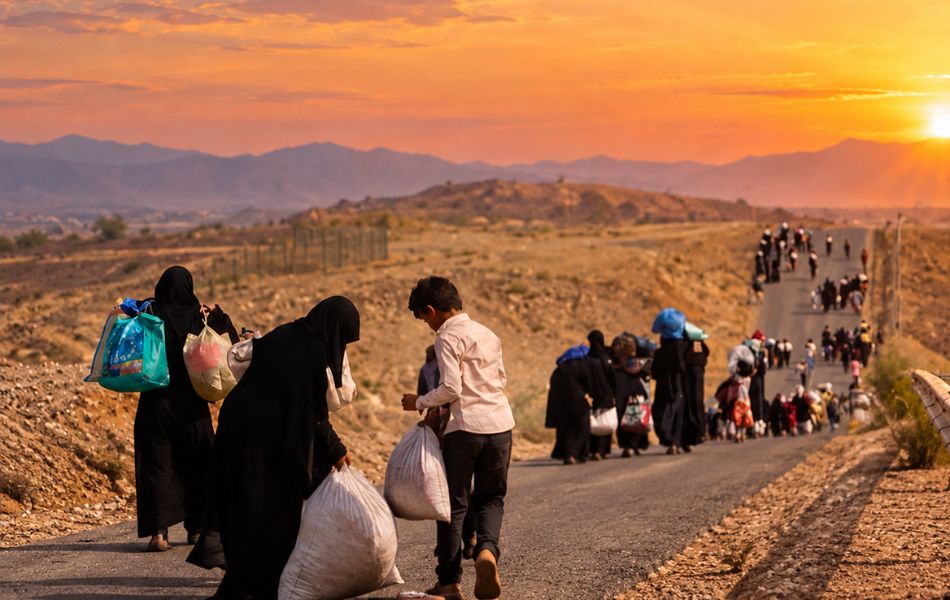
Human Rights Report Documents Civilian Deaths and Injuries, Widespread Displacement, Property Looting, and Child Recruitment During Escalation in Taiz and the Western Coast
“There Is No Longer a Safe Place”
A human rights report documents civilian deaths and injuries, widespread displacement, property looting, and child recruitment during the military escalation in Taiz and the Western Coast.
The report is based on a monitoring database containing 85 preliminary records and a verified list identifying at least 16 civilian deaths and approximately 18 injuries. Meanwhile, the number of displaced persons registered by the International Organization for Migration (IOM) reached 129,438 people as of 21 September.
The SAM Organization for Rights and Liberties, in partnership with the Rasd Organization for Rights and Liberties and the Justice, Equity, Development, and Human Rights Organization, has released an extensive human rights report entitled “There Is No Longer a Safe Place.”
The report documents the humanitarian and human rights consequences of the military escalation that took place in Yemen between 3 July and 22 September 2026, with particular focus on the intensified fighting that expanded since early September in western Taiz Governorate, the Western Coast, and areas surrounding the Bab al-Mandab Strait.
Published in September 2026, the report examines the impact of military operations and changes in territorial control on the lives of civilians. It documents incidents involving civilian killings and injuries, forced displacement, attacks on civilian objects and medical and humanitarian facilities, looting and seizure of property, arrests and restrictions on movement, the recruitment and use of children in hostilities, and violations involving the dignity of the deceased and burial sites.
The report emphasizes that its purpose is not to provide a military account of the course of the conflict, but rather to examine the direct consequences of the fighting on civilians and their rights, and to assess whether the documented incidents reveal patterns that require investigation and accountability.
85 Preliminary Records: The Figures Are Not Yet Final
The initial monitoring database relied upon by the report contained 85 records, including 70 records in the main database and 15 additional records received from the organization’s monitors in Al Hudaydah.
SAM stressed that these records do not necessarily represent 85 separate incidents, due to overlaps and duplication involving certain events, victims, and facilities.
After reviewing names and removing apparent duplication, the report reached a preliminary verified toll of at least 16 civilian fatalities and approximately 18 injuries in cases where victims could be identified by name. This figure also excludes additional victims mentioned in the details of some incidents whose verification process has not yet been completed, particularly among missing persons and injured individuals from displaced families.
The report explained that it intentionally avoided combining these cases into the final statistics before completing the verification process, in order to prevent duplication and ensure the accuracy of the final figures.
The monitoring records indicate that rocket attacks, mortar shelling, and gunfire were among the main causes of civilian casualties. The documented incidents also included cases of sniping and direct gunfire targeting civilians while they were travelling or attempting to flee, as well as attacks on homes, roads, and public facilities.
The report highlights the presence of children among the victims, including some between the ages of four and 15 years old, as well as children who were injured while standing outside their homes, during displacement, or while tending livestock.
From the “Mahan Air” Crisis to the Expansion of the War Along the Coast
The report places the documented incidents within the broader context of an escalation that began in July 2026 following the crisis involving an aircraft belonging to the Iranian airline Mahan Air.
This was followed by the Houthi group’s announcement of the end of the de-escalation period and the imposition of restrictions on vessels linked to Saudi Arabia under the slogan “blockade for blockade.”
Military operations subsequently expanded gradually toward western Taiz, Al Mokha, Al Khawkhah, Hays, and areas near the Bab al-Mandab Strait, accompanied by significant changes in territorial control and large-scale displacement of civilians.
The report documents, in chronological order, an attack attributed to the Houthi group on Al Mokha Port on 9 August using missiles and unmanned aerial vehicles (drones), before the clashes expanded on 3 and 4 September to Maqbanah, Jabal Habashi, Al Wazi’iyah, and areas connected to the coastline.
On 5 and 6 September, reports emerged of shelling along the Hija Al-Abd road and civilians being injured by sniper fire in western Taiz. In the early hours of 6 September, three ballistic missiles were launched toward Taiz city, landing near civilian facilities, including the vicinity of the College of Medicine at Taiz University, where buildings under construction sustained damage.
The geographical scope of the report covers Taiz city, Al Mokha, Al Wazi’iyah, Mawza’a, Maqbanah, Jabal Habashi, Al Ma’afer, and Al Shamayatayn, as well as the districts of Hays and Al Khawkhah in Al Hudaydah Governorate, Dhubab, Ras Al-Arah, and Bab al-Mandab.
It also includes incidents related to the escalation in Marib, Amran, and Sana’a, areas receiving displaced populations in Lahj, Aden, Abyan, Hadramawt, Al Mahrah, and Shabwah, in addition to movements of civilians crossing toward Djibouti.
Within the limits of their relevance to the broader context, the report also addresses attacks attributed to the Houthis in southern Saudi Arabia.
Homes, Universities, Hospitals, and Markets Under Threat
The report concluded that the danger was not limited to frontline areas but extended to homes, villages, displacement routes, gatherings of displaced civilians, schools, universities, hospitals, markets, judicial facilities, and places of worship.
Among the most significant incidents documented were the landing of missiles near civilian facilities in Taiz city, the targeting of the judicial complex in the Jabal Jarrah area, and incidents affecting educational facilities, healthcare facilities, homes, and civilian vehicles.
The report also recorded reports of damage to judicial, medical, and humanitarian facilities along the Western Coast following changes in control over several areas.
In Marib, the report examined the shelling of the Al-Soufi family home, which, according to information collected by the report, resulted in deaths and injuries among women and children. This included a child who suffered a severe injury that ultimately required the amputation of his leg.
The report also addressed attacks attributed to the Houthis inside Saudi territory, including the impact of a projectile in Al-Tuwal, Jazan Province, on 12 September. Saudi authorities reported that the incident injured two people and caused damage to a mosque, buildings, and vehicles, in addition to other missile and drone attacks targeting southern Saudi Arabia.
The report presents these incidents as information attributed to relevant official sources and not as findings from an independent investigation conducted by SAM.
Displacement Routes Turning Into Areas of Danger
One of the most serious incidents highlighted in the report occurred on the night of 9 September along the road between Bab al-Mandab and Dhubab near the Al-Omari Triangle. According to SAM’s sources, shelling targeted civilian families attempting to flee areas of active fighting.
Based on testimonies collected by the report, a second strike occurred while efforts were underway to rescue the injured, followed by the explosion of a fuel tanker, resulting in additional injuries and reports of missing individuals from several families.
The report emphasizes that the identity of the responsible party, the type of weapons used, and the final casualty figures still require further technical and field investigation.
Testimonies Document Injuries Among Children and Women and the Disappearance of Displaced Family Members
The testimonies documented injuries among children and women, as well as the disappearance of members of displaced families, including young children.
In one case, a father and two of his children remained missing, while other members of the same family were injured.
The testimonies also included the case of a child whose father was reportedly killed, while his mother remained missing.
The report emphasized that missing persons are not classified as deceased unless reliable evidence confirming their deaths is available, reflecting the cautious methodology adopted in assessing the human toll.
A Pregnant Woman Among the Victims and a Family Killed While Fleeing
The report documents several individual cases that highlight the human impact of the escalation. Among them was the death of Malia Abduljaleel Mahyoub Ali, 32, who was eight months pregnant. According to sources cited by the report, she was killed along with her unborn child after a mortar shell struck the Naqeel Al-Haddah area in Al-Shaqib, southeast of Taiz, on 12 September.
The report also examined the incident involving gunfire targeting a minibus carrying the family of engineer Abdulghani Razah while they were travelling toward Al Khawkhah on 11 September. According to testimonies collected in the report, the incident resulted in the deaths of Khalid Abdulghani Razah, 15, his sister Marina, and their grandfather, while the mother and several other family members were injured.
The report further documented cases of children injured by shelling, sniper fire, and gunfire, including the case of Turki Hazaa Ahmed Hizam, 8, who sustained shrapnel injuries to his face and neck while near his home in the Ukad area of Al Ma’afer. It also recorded cases of children injured while their families were attempting to flee Jabal Habashi.
Looting of Homes and Facilities Following Changes in Control
The report dedicates significant attention to what it describes as a concerning pattern of property looting and seizure in areas along the Western Coast following changes in military control.
SAM received testimonies regarding the forced entry into private homes and the theft of furniture, documents, electronic devices, equipment, and personal belongings, in addition to reports involving judicial, medical, and humanitarian facilities.
Among these testimonies was a statement from Omar Dabalah, who reported that his home in Al Mokha was looted, including personal belongings, official documents, and family photographs, after he was forced to leave the area.
The report estimated that hundreds of homes may have been subjected to looting, but it did not adopt this figure as a final confirmed number due to the absence of an independent and comprehensive assessment.
Salma Mohammed Abdullah Afisah, a widow and mother of three children, also recounted that she fled Al Mokha in haste and later learned that her home had been looted and that her belongings, including items belonging to her late husband, had been taken.
The report received allegations concerning the looting of equipment, devices, and documents from Al Mokha Port and Airport, the seizure of United Nations vehicles, and incidents affecting judicial facilities in Hays and Al Khawkhah, as well as medical and relief facilities, food warehouses, shelter material storage facilities, and water projects.
SAM stressed the need for an independent and systematic assessment of looted property, including the identification of owners and the status of each item on a case-by-case basis. The organization also emphasized that broad estimates should not be relied upon before the verification process is completed.
Arrests and Restrictions Targeting Civilians and Journalists
The report also addresses allegations involving the establishment of checkpoints, the detention of civilians, house raids, and restrictions on movement in areas that experienced changes in control.
Among the cases documented was the arrest of journalist Sadiq Shalil from his home in Al Mokha, according to the Yemeni Journalists Syndicate. The report also referenced information regarding the detention of Judge Abdulrazzaq Mahyoub Saleh Halboob in Hays, as well as allegations that relatives of individuals involved in the fighting were detained as a means of exerting pressure on them.
The report further cited the statement issued by the United Nations in Geneva in September regarding the continued detention of dozens of UN personnel by the de facto Houthi authorities, along with former employees, civil society and humanitarian workers, and diplomatic mission staff. The report highlighted the direct impact of such detentions on humanitarian operations.
Violation of the Sanctity of the Dead and Burial Sites
The report included information regarding the exhumation of graves and violations of the dignity of the deceased following changes in control in some areas of the Western Coast.
It focused particularly on the reported incident involving the grave of Brigadier General Yahya Al-Wuhaish in Al Khawkhah on 11 September, where allegations were made that the grave had been exhumed, the remains had been desecrated, and subsequently moved.
However, SAM clarified that it was unable to independently inspect the site, and that several accounts may have originated from the same primary sources. Therefore, the organization classified the incident as a serious indicator requiring further investigation, rather than presenting it as a confirmed widespread pattern.
Children from Schools and Training Courses to Military Camps and Frontlines
The report dedicates significant attention to the recruitment of children and their use in hostilities, based on direct testimonies from children who described pathways that sometimes began with religious or cultural courses, ideological mobilization, financial incentives, or family pressure, before progressing to weapons training, transportation to military camps, and deployment to combat fronts.
Among the documented cases was a 13-year-old child who stated that his recruitment was carried out through a local supervisor who promised financial compensation. He reported that other children between approximately 12 and 16 years old were involved, before he was transferred to a frontline in Taiz and assigned monitoring and guard duties.
Another 16-year-old child stated that he became associated with the group at a younger age and underwent a training camp lasting approximately 55 days. The training included weapons handling, shooting practice, military exercises, and religious and political lessons before he was transferred to military locations.
A third child provided testimony describing his recruitment through religious and cultural courses, followed by weapons training and transfer to a military front in exchange for limited financial assistance.
The report argues that poverty, loss of income sources, disruption of education, social and family pressure, and ideological mobilization may collectively contribute to creating an environment in which children become more vulnerable to recruitment.
It emphasizes that recruitment does not always require direct physical coercion and may occur through a combination of social, economic, and ideological pressures.
Displacement Exceeding 129,000 People
The report described displacement as one of the most significant humanitarian consequences of the escalation.
According to data from the International Organization for Migration (IOM) cited in the report, the number of registered displaced persons reached 129,438 individuals as of 21 September, representing 21,573 families.
In contrast, data from the Executive Unit for the Management of Displacement Camps showed higher figures, reaching approximately 158,109 people in field updates. The report explains that this discrepancy is due to differences in registration coverage, methodologies, and time periods. It cautions against combining figures from different sources and treating them as a single cumulative total.
In a previous UN update, the number of people displaced since the beginning of September was estimated at approximately 125,000 individuals, representing at least 18,000 families.
The report also noted that more than 3,100 people crossed from Yemen to Djibouti, coinciding with increasing pressure on reception sites and rising needs for shelter, water, food, healthcare, education, and protection services.
Displacement waves affected Taiz, Lahj, Aden, Al Hudaydah, Abyan, Hadramawt, and Marib. According to the data presented in the report, the largest number of displaced people came from areas in Taiz and the Western Coast.
Displaced individuals told the organization that they were forced to leave their homes within hours or while under fire. Some were forced to walk long distances due to the lack of transportation or fuel, arriving at displacement locations without tents, bedding, cooking equipment, or sufficient food supplies.
“We Left With Only the Clothes We Were Wearing”: Testimonies Reveal the Reality Behind the Numbers
The report presents multiple accounts of displaced people who lost their homes, sources of income, or were forced to abandon their belongings.
Salma, a mother of three children, stated that she left Al Mokha on the morning of 10 September without preparation, believing that she would return shortly. However, due to the shortage of transportation, she and her children were forced to travel in a truck normally used for transporting livestock.
She eventually arrived at a displacement site where her family lacked basic necessities, before receiving information that her home had been looted.
The report presents her testimony as an example of how civilians moved from the immediate danger of fighting to the loss of housing, property, and livelihoods.
A similar situation appeared in other testimonies. Families of six and nine members described leaving on foot, while others arrived without tents or blankets. Some families were forced to share a single house with several other displaced families.
One displaced person described his family’s condition by saying they were “sleeping on the ground and covered only by the sky.”
In another testimony, an elderly woman described leaving Al Mokha at night with her family. After a difficult journey, they reached a school being used as a shelter site before she was transferred to a hospital due to illness, exhaustion, and exposure to cold conditions.
More Than 137,000 Children Facing Disruptions to Education
The impact of displacement extends beyond shelter and food. The report cited UNICEF data indicating that more than 137,000 school-aged children experienced significant disruptions to their education as a result of the escalation.
The report also documented increasing pressure on healthcare facilities, shortages of medicines, medical supplies, and emergency services. It highlighted the disruption of major routes used for transporting the injured and delivering humanitarian assistance, as well as damage to or closure of health facilities in Taiz, Lahj, and Al Hudaydah.
The humanitarian data referenced in the report also indicates the presence of pregnant women among newly displaced populations, alongside elderly people, persons with disabilities, and children facing heightened risks in displacement sites amid declining humanitarian funding and increasing needs.
The report clarified that its primary focus was on incidents attributed to the Houthi group, due to the concentration of testimonies and reports concerning the group’s conduct during military operations and following the expansion of territorial control into new areas.
However, it emphasized that this focus does not exempt the Yemeni government, allied forces, or any other party from their obligations, nor does it mean that every form of harm occurring during the period covered by the report can automatically be attributed to the Houthis.
This distinction represents a key element of the report’s methodology, which separates:
SAM stated that the report was based on field documentation of more than 20 cases, including direct interviews with victims, survivors, their families, and witnesses.
The documentation process involved establishing the time and location of each incident, the identities of affected individuals, the nature of the harm, and the party allegedly responsible. The organization also collected photographs, documents, medical records, and visual materials whenever available.
The organization further contacted military and field actors to obtain their accounts and responses to the allegations, emphasizing that a failure to respond does not, by itself, constitute evidence proving the allegation or establishing responsibility.
The documentation process was supplemented through a review of official statements, UN data, media reports, open-source information, photographs, and recordings.
The report adopted the standard of “reasonable grounds to believe”, meaning that reliable and consistent information is available to support a reasonable conclusion that an incident occurred in the manner described.
However, it stressed that this standard does not equal the criminal standard of proof and is not, by itself, sufficient to establish individual criminal responsibility against a specific person.
The report classifies the confrontations between the Yemeni government and allied forces on one side, and the Houthi group on the other, at a minimum, as a non-international armed conflict.
Accordingly, it considers Common Article 3 of the Geneva Conventions, Additional Protocol II, and customary international humanitarian law applicable to the situation.
Under these legal frameworks, all parties are required to:
International humanitarian law also prohibits looting and forced displacement, except within the narrow circumstances permitted by law for civilian security or imperative military reasons.
It provides protection for detainees, the wounded, the sick, humanitarian personnel, and medical facilities, while granting children special protection against recruitment and participation in hostilities.
At the same time, the rules of international human rights law and the protection framework for internally displaced persons (IDPs) continue to apply alongside international humanitarian law.
The Report Warns Against Automatically Classifying Every Incident as a War Crime
However, the report cautions against directly moving from the occurrence of harm to describing every incident as a war crime. A final legal classification requires an examination of several factors, including the intended military objective, the type of weapon used, precautions taken, proportionality, intent, the identity of those responsible, and the command structure and chain of command.
Calls for an End to Attacks, Investigations, and Preservation of Evidence
The report concluded that there are recurring patterns of harm and potential violations requiring independent and effective investigations. These include:
The report called on the Houthi group to:
It also called on the Yemeni government and allied forces to:
The report further urged the United Nations and relevant international mechanisms to:
Humanitarian organizations and donors were urged to increase urgent funding for:
while prioritizing the needs of children, women, elderly people, persons with disabilities, and host communities.
Preservation of Evidence as a Key Requirement for Future Accountability
The report placed particular emphasis on the need to preserve:
It described these materials as potentially critical evidence for future efforts to determine individual responsibility and chains of command.
The report also stressed the importance of protecting victims, witnesses, and human rights monitors from retaliation.
Conclusion: “There Is No Longer a Safe Place”
In its conclusion, the report portrays “There Is No Longer a Safe Place” as documenting an escalation whose consequences have extended far beyond the frontlines.
Based on the incidents collected, the danger has reached homes, roads, schools, hospitals, and displacement sites, while thousands of civilians have moved from one area to another in search of safety—only to face new risks involving not only shelling and violence, but also the loss of homes, property, and sources of livelihood.
At the same time, the report emphasizes that its documentation does not represent a complete record of all victims or violations during the period covered.
It notes that security conditions, shifting territorial control, and access challenges prevented the verification of additional incidents. Therefore, the figures reached by the report should be understood as a minimum documented level of harm, rather than a final measure of the full human cost of the escalation on civilians.