

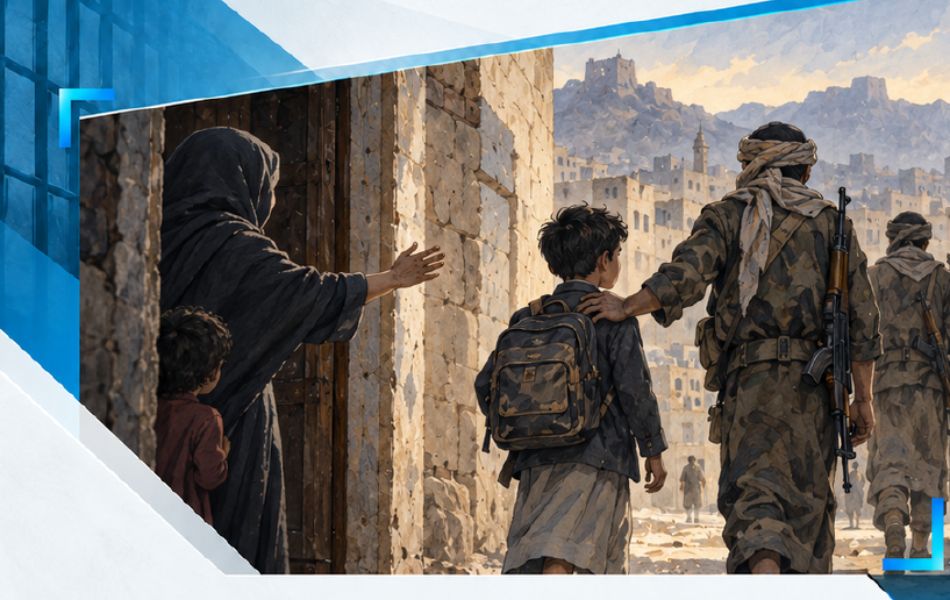
SAM Organization monitors 222 cases of children whose records indicate recruitment and death during the third quarter of 2026, documenting the transit of children from schools and local communities to military camps and combat sites.
The report tracks how children transition from induction and indoctrination to military training and frontline positions.
SAM for Rights and Liberties has published the first issue of its series “Witness and Impact: Series of Micro Human Rights Briefs” titled "From Home to the Frontline." The report addresses the pathways of child recruitment and deployment in the armed conflict in Yemen, the associated perils during training, combat, and detention, as well as the long-term psychosocial repercussions that persist even after a child leaves the frontlines.
The release coincides with recent military escalations in Taiz and the Western Coast throughout September and October 2026, which have returned the issue of children in combat zones and detention facilities to the forefront of human rights concern. The report explores how certain children transition from family, school, and cultural environments into military camps and active frontlines, detailing who recruits, trains, and transports them, as well as the ordeals they face upon sustaining injuries or being taken captive.
222 Cases Across 16 Governorates
The organization recorded 222 cases of children whose records document their recruitment and subsequent deaths within the context of the armed conflict. These incidents were attributed to the Houthi group and spanned 16 Yemeni governorates. The highest concentration was logged in Dhamar with 37 cases, followed by Sana'a (34), Hajjah (33), Sa'dah (25), Ibb (24), and 'Amran (21). Cases documented across these six governorates totaled 174, accounting for approximately 78.4% of the overall recorded figure.
Age-disaggregated data was verified for 147 children: 69 were aged between 12 and 14 years old, and 78 were between 15 and 17 years old, while the exact ages of 75 children could not be determined. According to the report, these metrics illustrate the young age profile of many victims and the extensive geographic breadth of the incidents reported to the organization.
SAM emphasized that these figures remain preliminary and partial, not reflecting the total toll of recruited children. The documented cases represent fatal casualties and do not necessarily encompass recruited children who remain alive. The organization continues to verify victim demographics, the circumstances of their enlistment and deaths, and the information required to establish legal accountability.
To illustrate the trajectory of this phenomenon throughout the protracted conflict, the report reviews past United Nations and NGO data, including UN documentation of 3,034 instances of child recruitment and use between April 2013 and December 2018, UN verification of 3,995 cases between March 2015 and September 2022, and a previous joint report by SAM and the Euro-Mediterranean Human Rights Monitor documenting 10,333 cases within its defined temporal and methodological scope. The report cautions against aggregating these totals mathematically, citing divergent monitoring timeframes and verification criteria.
Five Children in a Single Village
The report features field monitoring conducted in the village of Al-Marbak, located in the Jabal Al-Lawz sub-district of Al-Tyal District, Sana'a Governorate, which documented five cases involving children aged between 13 and 15 years from early September to October 16, 2026. Data revealed that three children were taken directly from the Qa'a Al-Sabla and Khalid Ibn Al-Walid schools, whereas two others were recruited from a local gathering point within the village.
Among the documented profiles is a child reportedly deployed to the Ma'rib front, while the whereabouts of two others remain unaccounted for, with one officially classified as missing. The intelligence gathered identified a local individual allegedly responsible for overseeing the recruitment drive; however, the organization is withholding personal identifiers pending full verification of his role and chain-of-command liability.
The report notes that the concentration of five cases within a single village over a six-week span—and the direct link between three cases and formal educational institutions—raises serious questions regarding the complicity of schools and local overseers in funneling children to camps and active fronts. Nonetheless, it clarifies that these instances do not constitute a statistically representative sample for assessing the national scale of the practice, emphasizing that determining the precise nature of recruitment and assigned operational tasks requires further case-by-case corroboration.
Testimonies on Indoctrination, Training, and Frontline Deployment
The publication presents testimonies from three children who recounted being recruited at an early age, along with an account from an individual whose exact age at enlistment could not be conclusively verified, supplemented by the expert testimony of a specialist working in child rehabilitation and reintegration programming from 2017 to 2025. Pseudonyms were assigned to all child witnesses to protect their identities.
The testimonies illustrate multiple recruitment methods. In one instance, a child recounted that a local supervisor framed participation in hostilities as a religious obligation, promising financial stipends and humanitarian assistance for the household. In another case, a minor reported that his father took him to a military camp at age thirteen, where he spent roughly 55 days receiving firearms instruction, marksmanship training, and physical conditioning, interspersed with religious and political lectures, before being deployed to forward operating positions.
Other accounts detail recruitment initiated through religious lessons, cultural seminars, and local networks, which subsequently transitioned into camp-based military drill before deploying the minors to defensive guard posts or frontline combat. Several testimonies cited initial promises of compensation or placement in non-combat support roles, only for the children to later find themselves transferred to high-risk zones exposed to active fire.
The report concludes that a child's presence in a military position is often the culmination of a process set in motion well before arriving at the front. Consequently, understanding each case requires examining the preliminary phases of indoctrination, training, transport, and assigned functions, rather than solely documenting a minor's physical presence on the battlefield.
Captivity and Allegations of Mistreatment
The report examines the experiences of children captured in combat, recording allegations of physical abuse, verbal intimidation, degradation, unauthorized filming, substandard detention conditions, and deprivation of adequate nutrition and medical care. SAM stresses that these allegations warrant an independent investigation, emphasizing that the recruitment culpability of one belligerent does not absolve the detaining party of its international obligations to guarantee humane treatment, physical integrity, and due care.
Furthermore, drawing on insights from a rehabilitation specialist, the report references allegations that certain children were administered unidentified psychoactive substances affecting consciousness and behavior. However, it notes that existing data lacks corroborating toxicological screenings or clinical records to confirm the pharmacological nature of these substances or their direct causal link to the reported behavioral changes. Consequently, the organization refrains from drawing definitive conclusions regarding the presence of specific agents or systemic policies, calling instead for rigorous clinical, forensic, and human rights inquiries conducted with stringent safeguards against secondary traumatization or stigmatization of witnesses.
Upon demobilization, former child recruits consistently report severe fear, pervasive anxiety, recurring nightmares, and substantial friction in reintegrating into family and academic life. The report underlines that affected children require extended, specialized psychosocial interventions, along with structured safeguards against re-recruitment, to support family reunification and the resumption of formal education.
Legal Framework and Accountability
The report sets forth the governing legal framework regarding the recruitment and use of children in armed conflict, underscoring that the Optional Protocol to the Convention on the Rights of the Child on the Involvement of Children in Armed Conflict expressly prohibits non-state armed groups from recruiting or utilizing persons under the age of eighteen in hostilities. It further highlights that conscripting, enlisting, or using children under the age of fifteen to participate actively in hostilities constitutes a war crime under international criminal law when requisite statutory elements are satisfied.
Additionally, the report underscores that children rendered *hors de combat* or held in detention retain full protections under international humanitarian law and human rights law, guaranteeing humane treatment regardless of the recruiting party or the nature of tasks performed. Accordingly, the report calls for evidentiary fact-finding to verify ages, chain of command, operational roles, and individual criminal responsibility, while demanding that allegations of mistreatment in detention be investigated independently from inquiries into illegal recruitment.
SAM’s Recommendations
SAM calls upon the Houthi movement and all belligerent parties to:
* Immediately end the recruitment and use of children in any capacity, cease the instrumentalization of schools and cultural gatherings for indoctrination purposes, proactively disclose the identities of all children affiliated with armed forces and groups, and facilitate their safe demobilization and referral to child protection and rehabilitation mechanisms.
* Request relevant governing authorities and parties to conflict to conduct an immediate census of children taken into custody during recent operations, ensure their humane treatment in accordance with international norms, grant unimpeded access to specialized humanitarian monitoring bodies, and initiate credible, independent investigations into all allegations of beatings, torture, coercion, indignities, and substandard detention conditions.
* Undertake comprehensive investigations into supply and mobilization networks, tracking routes from local indoctrination to frontline transit, establishing individual criminal liability based on documented evidence, and submitting claims regarding the administration of psychoactive substances to specialized clinical examination.
* Scale up resources for comprehensive rehabilitation and socio-economic reintegration programs, guaranteeing access to education, mental health and psychosocial support (MHPSS), family tracing and reunification, and actionable protection frameworks designed to prevent secondary recruitment.