

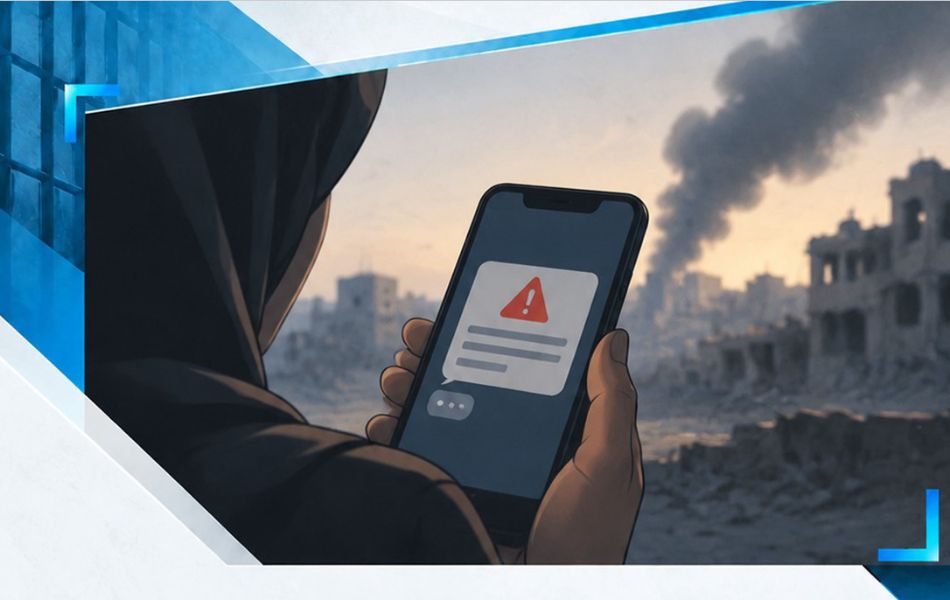
SAM Accuses Houthis of Sending Threatening Text Messages to Taiz Residents During Military Escalation
The report documented 11 messages received by a single family, stating that the texts called for surrender and cooperation with the group while threatening destruction. The organization maintains that the timing of the messages alongside ongoing shelling, combined with their repetitive content, exposes their use as a tool to spread fear and pressure civilians.
On the evening of October 16, as the sounds of shelling echoed across the outskirts of Taiz, a text message regarding the clashes arrived on the phone of Salim Mohammed’s wife. Anxious, she called her husband to ask where the family could go and whether the city was facing destruction.
The SAM Organization for Rights and Liberties reports that the Houthi group sent these messages to residents in Taiz during its military escalation between September 3 and October 20, 2026, utilizing telecommunications networks to deliver calls for surrender or cooperation alongside warnings of destruction. According to the organization, the messages were not isolated from the shelling and military operations, but rather formed part of a psychological pressure campaign aimed at instilling fear among civilians and influencing their stances and decisions.
SAM’s report, titled "Messages Under Bombardment"—published as part of its "Impact and Witness" series—documented 11 messages preserved by Salim’s family. The head of the household stated that the total number of messages sent to his two phones and his wife’s phone exceeded 30 by mid-October. The messages appeared under the sender ID "GOV" and reached subscribers across the Yemen Mobile, YOU (Yemeni Omani United), and Sabafon networks, according to the report.
Houthi Messages in the Context of Escalation
According to the report, the Houthi messages included calls for those the group describes as "deceived" to return and take advantage of an "amnesty," references to coordinating the return of individuals to their areas, and updates regarding military developments in the Taiz countryside and the Red Sea coast. Other messages addressed city residents directly, urging them to cooperate with the Houthis and linking continued clashes to the risk of destruction.
SAM states that the group sent these messages while Taiz was experiencing military escalation, shelling, clashes, and shifting frontlines, all while residents faced movement restrictions and dwindling options for relocating to safer areas. The organization argues that placing the messages within this context demonstrates how they functioned as part of the broader pressure exerted on civilians, who received Houthi warnings on their phones while simultaneously monitoring the bombardment, following news of the fighting, and fearing for their families and homes.
The report cites the example of Salim’s family, who had previously been displaced from Sanaa to a village north of Taiz before moving into the city. After the message arrived on his wife's phone on October 16, her fears of past displacement resurfaced, and her anxiety for their three children intensified. According to the report, Salim was forced to take an extended leave of absence from his law practice to remain by his family’s side. The report presents this experience as an illustrative humanitarian case rather than proof that all residents of Taiz received the exact same messages or were affected in the exact same way.
Report’s Evidence of the Group’s Responsibility
In attributing the messages to the Houthi group, SAM relied on their repetition and similar content, the synchronization of their transmission with the military escalation, the broad scope of their reach among subscribers in Taiz, and the consistency of their rhetoric with Houthi statements and publications concerning the city and military operations there. According to the report, these elements collectively serve as indicators that the group utilized telecommunications networks in a targeted messaging campaign against civilians.
A technical assessment consulted by the organization explained that bulk SMS messages can be dispatched via a telecom operator’s Short Message Service Center (SMSC), and that recipients can be targeted either through specific lists of phone numbers or by reaching devices within the coverage range of specific cell towers. The expert noted that the appearance of the "GOV" sender ID alone is insufficient to prove the sender's identity; consequently, SAM does not base its accusation solely on the sender ID, but rather on the convergence of indicators related to message content, timing, distribution scope, and alignment with Houthi rhetoric.
Based on these findings, the organization accuses the Houthi group of sending the messages and exploiting the telecommunications infrastructure under its control to pressure the residents of Taiz. It calls for an investigation into the role of Houthi-affiliated entities and the officials who drafted the messages, ordered their dispatch, or oversaw their distribution.
Impact of Threats on Families and Children
The report quotes psychosocial specialist Manea Al-Sharaabi, who notes that the impact of such messages extends beyond their literal wording, depending heavily on the circumstances under which they are received, civilians' sense of safety, and the options available to them. Psychological pressure intensifies when moving to a safer location is impossible due to road closures or a lack of resources, or when a household includes children, the sick, or the elderly.
The specialist points out that children may exhibit potential psychological effects, including the fear of losing their parents or home, sleep disturbances and nightmares, or a decline in concentration, school participation, and play. This does not mean that everyone who received a message experienced identical symptoms, as responses vary depending on prior experiences, family circumstances, and the degree of exposure to danger.
SAM believes that through these messages, the Houthis compounded the fears of civilians who were already living under bombardment and siege. The organization notes that the mobile phone—which residents rely on to check on family members, exchange information, and call for help—became an additional source of anxiety for some when the group used it to deliver messages demanding compliance and warning of destruction.
SAM: Threatening Civilians and Spreading Terror Are Prohibited
The report cites Article 13(2) of Additional Protocol II to the Geneva Conventions, which prohibits acts or threats of violence the primary purpose of which is to spread terror among the civilian population, as well as Rule 2 of Customary International Humanitarian Law. The organization maintains that when read alongside their timing, content, and the context of military escalation, the messages sent by the Houthis raise serious concerns regarding the use of threats to coerce the civilian population.
SAM affirms that the protection of civilians is unaffected by their political stances or places of residence, and that Houthi calls for "amnesty" or return do not justify threatening residents or pressuring them into declaring loyalty or cooperation. Furthermore, the organization considers the group’s responsibility to include investigating the use of telecommunications networks by entities and institutions under its control to direct these messages, as well as identifying the individuals who issued the orders or participated in their execution.
The organization called on the Houthi group to cease sending messages and threats aimed at instilling fear among civilians, and to refrain from using telecommunications networks and subscriber data for coercion or tracking. It also urged judicial and competent authorities to conduct an independent investigation, preserve digital evidence, and protect victims and witnesses from any acts of reprisal, alongside strengthening psychosocial support services for families, particularly children.
SAM’s report concludes that, based on the evidence and indicators documented by the organization, the Houthis used text messages as a tool of coercion accompanying the military escalation in Taiz. The organization states that holding those responsible for this practice accountable requires examining digital evidence, investigating the chain of command behind the issuance and distribution of the messages, and ensuring the protection of civilians from threats and intimidation—whether delivered via artillery shells or through their mobile phones.