

Hadramout – Mukalla | Special
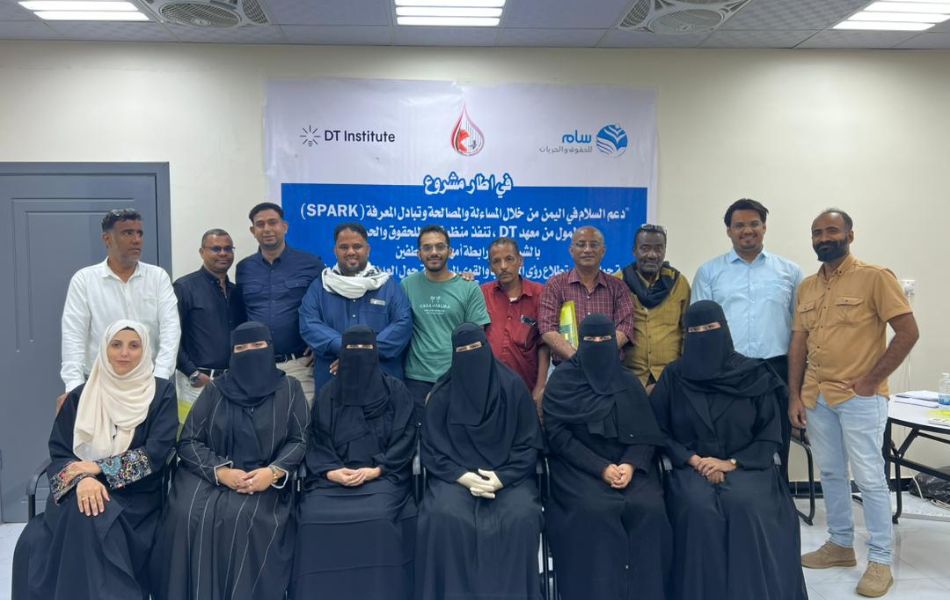
SAM Organization for Rights and Liberties, in partnership with the Abductees’ Mothers Association and DT Institute, organized a high-level dialogue session yesterday in the city of Mukalla in Hadramout Governorate. The session brought together leaders and elites from various political parties and forces to discuss their perspectives and visions regarding transitional justice pathways and implementation mechanisms within a comprehensive national framework, amid discussions marked by transparency and depth.
The session was held as part of the “SPARK” project funded by DT Institute. The discussion was moderated by Engineer Abdullah Al-Kharraz, and focused on formulating a balanced national vision among political parties and forces on transitional justice and reconciliation, in a way that takes into account the requirements of political and social stability. It also aimed to explore the positions of political parties on these concepts, understand their approaches to accountability and reparations, identify points of agreement and disagreement, and arrive at practical, implementable recommendations.
The session addressed several key themes, most notably the concept of transitional justice and its relationship to peacebuilding, along with the sensitive terminology associated with it, as well as political concerns that may hinder its implementation. It also discussed victims’ rights as a national and moral constant, where participants emphasized that reparations mechanisms should go beyond financial compensation to include explicit acknowledgment of violations, official apologies, and truth-seeking, as essential components of moral redress.
Participants further examined the challenge of balancing accountability and truth-telling on one hand with the need for political stability on the other. They also discussed the role of political parties in supporting transitional justice and reconciliation processes, and the reasons behind the stagnation of consensus on the 2013 Transitional Justice Law, stressing the possibility of building upon it as a starting point for revitalizing this process.
The contributions of attendees reflected a growing political awareness of the importance of transitional justice as a tool for preventing the recurrence of conflict and building sustainable peace. They called for the adoption of an inclusive national approach that goes beyond exclusionary rhetoric or provocative terminology, and is based on clear guarantees affirming that the objective is institutional and societal reform rather than revenge or political score-settling.
Session Outcomes:
The session concluded with several key outcomes and recommendations, most notably:
The session comes as part of ongoing efforts to promote the concepts of justice and reconciliation, and to pave the way toward building political consensus that contributes to ending the conflict and achieving sustainable peace in Yemen.