

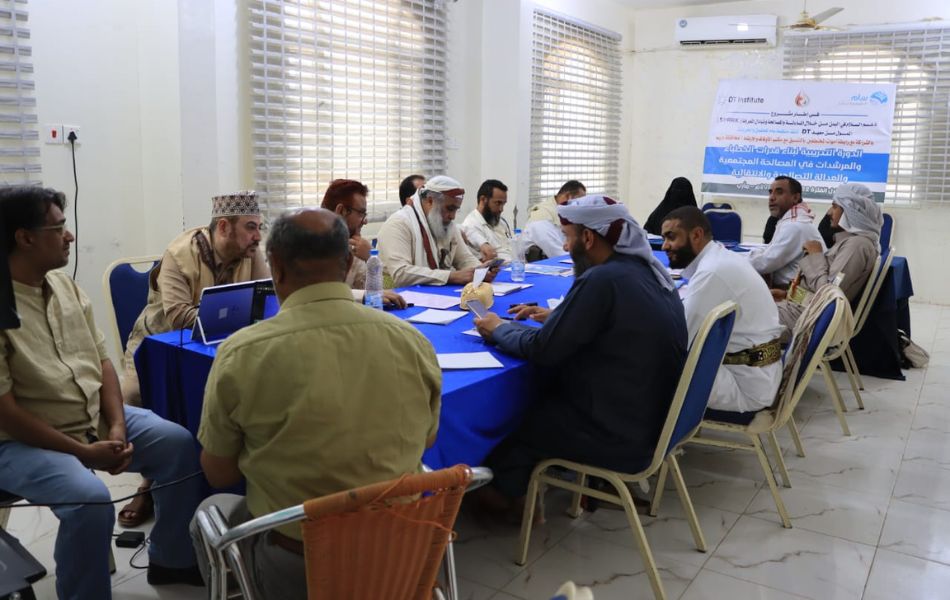
We, the preachers and religious guides participating in the training course entitled “Transitional Justice and the Role of Religious Guides in Supporting Community Reconciliation,” held in the city of Marib from 22 to 23 April 2026, organized by SAM Organization for Rights and Liberties in partnership with the Abductees’ Mothers Association, with the support of the DT Institute, and in coordination with the Office of Endowments and Guidance in Marib Governorate,
Expressing our deep awareness of the scale of suffering caused by years of conflict in Yemen, and of the highly complex humanitarian and social consequences it has produced, we affirm our commitment to playing an active and responsible role in promoting the values of tolerance, consolidating the principles of reconciliation, and contributing to healing the social rift through a moderate and balanced religious discourse rooted in the values of justice and fairness and supportive of civil peace.
This training course represented an important and meaningful milestone. It provided us with a deeper understanding of the concepts of transitional justice and its various dimensions, and introduced us to the foundations of restorative justice based on reparations, redress for victims, and the guarantee of the right to truth and recognition. It also strengthened our awareness of the role of community reconciliation as a fundamental pathway to stability, and of the importance of employing religious discourse as an effective tool for calming conflicts, restoring social relations, and building bridges of trust among members of society.
Based on our religious and social responsibility, we believe that the role of preachers and religious guides goes beyond preaching and guidance alone; it constitutes a key pillar in supporting transitional justice processes, promoting a culture of tolerance, and confronting narratives of hatred and division.
The course also provided a productive space for the exchange of expertise and experiences, and for collective reflection on ways to develop religious discourse so that it becomes more connected to the concerns of society and more capable of contributing to the building of a just and inclusive peace.
Accordingly, we recommend the following:
The participants also address their recommendations to the relevant stakeholders as follows:
The Yemeni Government and the Office of Endowments and Guidance:
To support and empower the role of scholars and preachers in serving national reconciliation and promoting community peace.
International organizations and the United Nations:
To involve religious guides in peacebuilding programs and benefit from their influential role within society.
The UN Special Envoy to Yemen:
To work toward dedicating a track that strengthens the contribution of scholars and religious guides to the peace process.
Parties to the conflict:
To cease using religion to inflame the conflict, and to create an enabling environment for supporting initiatives of justice and reparations.
The local community:
To engage positively with moderate religious discourse that supports the values of peace and coexistence.
In conclusion, we, the participants, affirm that this statement does not merely represent theoretical recommendations. Rather, it reflects a practical commitment and a genuine will to continue carrying out our role in serving society, spreading a culture of justice and tolerance, and building bridges of cooperation with all parties seeking to achieve peace, toward a Yemen that is safe, just, and stable.