

Marib – Special
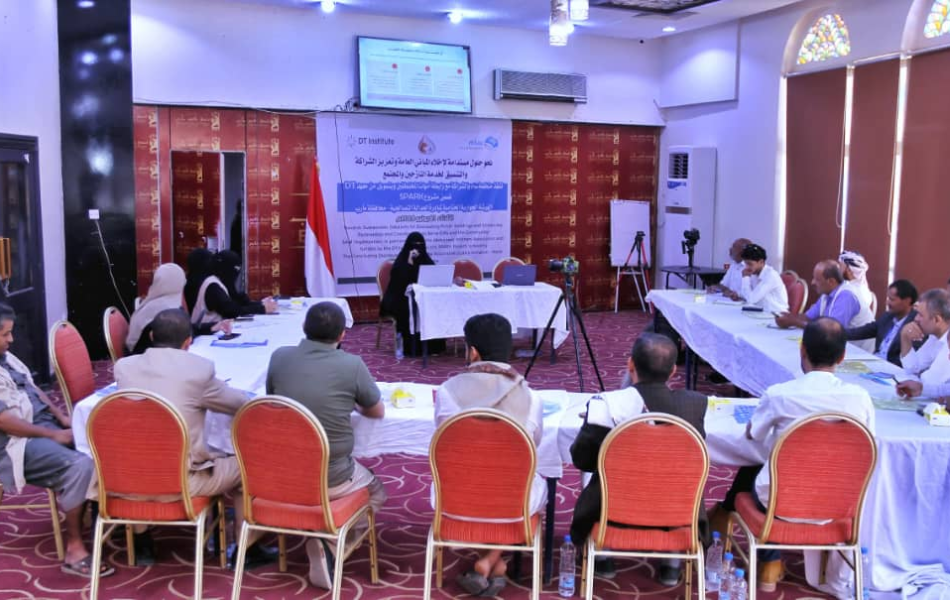
The closing dialogue workshop of the Restorative Justice Initiative concluded today, Tuesday, 21 July 2026, in Marib Governorate under the theme: "Towards Sustainable Solutions for Vacating Public Buildings and Strengthening Partnership and Coordination to Serve Internally Displaced Persons (IDPs) and Host Communities."
The workshop was implemented by SAM for Rights and Liberties in partnership with the Abductees' Mothers Association, and funded by the DT Institute as part of the SPARK Project.
The workshop brought together representatives from government institutions, local authorities, civil society organizations, and other relevant stakeholders. Participants reviewed the initiative's key activities and achievements, as well as the efforts undertaken by the Community Consensus and Reconciliation Committee to follow up on the issue of vacating public buildings. They also highlighted the progress achieved in addressing a number of cases through dialogue and coordination among the various stakeholders.
The workshop also featured the presentation of a policy paper developed based on the outcomes of the initiative. The paper examined the key challenges associated with the continued occupation of public buildings and presented a range of practical alternatives and recommendations aimed at supporting local authorities and strengthening the humanitarian response. These recommendations seek to promote sustainable and balanced solutions that address the needs of internally displaced persons while enabling public institutions to resume their role in delivering essential public services.
In addition, participants reviewed a number of success stories that demonstrated positive examples of cooperation and coordination between public institutions and community actors. These examples highlighted tangible progress in the peaceful vacating of several public buildings, reinforcing the values of consensus, partnership, and community collaboration.
At the conclusion of the workshop, participants issued a number of recommendations emphasizing the importance of continuing joint efforts to complete the vacating of the remaining public buildings, strengthening coordination among local authorities, humanitarian organizations, and relevant stakeholders, and adopting the recommendations set out in the policy paper. They stressed that these measures would help address existing challenges while balancing the protection of the rights of internally displaced persons with the restoration of public facilities to their essential role in serving the wider community.