

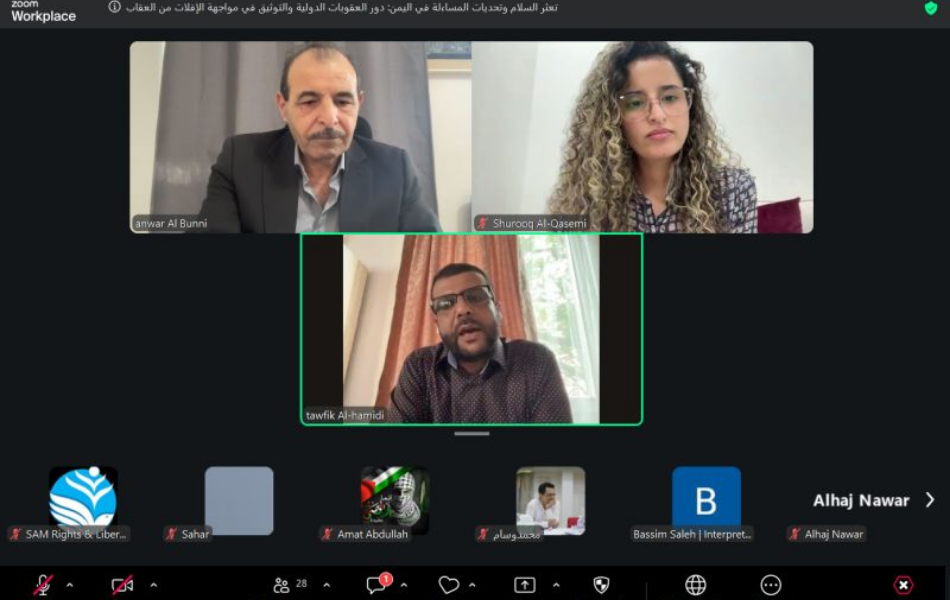
On Tuesday, 25 August 2026, SAM for Rights and Liberties and the Abductees’ Mothers Association held a discussion seminar entitled “Stalled Peace and the Challenges of Accountability in Yemen: The Role of International Sanctions and Documentation in Combating Impunity.” The event was organized as part of the SPARK Project, supported by DT Institute, with the participation of the Transitional Justice Ambassadors Forum, as part of broader efforts to strengthen discussion on transitional justice and the role of civil society in advancing accountability in Yemen.
The seminar featured Tawfiq Al-Hamidi, President of SAM for Rights and Liberties, and Syrian lawyer Anwar Al-Bunni, President of the Syrian Center for Legal Studies and Research. Discussions focused on the state of human rights documentation in Yemen and the challenges involved in transforming the large volume of testimonies, documents, and information accumulated throughout the conflict into files that can be used for sanctions, judicial investigations, and transitional justice processes.
Al-Hamidi said that the main problem in Yemen is no longer a lack of information or documentation. Human rights organizations, he noted, have accumulated thousands of testimonies, documented incidents, photographs, and records concerning various patterns of violations, including torture, detention, looting of property, destruction of homes, shelling, and recruitment.
However, he said, this extensive body of documentation has not translated to the same extent into effective accountability, particularly amid weak judicial and legislative institutions and because much of the documentation was not originally designed according to the standards required for criminal investigations and judicial proceedings.
Al-Hamidi explained that moving from a human rights report to an accountability file requires a different level of evidence-gathering. Documentation must go beyond establishing that a violation occurred and seek to identify those responsible, the relevant chains of command, those who issued instructions, and the actors involved in financing or facilitating violations.
He also pointed to divergent documentation methodologies among organizations, limited information-sharing, political polarization, and a lack of continuity among monitoring teams as factors that have weakened efforts to develop coherent files capable of supporting more advanced accountability mechanisms.
Against this background, Al-Hamidi called on Yemeni civil society organizations inside and outside the country to establish a coalition for transitional justice, based on a common code of conduct, shared priorities, and agreed working mechanisms. He said such a coalition could give the Yemeni human rights community a stronger voice nationally and internationally and help address fragmentation and the gap between human rights actors working inside Yemen and organizations and activists operating abroad.
For his part, Anwar Al-Bunni reviewed lessons from the Syrian experience, explaining that accountability should not be understood solely in judicial terms. He identified moral and public, political, and judicial forms of accountability, each requiring a different type and standard of documentation.
Al-Bunni stressed the importance of distinguishing between reports aimed at exposing violations to the public, documentation intended for engagement with political and international institutions, and case files prepared for submission to investigators and courts.
He also discussed the potential use of universal jurisdiction in certain European countries to develop cases concerning serious international crimes, drawing on the experience of Syrian civil society organizations that submitted files to European judicial authorities.
Al-Bunni argued that independent judicial proceedings can have an important impact even when they do not immediately lead to trials. Such cases, he said, can create legal and political pressure, restrict the rehabilitation of individuals implicated in serious crimes, and ensure that civil society and victims have a greater role in shaping future political arrangements.
He further stressed that transitional justice should not be left entirely in the hands of political actors. One of the key lessons of the Syrian experience, he said, was civil society’s ability to pursue legal avenues independently of political negotiations, giving accountability a degree of autonomy and creating barriers against attempts to disregard serious crimes as part of political settlements.
The seminar also devoted significant attention to the relationship between peace and justice, with speakers emphasizing that postponing accountability or overlooking victims’ rights cannot provide a sustainable foundation for peace.
Al-Hamidi said Yemen’s own experience has shown that moving beyond previous conflicts without addressing their underlying causes or holding those responsible to account has contributed to the re-emergence of crises and divisions at later stages. He warned against attempting to build peace on unresolved grievances and problems.
Participants also discussed the legal challenges surrounding enforced disappearance, the difficulty of proving certain crimes before courts outside Yemen, and the problem of establishing individual responsibility within armed groups whose members use aliases or conceal their identities.
Al-Bunni explained that focusing on chains of command and command responsibility can help overcome some of the difficulties involved in identifying individual direct perpetrators, particularly where the identities, positions, and organizational roles of commanders and senior officials are known.
The discussion also addressed the role of journalism and the media in moving victims’ cases beyond technical reports and statistics toward more human-centered storytelling capable of reaching wider audiences.
Participants emphasized the importance of stronger cooperation between journalists and human rights organizations and highlighted the potential role of podcasts, artistic projects, investigations, and human-interest stories in preserving victims’ memory and increasing public awareness of violations.
At the conclusion of the seminar, Al-Bunni expressed his readiness, together with the Syrian Center for Legal Studies and Research, to provide expertise and assistance to Yemeni human rights defenders in developing accountability files and drawing on international legal experience.
He stressed that Yemeni men and women deserve justice and the opportunity to live in a country capable of offering a better future for coming generations.