

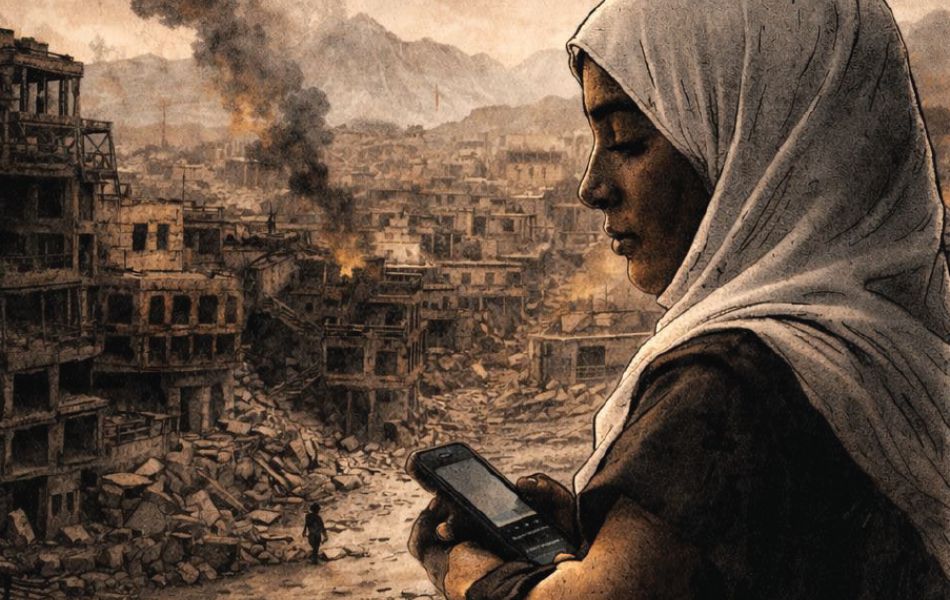
In a new human rights publication reflecting the depth of Yemen’s humanitarian tragedy, SAM for Rights and Liberties, in partnership with the Abductees Mothers Association and the DT Institute, has released a documentation report under the “SPARK” project titled “Voices of Survivors.” Through five real-life stories, the report presents a powerful snapshot of the suffering endured by civilians amid the ongoing war. It goes beyond merely presenting facts, seeking instead to restore dignity to victims as whole human beings—individuals with lives and dreams abruptly cut short. The report underscores that the war in Yemen is no longer just a political conflict, but a harsh human experience that reshapes the very meaning of life itself.
The report reveals that the victims whose stories are documented were not parties to the conflict, but ordinary civilians thrust to its frontlines against their will. Their stories vary, yet converge at a single defining moment—the rupture of a once-safe life and its transformation into a path burdened with loss. Violations intersect in multiple forms, including killing and injury, forced displacement, enforced disappearance, and deprivation of basic rights. All this unfolds amid an almost complete absence of accountability, compounding victims’ suffering and turning pain into an unending condition.
In one story, the tragedy of Ayman, a farmer, comes to life. His stable life in his village was upended when the war reached its outskirts, turning his land—once his source of livelihood—into a field of death. He could no longer harvest his crops due to snipers, lost a relative to direct gunfire, and was ultimately forced, along with thousands of others, to flee under threat of violence. The war did not stop at displacement; his home was later destroyed and his land mined, leading to a devastating psychological shock for his father that resulted in his death. Today, Ayman lives displaced in the city of Taiz, having lost his land, his home, and his sense of purpose. He asks for nothing more than justice and recognition of what he has endured.
Sara’s story presents a layered model of loss repeated across time and place. Forced to flee Al-Hudaydah due to shelling, she sought refuge in Taiz, where her brother was killed when a shell struck their home. She later suffered another devastating blow when her husband was killed in a 2024 attack targeting facilities in Al-Hudaydah. Across two cities and different contexts, the outcome remains the same: a fractured family and the burden of survival carried alone, in the absence of any guarantees of protection or justice. Sara expresses a shared sentiment among victims—that promises made rarely go beyond rhetoric, while daily suffering remains without real solutions.
In another context, the report sheds light on the dangers faced by journalists in conflict zones through the story of photojournalist Walid Al-Qudsi, who lost his leg due to shelling while covering events in Taiz. Walid was not a combatant, but a witness attempting to document the truth—yet the war made no distinction between those who carry cameras and those who carry weapons. Despite his injury, he managed to rebuild his professional life using new tools, demonstrating that a victim can become an agent of resilience, though this does not negate the need for justice. His story also reveals a hostile environment for media work, with the Journalists’ Syndicate documenting dozens of violations against journalists within a short period.
The story of the young girl Hadeel stands out as one of the most poignant. She lost both her arms due to shelling, yet did not lose her will to live. After the trauma, she fell into despair, but gradually began to rebuild herself—learning to write through alternative methods and continuing her education until enrolling in university. Her story reflects the human capacity for resilience, while also raising profound questions about the price children pay in war, and the limits of what justice can offer in the face of such immense loss.
The report also addresses one of the most severe violations—enforced disappearance—through the story of a father who has spent years waiting to learn the fate of his son, missing since 2018. This is not a conventional loss, but a prolonged form of suffering, where hope remains suspended between two unresolved possibilities, trapping the family in a permanent state of anxiety and psychological distress.
Overall, the report affirms that these stories are not merely individual testimonies, but moral documents that expose the profound transformation inflicted upon the Yemeni people. They place the international community before both a moral and legal responsibility. As the report emphasizes, building peace cannot occur without confronting the truth, listening to victims, holding perpetrators accountable, and ensuring that such tragedies are not repeated. Justice does not begin in courtrooms alone, but with acknowledgment—and with restoring a voice to those who have been denied the right to speak.
As the war continues, “Voices of Survivors” remains a stark reminder that the true cost of conflict is not measured only in the number of deaths or the scale of destruction, but in the deep scars left on individual lives—and in the unanswered questions victims carry about the meaning of justice and the possibility of reclaiming it.