

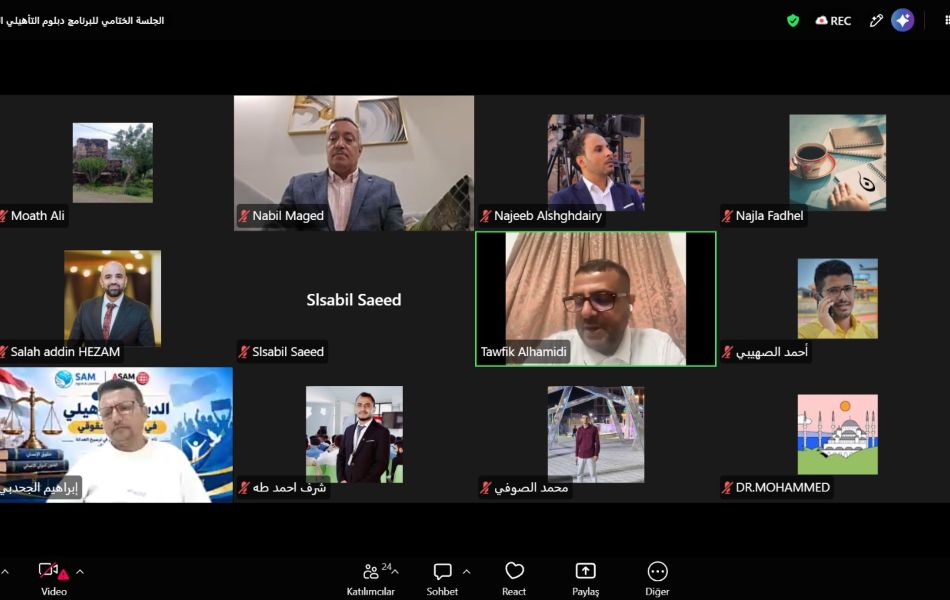
The proceedings of the Human Rights Qualifying Diploma have concluded following a three-month training program organized by SAM Organization for Rights and Liberties in partnership with the Arab Foundation for Strategic Studies. The initiative aimed to qualify young personnel and enhance their cognitive and professional capabilities in human rights work, bringing together 30 activists and human rights enthusiasts.
In his address during the ceremony, Nabil Abdulhafeez, Deputy Minister of Human Rights, praised the quality and core concept of the program. He noted that transitioning toward specialized qualification programs and diplomas marks a significant milestone in preparing personnel equipped with the expertise and knowledge required for human rights work, rather than relying solely on short-term training sessions.
Abdulhafeez emphasized the importance of synergy between human rights advocacy and media work, noting that field reports generated by participants could provide valuable support to the ministry's efforts. He expressed the ministry's keen interest in maintaining ongoing communication with the trainees, utilizing their outputs in drafting human rights reports, and escalating violations to the relevant authorities.
Along the same lines, Tawfiq Al-Hamidi, President of SAM Organization for Rights and Liberties, stressed the importance of building field-level capacities and expertise. He highlighted that human rights work extends beyond grasping principles and theory; it demands practical proficiencies in gathering and verifying information, collecting testimonies and evidence, and drafting reports in accordance with international law standards.
Al-Hamidi explained that field monitors and researchers play an essential role in amplifying victims' voices to international institutions. He reviewed examples of human rights reports produced by the organization on violations in Yemen, including child recruitment, abuses across the rural areas of Taiz, and the targeting of civilian and medical facilities.
Dr. Abdullah Al-Tamimi, Director General of the Arab Foundation for Studies and Research, stated that the diploma program focused on integrating theoretical grounding with practical application. It addressed several specialized topics, including the principles of international human rights law, mechanisms for monitoring and documenting violations, human rights reporting, advocacy campaigns, and local and international protection mechanisms, thereby enhancing participants' ability to address human rights issues professionally.
The blockade of Taiz and the Houthi military escalation were central topics during the closing session through an intervention by human rights activist Dalia Nasr. She outlined the dire humanitarian conditions in the city, detailing the severe toll of the blockade, road closures, and military escalation on civilians, the healthcare sector, and essential services.
The intervention urged immediate attention to the humanitarian crisis in Taiz, calling for the protection of civilians, the reopening of roads and access points, and intensified human rights documentation and international advocacy to convey the population's plight to relevant bodies and institutions.
For his part, Program Supervisor Abdulbaset Al-Shajea affirmed the program's significance as a stepping stone toward preparing young professionals equipped with the essential tools to tackle human rights challenges. He noted that the siege of Taiz and the resulting humanitarian crisis represent one of the most critical issues requiring consistent, serious human rights scrutiny. He underscored the need to document abuses, gather testimony and physical evidence, and compile professional case files that ensure the voices of affected communities reach international human rights organizations and stakeholders.
Program Director Alia Al-Rouhani remarked that the diploma spanned several months to prepare qualified human rights professionals with the knowledge and tools needed to monitor, document, and handle violations responsibly and professionally, while amplifying victims' voices and defending their rights. She emphasized that the demand for skilled human rights practitioners in Yemen continues to grow amid ongoing violations and humanitarian suffering.