

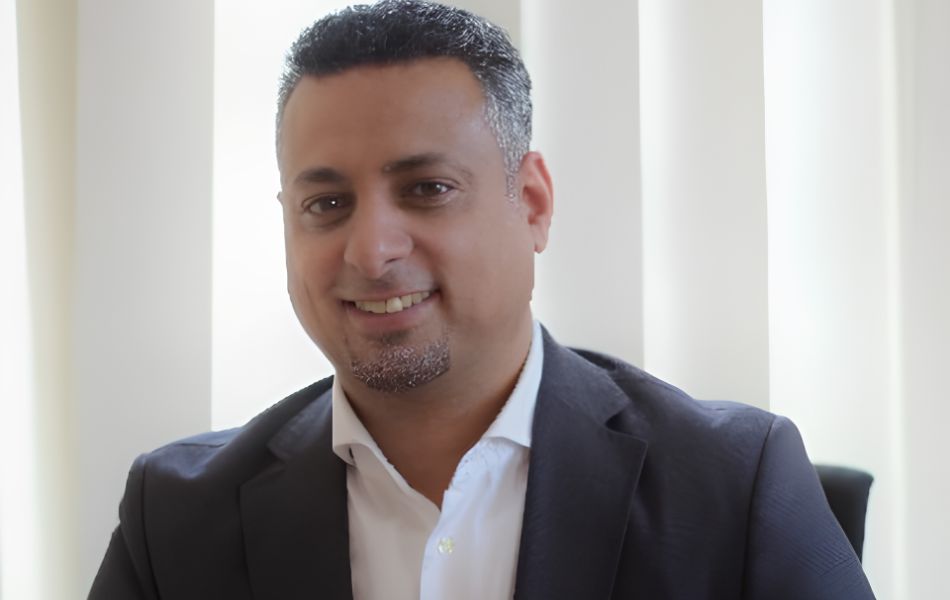
Geneva – SAM Organization for Rights and Liberties said that the abduction and killing of Wissam Qaid, Acting Executive Director of the Social Fund for Development, hours after he was kidnapped in Aden, constitute a serious crime that reveals the depth of the city’s security deterioration and the expanding risks facing civilians, administrative and development professionals, and civil society workers, amid weak law enforcement institutions, multiple centers of power, and continued impunity.
The organization explained that available information indicates that Qaid, a Yemeni national who also held British citizenship, was abducted on the morning of Sunday, May 3, 2026, near his home in Enma City by unidentified gunmen driving a blue Kia Pride. He was forced at gunpoint into their vehicle, while one of the gunmen drove the victim’s white Toyota RAV4. He was later found dead inside it in the Al-Haswa area, according to local media sources.
According to journalist Fares Al-Humairi, who posted on his account on the platform “X” citing private sources, gunmen intercepted Wissam Qaid, Acting Director of the Social Fund for Development, near his home in the Enma residential area of Aden. They restrained him and took him in their vehicle, while one of the gunmen drove his private car to the Al-Haswa area. According to the same information, during the brief period of his abduction, estimated at around half an hour, Qaid was beaten and coerced into unlocking his personal phone and making bank transfers from his account, some exceeding USD 6,000, to an account at a bank under the name of a person in Sana’a. Al-Humairi added that, after arriving in Al-Haswa, the perpetrators returned the victim to his car and placed him behind the steering wheel, then shot him at close range before leaving the scene and abandoning his body inside the vehicle.
SAM said the crime does not merely represent an attack on the life of a civilian individual; it also sends a dangerous message to those working in civil and development institutions that civic space in Yemen has become exposed to violence, and that public professionals working outside armed and political alignments are no longer safe from targeting, elimination, or intimidation.
The organization noted that the crime came about a week after the assassination of Dr. Abdulrahman Al-Shaer, Director of Al-Nawras Private Schools, who was killed on the morning of April 25, 2026, in Al-Mansoura District while on his way to his school to participate in an educational event. SAM considered that the close timing between the two crimes, and the civilian, educational, and development-related profiles of the victims, require these incidents to be treated as a dangerous indicator of the expanding violence against public figures and civilian professionals in Aden.
SAM affirmed that assassinations and abductions in Aden and other Yemeni areas are no longer isolated incidents that can be addressed through passing security statements. Rather, they have become an alarming pattern that reveals a deep flaw in the security and justice system. The organization recalled that, since 2015, Yemen has witnessed a wide series of assassinations, abductions, and killings targeting religious, educational, security, judicial, media, and local leadership figures, as well as civil society workers, without most investigations, when they have existed, leading to the truth being uncovered or those responsible being held accountable.
The organization added that the accumulating indicators of the existence of organized networks, possibly transnational, involved in planning, financing, facilitating, or providing cover for these crimes require serious national and international engagement with the file of assassinations in Yemen as a highly dangerous security and human rights issue, not merely a set of scattered local incidents.
SAM stressed that the abduction and subsequent killing of Wissam Qaid, according to the available information, constitute a flagrant violation of the rights to life, liberty, and personal security. The authorities’ duty does not stop at condemnation or announcing the opening of an investigation; it requires a serious and transparent criminal investigation that identifies the direct perpetrators, planners, inciters, and everyone who provided support, facilitation, or protection to the perpetrators, and ensures their referral to the competent judiciary.
The organization emphasized that an effective investigation must begin at the crime scene, including examining surveillance cameras, tracing the vehicles used, hearing witnesses, analyzing communications and movements before and after the crime, and reviewing patterns of previous assassinations, while protecting witnesses, victims’ families, and anyone with information from any pressure, threats, or retaliation.
SAM called on the local and security authorities in Aden, and on the Yemeni government, to open an urgent and public investigation into the abduction and killing of Wissam Qaid and the assassination of Dr. Abdulrahman Al-Shaer, to publish its findings for the public, to avoid limiting themselves to preliminary statements or general promises, and to ensure that these crimes are not registered against unknown perpetrators.
The organization also called for the formation of an independent investigative committee comprising judicial and security bodies and representatives of relevant human rights institutions, to review the recent crimes in Aden, assess security shortcomings, determine the responsibilities of the bodies tasked with protection, and propose practical measures to prevent the repeated targeting of civilians and workers in civil, development, and educational institutions.
SAM demanded concerted national and international efforts to support serious investigations into assassination and abduction crimes in Yemen, provide them with the necessary technical, financial, and logistical capacities, work to dry up the sources of violence, terrorism, and organized crime, pursue those involved, financiers, and inciters, and refer them to the competent judiciary in accordance with fair trial guarantees.
The organization urged the United Nations, the Office of the UN Envoy, and international bodies concerned with human rights in Yemen to work in a coordinated manner to press for an end to the policy of impunity and to support an accountability process that guarantees victims and their families their right to truth, justice, and redress.
SAM affirmed that the killing of Wissam Qaid must be a turning point in dealing with the file of assassinations in Aden, not merely another number in the record of forgotten crimes. It stressed that protecting civilians and workers in civil society, development, and educational institutions is an urgent priority, because leniency toward such crimes strikes at the very idea of the state, undermines the rule of law, and pushes Yemen toward further fear, chaos, and loss of trust.