

Covered Period: September 5–6, 2026, with information updated through the morning of September 6, 2026
Geographic Scope: Maqbanah, Jabal Habashi, Al-Wazi'iyah, and Al-Makha districts in Taiz Governorate, and adjacent areas along the West Coast
Nature of the Document: Preliminary briefing based on open sources as well as available official and media statements
This briefing is issued as part of SAM Organization for Rights and Liberties’ ongoing monitoring of field, humanitarian, and human rights developments associated with the military escalation in the governorates of Taiz and Al-Hudaydah. This escalation has introduced increasing dangers to civilians and civilian objects, alongside widespread waves of displacement, difficulties in reaching safe zones, and obstacles in addressing urgent humanitarian needs.
The briefing was compiled utilizing open sources, field information gathered by the organization, and available official and media statements, with data cross-referenced and verified across multiple sources whenever possible. SAM considers the contents to be preliminary information subject to updates, distinguishing between verified facts and those requiring further corroboration and independent investigation.
Timeline of Events
September 6, 2026
On September 5 and 6, 2026, SAM Organization for Rights and Liberties documented rapid developments linked to the military escalation across the governorates of Taiz, Al-Hudaydah, and Ibb. These included the firing of ballistic missiles toward areas containing civilian facilities, a missile impact on residences in rural Ibb, and reports of killings, arrests, raids, and searches in western Taiz areas where control shifted during recent clashes.
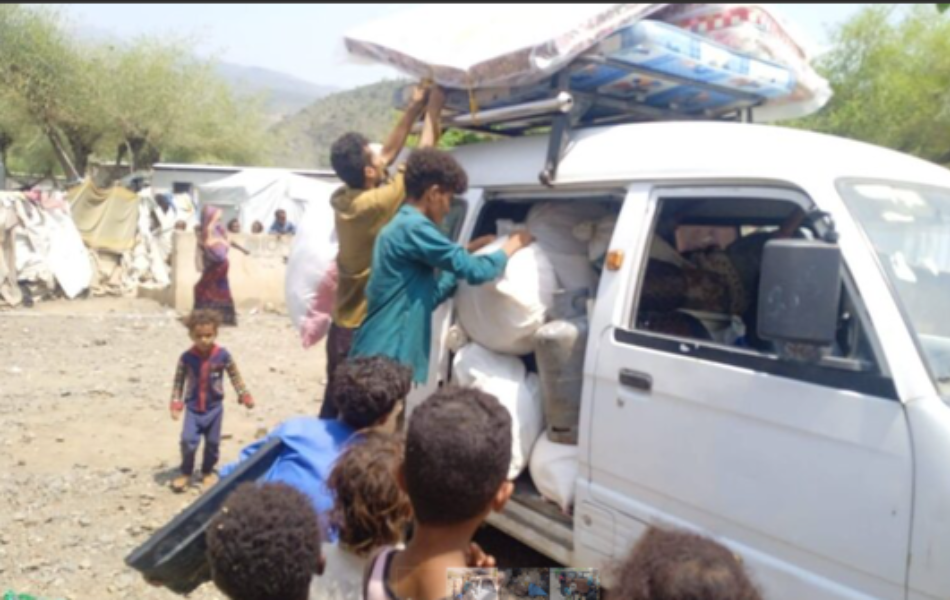
These incidents occur within the context of a wider escalation that began on September 3 along the Maqbanah and Jabal Habashi fronts in western Taiz. According to an update released by the United Nations Office for the Coordination of Humanitarian Affairs (OCHA), this led to the displacement of an estimated 1,790 families in a brief span of time, amid sustained shelling, constraints on accessing safer areas, and severe shortages in emergency response stockpiles.
Taiz City – Three Ballistic Missiles Near Civilian Facilities
At dawn on September 6, the Yemeni News Agency (Saba) reported that the Houthi group launched three ballistic missiles toward Taiz City. The missiles struck near the Social Welfare building, in the vicinity of the Faculty of Medicine, and near the Central Prison west of the city. The agency stated that the strikes triggered fear and panic among residents without recording casualties, noting in its initial bulletin that no material damage had been reported at the time. Anadolu Agency later confirmed the launch of the three missiles based on the same official and local sources.
In a field update published by journalist Fares Al-Himyari, it was reported that the missiles destroyed structures belonging to Taiz University’s Faculty of Medicine that were still under construction on the southwestern outskirts of the city. Given that Saba's initial bulletin noted no material damage at the time of publication, SAM emphasizes the necessity of conducting on-site verification to ascertain the extent and nature of the damage inflicted on the college, accurately determine the impact coordinates, and establish whether any military targets were situated in the vicinity during the attack.
Rural Ibb – Missile Impact on Residential Homes in Al-Majma'ah
In an incident linked to the same barrage, Al-Masdar Online reported, citing local residents, that a missile launched by the Houthi group toward Taiz fell shortly after launch in the Al-Majma'ah area of the Rural Ibb district. This resulted in structural damage to six houses, with no casualties recorded.
According to residents, the missile struck the home of citizen Hifzallah Qaid Al-Shanini, causing substantial damage, as well as damaging five adjacent houses. Residents stated that several missiles were fired around 3:00 AM, and that Houthi personnel cordoned off the site during the morning hours, barring residents from filming or disseminating information regarding the incident.
A circulated video clip from the area showed structural damage attributed to the missile strike. While video footage alone cannot decisively determine the projectile's origin or trajectory without technical and on-site investigation, it offers visual material that aids in verifying the strike's impact site and nature.
Maqbanah – Allegations of a Soldier Killed Inside His Home
In western Taiz, journalist Fares Al-Himyari reported that Houthi personnel entered the residence of soldier Taha Ahmed Mohammed Abdullah in a village in Maqbanah district recently captured by the group, killing him in front of his wife and children. According to the account, the man suffered from a physical disability resulting from an earlier landmine injury sustained years ago.
SAM is actively working to verify the victim's legal status at the time of his death, the precise circumstances surrounding the militants' entry into the home, and whether he was detained or brought under the control of the executing force prior to being shot. If verified that he was hors de combat or incapacitated from participating in hostilities at the time of his killing, his deliberate targeting raises grave concerns of a serious breach of international humanitarian law.
Jabal Habashi and Maqbanah – Arrests, Raids, and Property Confiscation
The same field update reported that Houthi forces set up snap checkpoints along roads in the Jabal Habashi district, detaining several citizens found in possession of military identification cards. Furthermore, personnel conducted search and raid operations targeting the homes of military personnel and dissidents in rural sectors of western Taiz, arresting several individuals and confiscating personal property and belongings.
Al-Kadhah – Detention of Civilians and Coerced Slogan Chanting
In a distinct incident, Fares Al-Himyari reported that civilians were searched and temporarily detained at a Houthi-manned checkpoint near the Al-Kadhah area west of Taiz. The checkpoint personnel conditioned their release on chanting the group's signature slogan, known as the "Sarkha" (The Cry).
SAM has not yet been able to independently verify the number of impacted individuals, their detention duration, or the identities of the checkpoint personnel. If confirmed, detaining civilians without a legal basis and conditioning their release on proclaiming a political or ideological stance raises critical concerns regarding arbitrary detention, coercion, and violations of dignity and the freedoms of thought and belief.
Maqbanah and Jabal Habashi – Broad Displacement and Surging Humanitarian Needs
These developments coincide with a major wave of displacement from the combat zones. According to the United Nations Office for the Coordination of Humanitarian Affairs (OCHA), hostilities intensified in the early hours of September 3 across the districts of Maqbanah and Jabal Habashi with heavy shelling and armed clashes, displacing an estimated 1,790 families since that date, with population movements ongoing at the time of the report's preparation.
OCHA noted that most displaced families relocated internally within Maqbanah and Jabal Habashi, while others fled to the districts of Al-Ma'afer, Ash-Shamayatayn, Mawza', and Dhubab. The agency also reported the complete evacuation of several displacement sites—including Al-Hajab, Al-Rajahi, and Hajjat Jaba'—triggering secondary displacement. The report highlighted that continuous shelling impedes families' capacity to reach safer areas, leaving some stranded close to active front lines. Concurrently, telecommunications disruptions hinder data collection, verification, and humanitarian coordination, occurring alongside critical depletions of emergency shelter, non-food items (NFIs), and food assistance supplies.
On September 6, journalist Mohammed Taher issued an urgent humanitarian appeal from Maqbanah, noting sustained family displacement from the district’s villages and sub-districts toward Taiz City, Al-Bayreen, Al-Nashma, Jabal Habashi, and other pockets within Maqbanah. He observed that some host homes are accommodating up to six displaced families under a single roof amid acute shortages of basic necessities. SAM treats these field details as accounts warranting independent corroboration, while the UN update attests to the massive scale of the displacement crisis and the critical need to scale up relief efforts.
Hays – Targeting of the Education Office with a Ballistic Missile
In Al-Hudaydah Governorate, Al-Jumhuriya TV reported on September 5 that the Education Office in Hays District was targeted by a ballistic missile attributed to the Houthi group.
The Yemeni Ministry of Education confirmed that the Education Office building was struck by a ballistic missile. Parallel reports quoting military media stated that the missile hit the office headquarters located in the district center, without confirmed figures regarding casualties or structural damage released in the hours immediately following the attack.
Civilian administrative and educational facilities are presumed protected from attack unless, according to the prevailing circumstances at the time of the strike, they are repurposed into military objectives as defined under international humanitarian law. SAM currently possesses no information indicating that the Education Office was utilized for military purposes, nor does it have sufficient independent data to definitively establish the intended target of the missile or the strike's precision.
Legal Characterization
The events documented within this brief window reflect a steep rise in the risks faced by civilians in active combat zones and adjacent areas. Launching ballistic missiles toward urban centers or areas with civilian infrastructure, alongside recurring shelling near villages and displacement camps, creates pervasive harm even when strikes do not result in direct casualties. The missile strike on residences in rural Ibb illustrates that military operations also expose communities situated near launch positions to acute danger.
These incidents raise serious questions regarding compliance with international humanitarian law governing the conduct of hostilities. This includes the perpetual duty to distinguish between civilians and civilian objects on one hand, and military objectives on the other; the prohibition of indiscriminate attacks; and the obligations to observe the principle of proportionality and adopt all feasible precautions to avoid or minimize civilian harm. These norms are equally binding upon parties to non-international armed conflicts.
Regarding the killing of soldier Taha Ahmed Mohammed Abdullah, Common Article 3 of the Geneva Conventions explicitly protects persons taking no active part in hostilities, including members of armed forces rendered hors de combat by sickness, wounds, detention, or any other cause. It strictly prohibits violence to life and person, particularly murder and summary executions carried out without previous judgment pronounced by a regularly constituted court affording judicial guarantees. Consequently, should investigations confirm that the victim was hors de combat or under the effective control of the executing forces, this incident would constitute a grave breach of international humanitarian law, potentially amounting to a war crime depending on the circumstances and evidence.
Furthermore, reports of arbitrary arrests, raids, property seizures, and forcing detainees to chant political or ideological slogans require an independent investigation to identify victims, responsible entities, and legal justifications for detention or confiscation, as well as to protect detainees from degrading treatment and coercion.
SAM emphasizes the imperative of allowing civilians safe passage from conflict areas and granting unhindered humanitarian access to displaced families and host communities, prioritizing shelter, food, clean water, and core relief items in Maqbanah, Jabal Habashi, and recipient districts.
The organization continues to gather information and verify the facts detailed in this briefing—specifically the circumstances surrounding the killing of the soldier in Maqbanah, the wave of arrests and raids in Jabal Habashi, the detention incident near Al-Kadhah, and the precise damage sustained by the Faculty of Medicine in Taiz and the Education Office in Hays. Updates will be released as corroborated evidence becomes available.
Recommendations