

21 September 2026
SAM for Rights and Liberties monitored, between 19 and 21 September 2026, rapidly evolving humanitarian and human rights developments reflecting the continued expansion of the impact of fighting on civilians, with displacement figures continuing to rise and growing pressure on camps and reception sites in Aden, Marib, and Djibouti. These developments coincided with reports of shelling affecting villages and civilian areas, the seizure of medicines and equipment from a health unit in Taiz, and a strike on a market near the Kahbub front in the Bab el-Mandeb area.
In a further indication of the scale of the crisis, the Executive Unit for IDP Camp Management announced on 19 September that it had documented the displacement of 146,943 people as of 18 September, before more recent field data reported by Al Jazeera indicated that the figure had risen to 158,109 people by 19 September. At the same time, a new World Health Organization report revealed that 680 new casualties were recorded between 13 and 18 September, according to the Ministry of Public Health and Population’s Health Emergency Operations Centre register, amid declining trauma-care capacity and severe shortages of funding and medical supplies.
On 19 September, the Executive Unit for IDP Camp Management announced that, as of 18 September, it had documented the displacement of 21,583 families comprising 146,943 people across eight governorates: Taiz, Lahj, Aden, Al Hodeidah, Abyan, Hadramout, Al Mahrah, and Shabwah.
According to the report, Taiz hosted 11,534 families comprising 80,792 people, followed by Lahj with 5,472 families and 38,304 people, Aden with 1,622 families comprising 7,162 people, Al Hodeidah with 1,471 families comprising 10,297 people, and Abyan with 1,278 families comprising 8,946 people, in addition to smaller numbers in Hadramout, Al Mahrah, and Shabwah.
However, more recent data obtained by Al Jazeera from the Executive Unit showed that the figure had continued to rise by 19 September to 23,550 families comprising 158,109 people, including 15,003 registered displaced people in Aden alone. This reflects how rapidly displacement figures are changing as registration continues and new families arrive.
SAM notes that these figures should not be combined with data from other organizations as though they constituted a single database, given differences in monitoring scope, reporting periods, and methodologies. Al Jazeera, citing data from the International Organization for Migration’s Displacement Tracking Matrix, reported a different figure of 120,078 people as of 18 September. This discrepancy does not necessarily indicate a contradiction, but rather reflects differences in registration and verification mechanisms.
The World Health Organization’s Yemen Conflict Escalation Situation Report, issued on 20 September and covering the period from 13 to 18 September, showed that the Ministry of Public Health and Population’s Health Emergency Operations Centre register recorded 680 new casualties over six days, including 516 injuries and 164 deaths.
According to the report, the cumulative total recorded since 6 August had risen to 3,672 casualties, comprising 2,998 injuries and 674 deaths. SAM notes that these figures are drawn from the Health Emergency Operations Centre’s operational register and do not constitute a casualty toll independently verified by WHO on a case-by-case basis.
Lahj recorded 284 casualties over the six-day period, including 58 deaths, while Marib recorded 277 and Taiz 103. The report noted an increase in the proportion of deaths relative to injuries during the period, explaining that this could be linked to delays in accessing surgical and emergency care and limitations in referral mechanisms, while the nature of injuries and difficulties in communications and access may also have affected the figures.
The World Health Organization report stated that nine health facilities or health-related assets in Taiz, Lahj, and Al Hodeidah had been damaged, closed, put out of service, or directly attacked. It also reported that ambulances were targeted on the Kahbub front on 18 September, killing an ambulance driver and an emergency medical responder.
The report also referred to shelling incidents affecting IDP sites in Marib, while some health facilities along the western coast had reopened and others remained closed.
SAM stresses that medical personnel, medical transport, and health facilities enjoy special protection under international humanitarian law, and that respect for this protection is essential not only to safeguard medical workers and patients directly, but also to preserve the health system’s ability to respond to the growing number of wounded people.
The WHO report showed that the Aden warehouse had run out of several essential supplies, including normal saline, sterile surgical gloves, certain medicines, trauma-care supplies, and anaesthetic drugs, while the organization was working to procure and ship additional supplies.
The report also stated that the health response plan had moved to Scenario 2, which requires approximately US$9 million, while only around US$2 million had been secured or pledged at the time of reporting, leaving a funding gap of approximately US$7 million, or 78 percent of requirements. According to the report, this gap limits the ability to expand trauma stabilization points, intensive care capacity, specialized care teams, referral services, mobile medical teams, and services for displaced populations.
On 20 September, Aljoumhouriya TV, citing residents of Haraz village in Jabal Habashi District, Taiz Governorate, reported that members of the Houthi group had entered the village health unit and seized medicines, equipment, and medical supplies stored inside.
At the time of preparing this briefing, SAM had no independent information regarding the quantity of materials seized, their whereabouts, or whether the health unit had completely ceased providing services. SAM therefore treats the report as an account requiring further field verification.
If the seizure of medicines and equipment is established and resulted in disruption to health services for local residents, the incident would raise serious concerns in light of the special protection afforded to medical activities and equipment, as well as the consequences of depriving civilians of essential health services.
On 20 September, Aljoumhouriya TV reported that residential villages in the Rasin area of Al-Shamayatayn District had come under shelling, which it attributed to the Houthi group, following military confrontations in the area.
The post did not provide a casualty toll or sufficient details regarding the type of weapon used or the specific locations struck.
SAM calls for verification of the impact sites, launch locations, and intended targets, and stresses that the proximity of military operations to residential villages imposes a heightened obligation on all parties to take all feasible precautions to spare civilians from the effects of hostilities.
On 21 September, media reports published surveillance-camera footage showing the immediate aftermath of shelling at a market in the Bab el-Mandeb complex, following clashes on the Kahbub front between Yemeni government forces and the Houthis.
There is no reliable information identifying the party responsible for the strike, nor is there a confirmed casualty toll. SAM therefore does not, at this stage, make any definitive attribution of responsibility pending further verification of the weapon used, the source of the attack, and the circumstances surrounding the incident.
Given that the reported site was a market used by civilians, any attack on the location requires careful investigation into whether the site or its surroundings contained a lawful military objective, and whether the rules of distinction, proportionality, and precautions were respected.
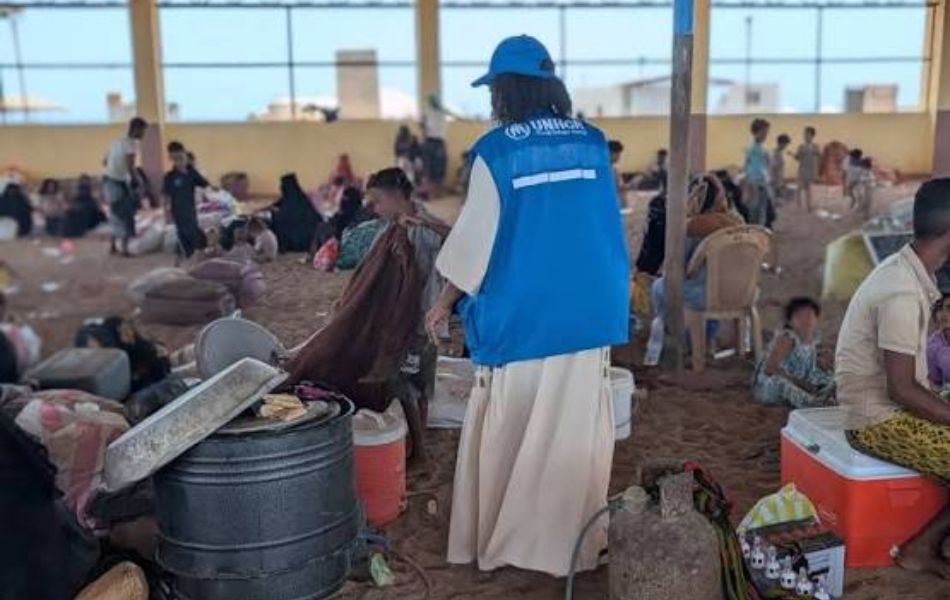
On 21 September, the United Nations High Commissioner for Refugees in Yemen published footage from the newly established Al-Firdous IDP site near Aden, which was set up to receive newly displaced people arriving from Taiz, Al Hodeidah, Al-Mokha, and Bab el-Mandeb.
During a visit to the site, a UNHCR representative said families needed water, food, and medical care, and that women, children, and other vulnerable groups constituted a large proportion of new arrivals. UNHCR noted in its post that one family told its representative that this was the fourth time they had been forced to flee.
This account is consistent with a field report published by Al Jazeera from Al-Firdous camp, which documented the arrival of families from Al-Mokha, Hays, Al-Khawkhah, and other western coastal areas, some of whom had arrived with little more than the clothes they were wearing, amid continuing needs for water, food, medicine, electricity, and ventilation.
According to camp management, Al-Firdous had received approximately 218 to 220 families at the time of the visit, with new displaced families continuing to arrive. Testimonies documented by Al Jazeera indicate that while tents provide initial shelter, they offer insufficient protection from Aden’s extreme heat, while needs vary depending on family size and the conditions of children and sick family members.
In a report published on 20 September, Al Jazeera documented the case of a Yemeni family that had been forced to move between several areas since 2015 before once again leaving Al-Khawkhah during the latest wave of fighting and eventually moving to Marib.
The testimony reflects a broader pattern of repeated displacement, in which families not only have to rebuild their lives from scratch after each displacement, but also lose part of their property, livelihoods, and access to basic services with every new move. The report noted that camps in northern Marib are receiving growing numbers of displaced people under conditions that are exceeding the capacity of humanitarian actors to respond.
The consequences of repeated displacement are particularly severe for children, as continued movement results in repeated interruptions to education, prolonged exposure to unstable living conditions, and health and psychological risks associated with life in displacement camps.
On 21 September, Al Jazeera reported that Yemeni refugees in the Obock area of northern Djibouti were facing severe humanitarian and health conditions amid overcrowded shelter facilities and shortages of tents, water, food, and clothing.
The report showed that a large number of arrivals were still staying in a single overcrowded communal shelter, while the only medical clinic at the site was under increasing pressure, particularly amid high temperatures and the presence of children and pregnant women requiring health care.
According to the report, Djibouti’s Minister of Social Affairs renewed an appeal to donors and international organizations for urgent support, noting that local response capacity was below the level of growing needs.
SAM stresses that reaching a place of safety does not necessarily end the risks associated with displacement. Overcrowding and inadequate access to water, medical care, and sanitation can create new health risks, particularly for children, pregnant women, older people, and those with chronic illnesses.
Developments recorded through 21 September indicate that the displacement wave is evolving into a crisis that is expanding both geographically and over time, as families continue to move within Yemen while others are being displaced for a second, third, or fourth time.
The gap between the different figures published by the Executive Unit and the International Organization for Migration also demonstrates the importance of treating displacement data as evolving figures shaped by different registration and verification methodologies, rather than combining or comparing them without accounting for those methodological differences.
WHO data reveal severe pressure on the health system: rising casualties are coinciding with limited trauma-care capacity, shortages of medical supplies, a major funding gap, and reports of damage to or disruption of health facilities and medical transport. Any seizure of medicines or medical equipment from health units would further aggravate these risks, particularly in areas where access to alternative facilities is difficult.
The shelling of the Bab el-Mandeb market raises particular concerns because of the civilian nature of the site based on currently available information. However, responsibility for the attack requires independent verification, and no definitive attribution should be made before the source of the strike, the weapon used, and the intended target are established.
Conditions at Al-Firdous camp in Aden and reception sites in Obock, Djibouti, highlight a growing humanitarian challenge: reaching an area away from active fighting does not necessarily guarantee access to minimum standards of shelter, water, health care, protection, and education.
SAM stresses that all parties to the conflict are required at all times to distinguish between civilians and combatants and between civilian objects and military objectives, respect the principle of proportionality, take all feasible precautions to minimize civilian harm, and respect and protect medical facilities, medical personnel, and medical transport.
The organization calls for safe and unhindered access for humanitarian and medical assistance, an urgent increase in funding for shelter, water, health care, protection, and education in displacement areas inside Yemen and in Djibouti, and independent and effective investigations into attacks affecting civilians, civilian objects, and medical facilities.
SAM continues to collect information and verify casualty and displacement figures, shelling incidents, the status of health facilities, and conditions in displacement and reception sites, while distinguishing between official and UN data, direct testimonies, and allegations that still require independent verification.