

Geneva – 24 October 2026
SAM Organization for Rights and Liberties stated that field information it obtained—alongside human rights testimonies, medical, official, and UN data, as well as reviewed audiovisual evidence—reveals a dangerous escalation in violations committed by the Houthi group against civilians between October 21 and 24, 2026. These violations included the killing of children and other civilians, injuries to others, the shelling of homes and residential neighborhoods in Taiz Governorate, raids, arrests, and the looting of private property, as well as ballistic missile attacks targeting Aden International Airport and Coast Guard facilities in Yemen's interim capital. These attacks coincide with a siege that is accelerating the collapse of essential services in Taiz. Separately, Al-Masirah TV, which is affiliated with the Houthi group, published reports concerning attacks in Sana'a, Hodeidah, and Hajjah, accusing Saudi forces of carrying them out.
The organization explained that incidents documented by its sources on 24 October included the killing of 65-year-old Adel Hamid Al-Haj Ahmed in Houthi shelling that struck his home in the Old Airport neighborhood of Taiz city, and the killing of 14-year-old Ammar Yasser Al-Shuraihi by Houthi gunmen in Al-Akmah village, Sabir Al-Mawadim District. A separate local account also reported the killing of nine-year-old Mohammed Taher Saeed as a result of Houthi shelling in the Al-Aqroud area. SAM treats these as separate incidents and continues to review victims' information and cross-check the evidence relating to each case.
In Aden, Yemen's Ministries of Interior and Transport announced that the Houthi group had carried out ballistic missile attacks against two Coast Guard facilities and Aden International Airport on 24 October. The Ministry of Transport stated that the airport was targeted by two ballistic missiles on Saturday afternoon, in the latest in a series of attacks threatening civil aviation safety and the lives of passengers, airport employees, and flight crews, while placing one of Yemen's most important civilian and humanitarian gateways at risk.
In incidents separate from the attacks in Taiz and Aden, Al-Masirah TV published reports of deaths, injuries, and damage to homes and workers' accommodation in Sana'a, Hodeidah, and Hajjah governorates. The channel accused Saudi forces of carrying out the attacks and described some of them as airstrikes. SAM has not independently verified the identity of those responsible for these attacks or the weapons used. In another incident in Nihm District, east of Sana'a, the official spokesperson for the Yemeni Armed Forces announced that a ballistic missile launched by the Houthi group had failed to complete its trajectory and struck a civilian home, causing deaths and injuries.
SAM emphasizes the need to clearly distinguish between the Houthi group's responsibility for the attacks described in testimonies from Taiz and official statements concerning Aden, and the allegations made by Al-Masirah TV against Saudi Arabia in separate incidents. The need to examine fragments, trajectories, and the types of munitions used must not serve as a pretext for obscuring the identity of the party identified in the available accounts and testimonies. Such examinations nevertheless remain essential to completing the technical evidence and establishing criminal accountability. SAM does not treat Al-Masirah's accusations against Saudi Arabia as established facts in the absence of independent evidence.
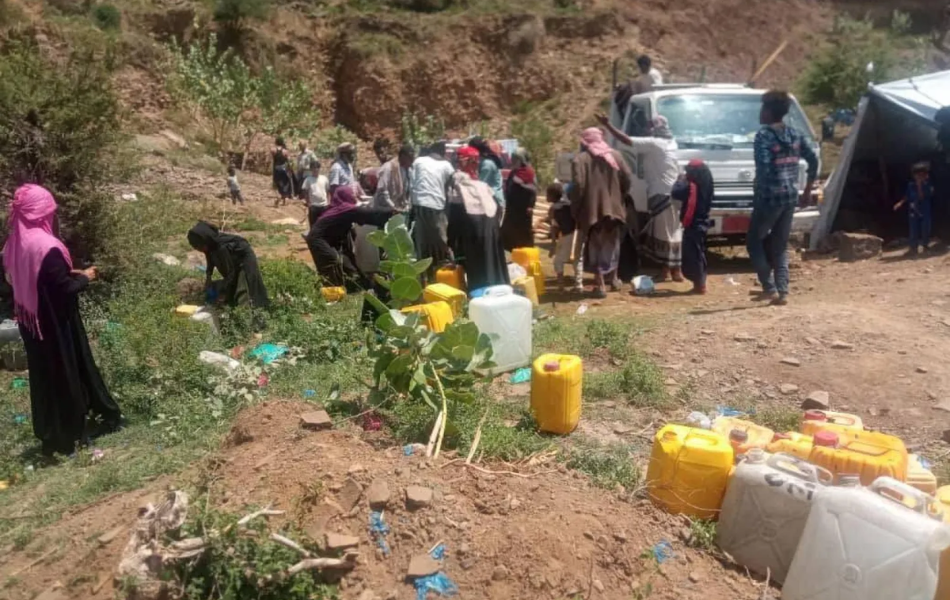
On the humanitarian front, the United Nations warned on 23 October that Taiz city had remained isolated for approximately 20 days, with vital supplies unable to reach it. SAM considers that the siege and restrictions imposed by the Houthi group on civilian movement and the delivery of supplies increase its responsibility for exposing the population to danger. The World Health Organization reported that 42 healthcare facilities were facing severe supply shortages, threatening more than 1,100 patients with kidney failure, 192 patients receiving intensive care, and 154 newborn babies in incubators. The United Nations also announced that it had verified 262 civilian casualties, including those killed and injured, since the beginning of August, more than half of whom were children. This separate UN-verified figure does not represent the total number of casualties.
In preparing this briefing, SAM for Rights and Liberties relied on information collected by its field monitors, medical records concerning the admission of injured persons and deaths, direct accounts from victims, their families, and local sources, as well as reviews of statements issued by official authorities, United Nations bodies, human rights and humanitarian organizations, visual materials, and publicly available open-source publications.
To the extent possible, the organization sought to cross-check victims' names, ages, incident dates and locations, and the nature of their injuries. It also distinguished between cases for which it had obtained direct information and those reported through published statements or testimonies. SAM further considered the possibility of duplicate entries across hospital records and human rights reports, and did not aggregate figures from different casualty counts before completing the verification of their respective timeframes, geographical coverage, and potential overlap.
This briefing identifies the Houthi group as the party responsible for the attacks attributed to it in the field testimonies, human rights reports, and official statements presented in the sections concerning Taiz and Aden. It avoids ambiguous formulations that obscure this responsibility. At the same time, the organization distinguishes between the occurrence of an incident and its attribution based on available sources, on the one hand, and the degree of independent verification of each technical or medical detail, on the other.
As for the attacks reported by Al-Masirah TV in Sana'a, Hodeidah, and Hajjah, which the channel attributed to Saudi Arabia, SAM explicitly presents these as allegations made by the channel, without adopting the attribution of responsibility to Saudi Arabia before an independent investigation. Photographs and footage showing destruction and victims remain valuable evidence, but they alone are insufficient to establish the type of projectile or its launch platform.
On 24 October 2026, the Taiz Human Rights Center reported in a statement that 14-year-old Ammar Yasser Al-Shuraihi had been killed in Al-Akmah village, Al-Najada subdistrict, Sabir Al-Mawadim District, in southern Taiz Governorate.
According to information that the center said had been collected by its monitors, members of the Houthi group shot the child at close range as he was preparing to leave the village with his family in search of safety amid military developments.
The center indicated that the incident followed raids and searches of homes in the village, some of which were occupied only by elderly people, women, and children. Armed men reportedly attempted to interrogate the child to obtain information, using threats and inducements, before shooting him after he refused to cooperate and prepared to leave with his family.
The details reported by the Taiz Human Rights Center reveal an extremely serious attack against a civilian child who was not participating in hostilities. The child was allegedly subjected to attempted interrogation, pressure, and threats by Houthi gunmen before being shot at close range.
SAM condemns the killing of Ammar Yasser Al-Shuraihi by members of the Houthi group and stresses that deliberately targeting a civilian child constitutes a serious violation of international humanitarian law and may amount to a war crime where the requisite legal elements are established. Completing medical and forensic examinations and interviewing witnesses must not delay accountability for the perpetrators or protection for the child's family.
The organization emphasizes that children are entitled to special protection during armed conflicts and that compelling them to provide information of a military nature or subjecting them to threats and violence is incompatible with the obligations to protect them.
SAM calls for an urgent, independent investigation to identify the Houthi members who shot the child and those who issued the orders. It further demands the preservation of medical and forensic evidence, documentation of the interrogation and threats to which he was subjected, protection of his family and witnesses against reprisals, and the prosecution of those responsible for the crime.
On 24 October, SAM obtained medical information confirming that 65-year-old Adel Hamid Al-Haj Ahmed was admitted to the emergency department of Al-Thawra General Hospital Authority in Taiz city at 12:25 p.m. He had died from multiple shrapnel injuries sustained across his body.
The information indicated that the victim was a resident of the Old Airport neighborhood and that he sustained his injuries in the same area as a result of shelling carried out by the Houthi group against the residential neighborhood.
The medical records were consistent with an update published by the Taiz Siege Affairs Office, which reported that 65-year-old Adel Hamid Al-Haj Ahmed had been killed after sustaining multiple shrapnel injuries when shelling struck his home in the Old Airport neighborhood.
In a separate statement issued by the Taiz Human Rights Center, the center recorded the victim's name as Adel Hamid Al-Haj Al-Haddad and described him as an educator. It confirmed that he was killed by an artillery shell fired by the Houthi group at his home.
SAM notes the discrepancy in the victim's surname across the sources, which requires consultation of identity documents and the final medical record to establish his full name. There are, however, strong indications that both accounts concern the same incident, given the matching date of death, location, and circumstances of injury.
SAM condemns the Houthi group's shelling of a residential home in the Old Airport neighborhood and the killing of one of its occupants. It stresses that shelling residential areas in a manner that targets civilians or fails to distinguish them from military objectives constitutes a serious violation of international humanitarian law. Examining the shell remnants and determining the direction from which it was fired remain necessary to strengthen the evidentiary record and establish individual and command responsibility for the attack.
SAM demands accountability for the Houthi members responsible for firing the shell and those who ordered the attack, justice and compensation for the victim's family, reparations for the harm suffered, and immediate measures to halt Houthi shelling of residential neighborhoods.
On 24 October, SAM documented a local account published by Issam Balghaith, reporting the killing of nine-year-old Mohammed Taher Saeed as a result of shelling carried out by the Houthi group against villages in the Al-Aqroud area of Taiz Governorate.
The published account did not provide sufficient details concerning the precise location of the injury within the area, the type of projectile used, the time of the incident, or the medical facility that received the child.
SAM stresses that this case requires further field and medical verification, including confirmation of the child's identity, age, date of death, and circumstances of injury. It also requires checking for any confusion with other children bearing similar names who appeared in previous medical records from the area.
SAM emphasizes that documentation of this case remains incomplete, particularly the medical report and the location and timing of the injury. These gaps in documentation must not be used to erase the Houthi group's responsibility for the shelling as identified in the local account, while the attribution should be further supported by independent testimony and physical evidence.
SAM calls for statements to be collected from the child's family and witnesses, the death certificate and medical report to be obtained, the projectile's impact evidence to be examined, and the evidence necessary to hold those responsible for the Houthi shelling accountable and secure justice for the family to be completed.
On 23 October, SAM obtained information concerning the injury of 40-year-old Radhiya Abdulraqeeb Sultan Hizam, who sustained a gunshot wound to her left hand while in Al-Sarm village in the Al-Dhabab area, west of Taiz city.
The information obtained by the organization is consistent with a report published by the Siege Affairs Office on 23 October, which stated that gunmen affiliated with the Houthi group had opened fire on the victim.
The preliminary information did not provide sufficient details regarding the shooting distance, the type of weapon used, or the circumstances in which the victim was present when she was injured.
SAM calls for a direct statement from the injured woman to be obtained, her medical report to be reviewed, the location and identities of the Houthi gunmen responsible for the shooting to be established, and those responsible for injuring a civilian to be held accountable. It also calls for the provision of necessary medical treatment, protection, and reparations to the victim.
On 24 October, SAM obtained field information concerning the Houthi group's shelling of civilian homes in rural areas of Taiz Governorate and the resulting damage. The incidents included attacks that occurred on 19 October, for which additional information was collected during the current reporting period.
The information covered three single-story residential homes in Al-Naydani village, Sabir Al-Mawadim District, belonging to Mohammed Qasim Ali Al-Naqeeb, Fahd Mohammed Mohammed Ali Al-Naqeeb, and Hammoud Abdulhaq Abdulhamid Al-Naqeeb.
According to the information received, all three homes were subjected to Houthi shelling on 19 October. Further technical and field verification is still required to establish the extent of damage to each home, the types of munitions used, and whether residents were inside at the time of the attack.
The testimonies also included information about the complete destruction by fire of a single-story home belonging to Walid Abdulrahman in Dhi Rahbah village, Watir subdistrict, Al-Misrakh District, amid shelling of the area. The exact date of the fire and its immediate technical cause have not been established. These aspects require independent examination without diminishing the seriousness of the attacks on the village.
This information is consistent with video footage published by the Taiz Human Rights Center on 23 October, which, according to the center, documents part of the Houthi artillery shelling of villages and residential homes in the Dhi Rahbah area of Jabal Sabir on 19 October, and the resulting damage to homes and private property.
The Siege Affairs Office also published another video, which it said showed shelling targeting civilian homes in Taiz Governorate.
SAM condemns the Houthi group's shelling of homes and civilian property in these areas and calls for the completion of documentation concerning the geographical coordinates, extent of damage, and testimonies of homeowners and witnesses, as well as the identification of the units and commanders responsible for the attacks. Technical examination is a means of strengthening the evidence needed for accountability, not a justification for obscuring the identity of the party that carried out the shelling.
The organization stresses that civilian homes are protected under international humanitarian law. Deliberately targeting them when they are not military objectives, or subjecting them to indiscriminate or disproportionate attacks, constitutes a serious violation requiring the prosecution of those responsible and compensation for affected civilians.
Between 22 and 24 October, SAM documented local reports of arrests and raids targeting homes and civilian facilities in Al-Turbah and Al-Shamayatayn District, southern Taiz Governorate. According to the reports, the incidents were carried out by Houthi members amid military developments and changes in control over certain areas.
Preliminary information received by the organization included the names of people reportedly detained by Houthi members, including teachers, employees of commercial establishments, and local figures, in addition to reports concerning current and former electricity-sector employees.
Among the names appearing in the preliminary information were Hudhayfah Ahmed Al-Ezzi, engineer Muneer Al-Maqtari, Shuaib Mohammed Ali Fare', and Arsalan Al-Akhali, together with others whose identities and circumstances of detention have not yet been fully verified.
SAM continues to document the date and location of each person's arrest and detention, the identities of the Houthi members and units responsible, and any legal basis they may claim for the arrests. The available list is not considered a final count of detainees.
In a related development, Yemen Shabab TV reported on 22 October that Houthi members had raided the headquarters of Al-Aqsa Charitable Association in Al-Turbah, Al-Shamayatayn District, assaulted the premises' guard, and seized devices, equipment, documents, money, and furniture.
The organization has not obtained sufficient independent information concerning the value of the missing property, the number of individuals involved in the raid, or the legal status of the premises at the time.
In a firsthand account published by Amr Fouad Al-Zain on 22 October, he accused Houthi members of raiding his family's home in the Al-Azaz area of Al-Shamayatayn District and looting its contents under the pretext of searching for weapons.
He explained that the house belonged to his father, Fouad Taher Al-Zain, head of the Yemeni Congregation for Reform (Islah) branch in the district. Family members had already left because of military developments, and the house was unoccupied when the raid took place.
SAM condemns the raids carried out by Houthi members against homes and civilian premises and the looting of their contents. The organization considers these practices an assault on the inviolability of homes, the security of property, and the rights of residents. They also raise concerns that detention and raids may be used to retaliate against individuals because of their political positions or affiliations.
SAM stresses that arbitrary arrest, looting, and the seizure of property without legal grounds are prohibited acts. The Houthi leadership must halt these practices and hold its members accountable, while ensuring further verification of the circumstances of each incident and the rights of those affected.
The organization demands that the Houthi group immediately disclose the fate and whereabouts of all individuals arrested by its members, allow detainees to communicate with their families and lawyers, release those arbitrarily detained, return property looted from homes and the headquarters of Al-Aqsa Charitable Association, investigate the assault on the association's guard, and hold those responsible accountable.
On 23 and 24 October, SAM documented local testimonies concerning the Houthi group's intensification of military mobilization and recruitment activities in areas under its control in Taiz Governorate, including the use of mosques, preachers, community leaders, and neighborhood representatives to attract new fighters, alongside interference in religious practices and education.
In a report published by journalist Ahmed Al-Shalafi on 24 October, he presented accounts of recruitment appeals made through mosques, with mobilization representatives attending to register individuals wishing to enroll in military training courses. Local sources also described changes in the incentives offered to recruits and a reduction in the interval between training and deployment to the front lines.
In a separate account published by Al-Shalafi on 23 October, local sources reported that a new preacher had been imposed on a mosque in Adhkar village, Al-Nashmah area, Al-Ma'afer District, in the presence of armed men. The preacher reportedly called on worshippers to chant the Houthi group's slogan after prayers.
Another local account published on 24 October provided information about changes introduced to the wording of the call to prayer at a mosque in Dhi Al-Balas village, Bani Ahmed subdistrict, Same' District. According to the account, some residents subsequently boycotted mosques, while students also began staying away from schools.
The account further stated that teachers had been offered payments of 20,000 Yemeni rials each, according to the sources, with promises that salaries would be paid if they succeeded in bringing students back to school.
SAM condemns the Houthi group's exploitation of mosques and educational institutions for military mobilization and the imposition of its slogans on worshippers and students, as well as the use of armed men to pressure local communities. These practices violate freedom of religion or belief, freedom of expression, and the right to education, while increasing the risk of children and young people being exploited in conflict-related activities.
SAM demands that the Houthi group cease forcibly imposing political and military slogans and practices inside mosques and schools, stop turning such institutions into centers for mobilization and recruitment, prevent its armed members from interfering in the affairs of teachers, worshippers, and students, and hold those responsible for threats and coercion accountable.
On 24 October, Yemen's Ministry of Interior announced in an official statement that two Coast Guard facilities in the interim capital, Aden, had been attacked with three ballistic missiles launched by the Houthi group.
According to the statement, two missiles struck the Coast Guard headquarters located within the Ministry of Interior complex, while a third missile targeted the Coast Guard building in Al-Tawahi District.
SAM stresses that the nature of the declared targets and their actual use require independent legal assessment. A facility cannot automatically be classified as a civilian object merely because it belongs to a security institution, nor can it be considered a lawful military objective without examining its actual use, its effective contribution to military operations, and the military advantage anticipated from attacking it.
The organization emphasizes that the use of ballistic missiles in densely populated urban areas poses grave risks to residents and requires investigation into the accuracy of the weapons used and the precautions taken to prevent unlawful harm to civilians.
SAM condemns the Houthi group's use of ballistic missiles in attacks against locations within urban areas because of the serious dangers such attacks pose to civilians. It calls for the preservation of missile remnants and evidence from explosion sites, the documentation of damage, and investigations into compliance with the principles of distinction, proportionality, and precautions in attack. It further demands accountability for Houthi officials responsible for any violations established by investigations, rather than overlooking the party identified in the official statement as having carried out the attacks.
On 24 October 2026, Yemen's Ministry of Transport announced that the Houthi group had targeted Aden International Airport with two ballistic missiles on Saturday afternoon, in the latest in a series of attacks against the airport during October. The ministry described the incident as the fourth attack that month, stressing that repeated attacks against this vital civilian facility posed a direct threat to civil aviation safety and the security of passengers, airport personnel, and flight crews.
The announcement appeared in a statement published by the Ministry of Transport's Media Office and was also reported by Yemen's official Saba News Agency on 24 October. The ministry condemned the targeting of the airport with ballistic missiles and warned of the serious consequences of repeated attacks against civilian and public-service facilities on which people depend for travel.
The ministry emphasized that Aden International Airport is a vital civilian facility protected under international law, given its role in passenger transport, facilitating the delivery of humanitarian assistance, and conducting medical evacuations. It also serves as an essential air gateway for patients, students, expatriates, and other civilians who depend on it for travel.
SAM points out that the dangers of targeting the airport with ballistic missiles extend beyond possible damage to the runway or airport buildings. Such attacks also threaten civilian aircraft during takeoff and landing, expose passengers, flight crews, and airport personnel to danger, disrupt air traffic, and obstruct civilian travel and humanitarian flights. These risks are particularly serious given the thousands of Yemenis who depend on the airport to access medical treatment and essential services abroad.
The latest attack comes amid previous incidents that Yemeni authorities said were carried out by the Houthi group against the airport during the same month. Official statements issued by the Ministry of Transport and the Aden Security Directorate documented attacks on 7, 16, and 21 October involving ballistic missiles and drones. These incidents reportedly prompted precautionary measures to protect passengers and aircraft and resulted in flight suspensions or delays. Differences in the numbering of attacks in some official statements require a review of airport records to establish the precise chronology of all incidents.
The Ministry of Transport's statement issued on 24 October did not provide a specific casualty toll or technical details concerning where the two missiles landed or the damage they caused. Further field inspections are therefore needed to verify casualties, material damage, and any direct effects on airport operations.
SAM for Rights and Liberties condemns the Houthi group's targeting of Aden International Airport with ballistic missiles. It stresses that repeated attacks against a facility dedicated to civilian aviation represent an extremely serious escalation that threatens civilian lives and undermines their right to safe travel and freedom of movement. The organization emphasizes that civilian facilities are protected under international humanitarian law and that deliberately targeting them when they do not constitute lawful military objectives, or subjecting them to indiscriminate or disproportionate attacks, may constitute serious violations of international humanitarian law and war crimes where the requisite legal elements are established.
SAM further stresses that military considerations do not justify unlawfully endangering civilian aviation or airports used to transport patients, passengers, and humanitarian assistance. All military operations remain subject to the obligations of distinction, proportionality, and feasible precautions to protect civilians and civilian objects.
The organization demands that the Houthi group immediately cease its missile attacks against Aden International Airport and other airports and civilian facilities. It calls for an independent and effective investigation, including the collection of remnants from the two missiles, determination of their trajectories and impact locations, documentation of any resulting damage, identification of those who ordered and carried out the attack, and accountability for those responsible.
SAM calls on the United Nations, the International Civil Aviation Organization (ICAO), and other relevant international bodies to take practical measures to protect the airport and ensure the safety of civilian flights, airport personnel, and passengers. It urges these bodies to go beyond statements of condemnation and work to ensure that the airport can continue operating and providing humanitarian services without threats or disruption.
On 23 October, the official spokesperson for the Yemeni Armed Forces announced that the Houthi group had launched a ballistic missile from the Ayal Sayyad area of Nihm District. The missile reportedly failed to complete its trajectory and struck a civilian home, causing casualties.
SAM presents these details as information contained in the official military statement and calls for the preservation of physical evidence that can support accountability for those responsible for launching the missile.
The statement added that government forces had detected several failed ballistic missile launches by the group in the preceding days, with missiles deviating from their intended trajectories and falling in populated areas. It indicated that a similar malfunction had occurred in the incident in question.
In an update published by the official spokesperson on 24 October, the damaged home was identified as being in the Maswarah area of Ayal Mohammed village in Nihm District. The spokesperson stated that the house belonged to Mabkhout Ahmed Mohammed Al-Qash'ah and that the incident had killed three people and injured five others, including women and children.
SAM stresses the need to examine the site where the Houthi missile fell, any remaining fragments, the characteristics of the impact crater, shrapnel patterns, and the damage sustained by the home. Relevant footage, satellite imagery, and witness statements must also be reviewed. The purpose is to document the projectile's trajectory, the circumstances of the failed launch, and the individual and command responsibility for exposing civilians to danger, rather than treating the incident as an event without an identifiable perpetrator.
SAM calls for an independent and transparent investigation into the Houthi group's launching of the missile and its impact on the civilian home, verification of the victims' identities and the number and circumstances of deaths and injuries, accountability for those responsible for the launch and any failure to take required precautions, and justice and reparations for the victims and their families.
Between 22 and 24 October, SAM for Rights and Liberties monitored a series of reports published by Al-Masirah TV, which is affiliated with the Houthi group, concerning deaths, injuries, and damage to homes and workers' accommodation in Sana'a, Hodeidah, and Hajjah governorates. These incidents are separate from the Houthi attacks discussed in the preceding sections.
The channel accused Saudi forces of carrying out the attacks and described some incidents as airstrikes. SAM presents this information as the channel's account of responsibility and the weapons used, rather than as an independent finding by the organization.
SAM stresses that Al-Masirah's reports of civilian casualties warrant serious investigation. However, an accusation against Saudi Arabia does not become an established fact simply because it is published by a media outlet affiliated with a party to the conflict. Verifying civilian harm must be distinguished from establishing the source of an attack.
Sana'a – Hamdan District
In a video report published by Al-Masirah TV on 24 October, the channel reported that eight people, including six women and a girl, had been killed and more than ten others injured in an attack it said had targeted a cement factory and accommodation for its workers in Hamdan District, Sana'a Governorate.
The channel attributed the attack to Saudi forces. However, SAM has not obtained sufficient independent information concerning the types of projectiles used, their launch methods, or the nature of the site at the time of the attack.
The organization stresses the need to verify the targeted site's location and its civilian or military uses, the whereabouts of workers and their families, the medical casualty records, and the technical evidence that may establish the source of the explosions.
Hodeidah – Al-Tuhayta District
In another report published by Al-Masirah on 24 October, the channel quoted its correspondent as reporting that five members of the family of Abdulwahid Al-Wasabi had been killed: the head of the household, two of his children, and his two wives. A girl was also reportedly injured in an attack on the family's home in Al-Tuhayta District, Hodeidah Governorate.
The channel described the incident as Saudi aerial bombardment. SAM, however, has not obtained independent evidence sufficient to confirm that an aircraft was used or to establish the type of munition and its launch location.
The organization stresses that an attack against an occupied home, if established, requires investigation into the harm caused to civilians, including verification of the victims' identities, ages, and circumstances at the time of the attack.
Sana'a – Asr Neighborhood
Al-Masirah TV also published photographs and information on 24 October concerning an attack it said had struck a residential home in the Asr neighborhood of Sana'a, killing four people and injuring others. The channel described the casualty toll as preliminary.
The channel attributed the attack to Saudi forces. However, the information reviewed by SAM did not contain independent technical evidence sufficient to determine whether the explosion resulted from an aerial munition, a missile, or another cause.
The organization stresses that the reported casualty toll should not be regarded as final and calls for verification of the victims' number and identities, the location of the house, and the physical evidence left by the explosion.
Hajjah – Bakil Al-Mir District
In a post published by Al-Masirah on 22 October, the channel reported that a woman had been killed, a girl injured, and several livestock killed in an attack it said had targeted civilian homes in Bakil Al-Mir District, Hajjah Governorate.
The channel attributed responsibility for the attack to Saudi forces. SAM has not obtained independent information concerning the type of weapon used, its launch location, or the nature of the intended target.
SAM stresses the need for independent verification of the incident, including testimonies from victims and witnesses, medical records, photographs of the damage, and examination of projectile remnants, to establish responsibility for any unlawful harm inflicted on civilians and their property.
SAM emphasizes that Al-Masirah's reports concerning Sana'a, Hodeidah, and Hajjah contain explicit accusations that Saudi forces carried out attacks that killed civilians and damaged homes and civilian facilities. The organization takes these reports seriously while emphasizing that it has not independently verified the means used or responsibility for each attack. Bringing perpetrators to justice requires examinable evidence, not merely a media narrative.
The organization calls for independent technical investigations into the incidents Al-Masirah attributed to Saudi Arabia. These investigations should determine whether the munitions were launched from combat aircraft, drones, or ground-based platforms, or whether the explosions resulted from other causes. Saudi responsibility must not be asserted as established before verification is completed. Equally, potential civilian victims must not be ignored merely because the reports originated from a Houthi-affiliated media outlet.
The investigations should include on-site examinations of explosion locations, analysis of munition remnants, shrapnel, and metal fragments, documentation of impact crater characteristics and damage patterns, analysis of photographs, videos, and satellite imagery, verification of times and geographical locations, and collection of witness testimonies and medical records, while preserving the integrity of evidence and the chain of custody.
Where possible, investigators should also obtain information concerning aircraft movements, military operations, missile launches, and air interceptions at the times of the incidents, and compare these data with independent physical evidence. The absence of publicly available flight data must not be treated as conclusive proof that no aerial activity occurred.
SAM stresses that attributing these attacks to Saudi Arabia, or describing them as airstrikes, requires technical evidence, independent testimonies, and verifiable information. These allegations must not be conflated with the Houthi attacks in Taiz and Aden or the incident involving a Houthi missile in Nihm described in the Yemeni Armed Forces' statement.
The organization considers that impartial, professional investigations into Al-Masirah's allegations are essential to protecting victims' rights to truth and justice and preventing their suffering from being exploited in conflicting political narratives, without diminishing the responsibility of any party found to have committed unlawful attacks.
In a report published by UN News on 22 October, the United Nations Office for the Coordination of Humanitarian Affairs (OCHA) stated that civilians in Yemen continued to pay a heavy price as conflict and military escalation persisted.
According to the published UN information, the Office of the United Nations High Commissioner for Human Rights (OHCHR) had verified 262 civilian casualties since the beginning of August 2026, including 66 people killed and 196 injured. More than half of the casualties were children.
United Nations spokesperson Stéphane Dujarric stated that the conflict continued to obstruct the humanitarian response, particularly in Taiz city, where access difficulties had prompted the World Food Programme to shift from food distributions to cash assistance, with the aim of reaching approximately 132,000 people in four neighborhoods of the city during the week concerned.
Dujarric warned that continuing shortages of available supplies in markets were driving up the prices of essential goods rapidly, limiting families' ability to meet their basic needs even when they received cash assistance.
SAM stresses that the siege imposed by the Houthi group on Taiz, together with attacks against residential areas and road closures, is worsening civilian suffering. It calls for urgent action to lift unlawful restrictions, protect infrastructure, and secure the delivery of humanitarian aid and essential commercial goods without extortion or obstruction.
In a report published by UN News on 23 October, the United Nations Office for the Coordination of Humanitarian Affairs warned that Taiz city had remained isolated for approximately 20 days because of fighting and the closure of access roads. SAM emphasizes that the Houthi group bears responsibility for the siege and restrictions it imposes on the movement of civilians and supplies, and for the serious dangers these measures pose to residents and patients.
OCHA spokesperson Jens Laerke stated that ongoing fighting had made it extremely difficult for humanitarian workers to reach the city and prevented residents from leaving. He noted that only very limited quantities of fuel, food, and other supplies had reached Taiz since 3 October.
He explained that water production in the city had fallen by almost half because of road closures and shortages of diesel fuel needed to operate pumps and water trucks, while the cost of trucked water had nearly tripled.
He also warned of cooking gas shortages that could force community kitchens providing hot meals to vulnerable families to close. Local humanitarian organizations were reportedly using their remaining reserves to keep water pumps and hospitals operating.
In the same context, World Health Organization spokesperson Christian Lindmeier warned that hospitals in Taiz were facing severe difficulties maintaining life-saving services because of acute shortages of fuel, oxygen, medicines, and medical supplies.
He explained that 42 healthcare facilities within Taiz city had reported severe supply shortages. More than 1,100 patients with kidney failure required dialysis, while 192 patients were receiving treatment in intensive care units and 154 newborn babies were in incubators.
He warned that continued shortages threatened to disrupt emergency surgery, dialysis, intensive care, maternal healthcare, and neonatal services.
SAM notes that this information is consistent with local reports of difficulties operating healthcare facilities in Taiz, shortages of fuel for ambulances and hospitals, and the inability to transfer some patients and injured people out of besieged areas.
SAM condemns the Houthi group's continued siege of Taiz, the closure of roads, and the obstruction of fuel, medicines, oxygen, and essential supplies. The organization warns that these practices endanger the lives of patients and children and may constitute serious violations of international humanitarian law, depending on the nature, purpose, and consequences of the restrictions. The effects of the siege must not be treated as an incidental supply crisis for which no party bears responsibility.
SAM demands that the Houthi group immediately lift its siege and unlawful restrictions on roads leading to Taiz, allow the entry of fuel, oxygen, medicines, medical supplies, food, and water, and ensure the unhindered movement of patients, ambulances, and humanitarian workers.
In a report published by Médecins Sans Frontières (MSF) on 22 October, the organization stated that more than 230,000 people had been displaced from Yemen's western coast since September 2026, fleeing military escalation and insecurity.
MSF explained that many displaced people had already been forced to flee their homes on previous occasions since the conflict began in 2015. The latest wave of displacement occurred amid worsening humanitarian conditions, funding shortages, and increasing risks of malnutrition and cholera.
The report included firsthand testimonies from displaced people describing their flight and the hardships they faced in displacement camps in Lahj and Aden governorates.
Maher, a 19-year-old former fisherman from Mokha, described fleeing in September alongside five other families after security conditions deteriorated and roads were closed.
He said that he and the others were forced to walk for approximately a day and a half before they could board a bus to Atirah displacement camp in Lahj Governorate, approximately 250 kilometers from Mokha.
Upon arrival, no tents were available to accommodate them, forcing them to remain under trees for nearly a week, exposed to wind and harsh weather conditions, before receiving shelter.
In another testimony, Fatima, a mother of eight children, described fleeing Mokha at night because of shelling and reaching Atirah camp without being able to bring her family's essential belongings.
She explained that access to drinking water was her most urgent concern. She could not afford bottled water, while the water available in storage tanks was saline and unsuitable for drinking.
She added that she suffered from health problems and had been forced to push her child, who uses a wheelchair, over long distances during the journey.
These testimonies demonstrate the direct humanitarian consequences of forced displacement, particularly for women, children, and persons with disabilities, and the difficulties families face in obtaining food, water, shelter, and medical care after fleeing areas affected by fighting.
MSF explained that Atirah camp had recently been expanded to accommodate 150 newly displaced families and that approximately 310 families were living at the site, which is located in a semi-desert area far from basic infrastructure and services.
Etta Hieland-Hansen, MSF's country coordinator in Yemen, stated that displaced people urgently required medical and humanitarian support. She noted that MSF teams had encountered pregnant women who had not received any antenatal consultations and had been forced to give birth in unsuitable conditions, as well as children suffering from severe acute malnutrition who required referral to hospitals already operating at full capacity.
The organization also reported that it had conducted more than 1,000 medical consultations through its mobile clinics in Aden and Lahj governorates since 15 September, responding to the growing health needs of displaced people.
MSF warned of continuing shortages of medicines for chronic diseases and increasing risks of illnesses associated with poor living conditions, water quality, and sanitation.
SAM stresses that these testimonies show that the consequences of conflict do not end when people escape shelling. They extend to the loss of shelter and livelihoods, food insecurity, and difficulties accessing water and healthcare, and may lead to repeated displacement that further undermines the resilience of already vulnerable families.
The organization calls for an expanded humanitarian response for displaced people, including shelter, clean water, sanitation services, food, and medical care, with priority given to children, pregnant women, persons with disabilities, and older people.
The incidents documented in this briefing reveal a serious pattern of Houthi attacks against civilians in Taiz Governorate, including the direct killing of children and other civilians, artillery shelling of residential neighborhoods and homes, the shooting and injury of a woman, home raids, detentions, property looting, and armed interference in mosques and schools. The developments also include Houthi missile attacks against Aden International Airport and Coast Guard facilities, according to statements issued by the Ministries of Transport and Interior, and a Houthi missile striking a civilian home in Nihm, according to the official military statement, alongside the consequences of the siege of Taiz and widespread displacement. Separately, Al-Masirah TV's accusations against Saudi Arabia concerning attacks in Sana'a, Hodeidah, and Hajjah require independent investigation.
SAM emphasizes that international humanitarian law requires all parties to an armed conflict to distinguish between civilians and combatants, and between civilian objects and military objectives. It prohibits direct attacks against civilians, as well as indiscriminate and disproportionate attacks, and requires all feasible precautions to be taken during military operations to avoid or minimize civilian harm.
The killing of a child by Houthi gunmen while his family was attempting to flee, the killing of a civilian by Houthi shelling that struck his home, and the injury of a woman by gunfire from Houthi members are incidents that directly raise questions of accountability for those who carried out the attacks and their commanders. Investigations must establish the specific circumstances of each attack, the chain of command, and whether civilians were deliberately targeted or indiscriminate or disproportionate means were employed.
SAM stresses that the existence of an armed conflict, or a claim that military objectives are located in a particular area, does not remove the legal protection afforded to civilians present there. Nor does it exempt parties from the obligations of distinction, proportionality, and precautions in attack.
Regarding the targeting of Aden International Airport, the organization emphasizes that airports used for civilian transport enjoy the protection afforded to civilian objects and may not be deliberately attacked unless they meet the criteria for military objectives under international humanitarian law. Even where a lawful military objective exists, the rules of distinction, proportionality, and precautions remain applicable, and civilian aircraft, passengers, and facilities must not be exposed to unlawful risks.
SAM stresses that repeated ballistic missile launches toward an airport providing civilian and humanitarian services require serious investigation into the nature of the intended targets, the methods and means used, and the extent to which feasible precautions were taken. If deliberate targeting of a civilian facility that does not constitute a lawful military objective, or an indiscriminate or disproportionate attack, is established together with the necessary legal elements, such conduct may constitute a war crime giving rise to individual criminal responsibility.
Attacks for which available sources identify Houthi responsibility in Taiz and Aden must not be grouped together with Al-Masirah's accusations against Saudi forces as though all the incidents involved unidentified perpetrators. Evidentiary assessment must distinguish between specific attributions supported by testimonies or official statements and separate media allegations that have not yet been independently verified by the organization.
Concerning Al-Masirah's allegations of Saudi airstrikes, photographs of destruction, explosion craters, and munition fragments are not, by themselves, sufficient to establish the launch platform or identity of the attacking party. The incident involving the Houthi missile in Nihm, as described in the official military statement, requires further technical analysis to support the determination of its trajectory, the circumstances of its impact, and the responsibility of those who ordered and executed its launch.
The findings of technical investigations must be based on a comprehensive analysis of munition remnants, damage patterns, witness testimonies, temporal and geographical evidence, and their correlation with available military information, while preserving the integrity of evidence and its chain of custody so that it may be used in accountability proceedings.
SAM also stresses that the existence of civilian casualties does not automatically mean that every attack constitutes a war crime. A final legal determination requires examination of the nature of the target, the means employed, anticipated harm, precautions taken, and the relevant elements of intent or knowledge where required by law.
Conversely, establishing that civilians or civilian objects were deliberately attacked, or that an indiscriminate or disproportionate attack was committed with the requisite legal elements, may give rise to individual criminal responsibility.
On the humanitarian front, the Houthi group bears responsibility for lifting the restrictions it imposes on the movement of Taiz residents and the delivery of supplies to the city. Unlawfully obstructing humanitarian assistance or disrupting medical supplies essential to the population's survival may constitute a serious violation of international humanitarian law, depending on the circumstances, purpose, and consequences of the conduct.
The organization further emphasizes the necessity of protecting humanitarian and medical personnel, ensuring the passage of humanitarian assistance and essential commercial supplies, and preventing the exposure of civilians to starvation or deprivation of items indispensable to their survival.
SAM stresses that identifying the party responsible for violations does not undermine human rights impartiality; rather, it is essential to protecting victims and preventing impunity. Accordingly, it demands accountability for the Houthi group, its members, and those responsible for shelling, detention, the siege, and attacks against civilian facilities. It also calls for independent investigations into Al-Masirah's accusations against Saudi Arabia, applying consistent evidentiary standards to all parties.
SAM for Rights and Liberties unequivocally condemns the killing of children and other civilians by Houthi members, the group's shelling of residential neighborhoods and homes in Taiz, the injury of civilians, and the intimidation of residents through raids, arrests, and looting. It demands that the group immediately cease these violations and lift its siege of Taiz. SAM also condemns repeated Houthi missile attacks against Aden International Airport, which endanger aviation, passengers, and flight crews, and calls on all parties to the conflict to respect international humanitarian law, particularly the principles of distinction, proportionality, and precautions in attack.
SAM calls for independent and effective investigations leading to accountability for the Houthi group's killing of Ammar Yasser Al-Shuraihi and Adel Hamid Al-Haj Ahmed in Taiz, the completion of medical and field documentation concerning the death of Mohammed Taher Saeed in Al-Aqroud as a result of Houthi shelling, and investigations into civilian injuries and attacks against homes and private property.
The organization demands the preservation of medical and technical evidence and testimonies from victims, witnesses, and families; the identification of Houthi members responsible for shelling and shooting, as well as commanders who ordered or supervised these operations; immediate measures to prevent further attacks; and access to justice and reparations for those affected.
SAM demands that the Houthi group immediately cease its ballistic missile and drone attacks against Aden International Airport and other airports and civilian facilities. It calls for an independent investigation into the airport attack involving two ballistic missiles on 24 October, documentation of the missiles' impact locations and resulting damage, and the identification and prosecution of those responsible for planning, ordering, and carrying out the attack.
The organization also calls on the International Civil Aviation Organization, the United Nations, and other relevant international bodies to take urgent, practical measures to protect Aden International Airport and civil aviation safety, ensure the security of passengers, flight crews, and airport personnel, safeguard medical and humanitarian flights, and prevent further missile attacks threatening one of Yemen's most important civilian air gateways.
Separately, SAM stresses the need for independent investigations into the incidents in which Al-Masirah TV accused Saudi forces of attacking homes and workers' accommodation in Sana'a, Hodeidah, and Hajjah. It emphasizes that it does not adopt the accusations against Saudi Arabia without independent evidence, while insisting that all potential civilian casualties be documented and the circumstances investigated.
Such investigations must include examination of munition remnants, explosion sites, and damage patterns; analysis of visual and geospatial evidence; and the involvement of independent weapons experts to determine the type of weapon, its launch platform, and trajectory, and to verify whether the explosions resulted from Saudi airstrikes or other causes.
Regarding the Nihm incident, SAM calls for an investigation into the Houthi group's launch of the ballistic missile that struck a civilian home, according to the official statement. It demands the preservation of missile remnants and trajectory-related evidence, the identification of those responsible for the launch and the decision to use the missile, and accountability for any violations established through the investigation.
SAM further calls on all parties to provide independent investigators, medical teams, and humanitarian organizations with safe access to incident locations, refrain from tampering with projectile remnants or evidence relating to victims, and protect witnesses and families from threats and reprisals.
SAM demands that the Houthi group disclose the fate and whereabouts of those detained by its members in Al-Turbah and Al-Shamayatayn, allow them to communicate with their families and obtain legal assistance, and immediately release all arbitrarily detained individuals. It also demands the return of property looted by Houthi members from homes and charitable organizations, compensation for those affected, and accountability for those involved in the abuses.
SAM calls on the Houthi group to stop using mosques and schools for military mobilization and the forcible imposition of slogans, cease pressuring teachers, students, and worshippers, refrain from recruiting children or involving them in hostilities, and hold those responsible for threats and coercion accountable.
On the humanitarian front, SAM demands that the Houthi group immediately lift the siege and unlawful restrictions it imposes on roads leading to Taiz city, ensure the entry of food, fuel, medicines, oxygen, medical supplies, and water, and facilitate the movement of patients, ambulances, medical teams, and humanitarian personnel.
The organization also calls for urgent support to healthcare facilities facing severe shortages, particularly dialysis services, intensive care units, neonatal incubators, emergency departments, and surgical services, to prevent their closure because of shortages of fuel, equipment, or medicines.
SAM urges the United Nations, donor countries, and humanitarian organizations to expand their response to displaced people in Lahj, Aden, Taiz, and other areas affected by the escalation, providing shelter, food, clean water, sanitation, healthcare, and psychosocial support, with priority given to the most vulnerable families, children, women, and persons with disabilities.
The organization further emphasizes the importance of strengthening mechanisms for monitoring, documentation, and independent verification of civilian casualties and damage, ensuring that victims are not counted more than once and that preliminary casualty figures are not used outside their proper temporal and evidentiary context.
SAM stresses that ending the killing of civilians, the shelling of their homes, and attacks against airports and civilian facilities is not a negotiable demand. The Houthi group must end its attacks and siege of Taiz, halt its attacks against Aden International Airport, disclose the fate of detainees, return looted property, and cooperate with independent investigations capable of holding perpetrators and those who ordered the violations accountable. SAM also emphasizes the need for impartial investigations into the attacks Al-Masirah TV has attributed to Saudi Arabia, establishing the facts on the basis of evidence, ensuring unhindered humanitarian access, providing justice and redress for all victims, and protecting civilians from further violations.