

October 26, 2026
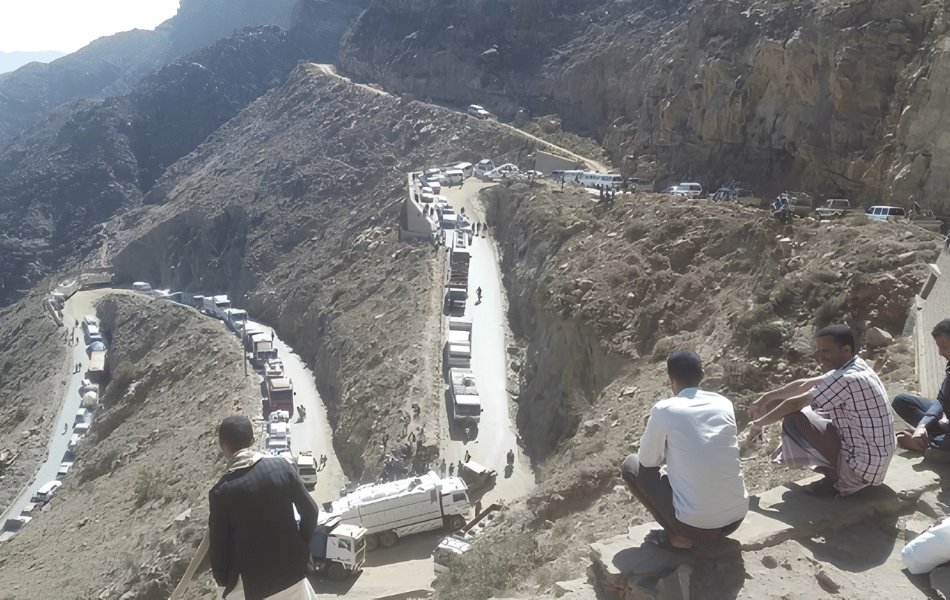
SAM Organization for Rights and Liberties stated that the siege imposed by the Houthi group on the city of Taiz—alongside tightened restrictions and the closure of supply routes since October 4, 2026, coinciding with bombardment and the bombing of a flood drainage culvert along the Taiz–Aden road—threatens residents' lives and severely restricts their access to food, water, medical treatment, and education.
SAM called on the Houthi group to halt attacks against civilians and residential areas, lift restrictions imposed on the movement of civilians and essential supplies, and reopen roads to patients, commercial trucks, and humanitarian aid. The organization also urged the international community to condemn these attacks and take urgent action to protect civilians and guarantee access to basic services and critical goods.
The attacks launched by the Houthi group on Taiz occur against the backdrop of a blockade enforced on the city for nearly twelve years, coupled with a military escalation initiated on September 3, 2026, followed by tightened restrictions and the closure of supply routes. These measures have paralyzed commercial trade, impeded patient access to hospitals and the movement of ambulances, obstructed the transport of food, medicine, and fuel, and prevented students and teachers from reaching schools. They have also disrupted the operation of water wells, water pumps, and waste collection and management services.
SAM emphasized that the Houthi group’s blockade of Taiz, the deprivation of its residents of food, water, and medicine, and the obstruction of humanitarian relief constitute violations of international humanitarian law. The organization noted that the deprivation of objects indispensable to the survival of the civilian population as a method of warfare constitutes a war crime under the prohibition of civilian starvation codified in Article 14 of Additional Protocol II to the Geneva Conventions. It added that attacks on civilians and residential areas, the targeting of civilian infrastructure, and the disruption of critical supply corridors relied upon by the population may also amount to war crimes.
Health, Water, and Food Conditions
SAM noted that available data indicates approximately 1,110 renal failure patients require around 120 dialysis sessions per day, while 192 patients are admitted to intensive care units and 154 infants are in incubators. Their lives depend on the availability of fuel, medicines, oxygen, and medical consumables, as well as the continuous operation of hospitals and unhindered access for both patients and medical personnel.
According to a UNICEF update issued on October 11, 2026, 98 health facilities were either operating partially or rendered completely out of service. Additionally, 42 health facilities faced acute shortages of medical supplies and oxygen, while the fuel crisis threatened to shut down or scale back services across 12 hospitals and health centers. This leaves patients suffering from kidney failure, cardiovascular diseases, diabetes, cancer, and other chronic illnesses at risk of interrupted or delayed treatment, while jeopardizing emergency services and neonatal incubator care.
An official memorandum addressed by the local authority of Taiz Governorate to the UN Humanitarian Coordinator warned of the worsening living conditions and basic services in the city. The memorandum stated that the affected districts comprise roughly 4,352,600 residents, and that road closures continue to cause prolonged civilian suffering while blocking main and secondary transit corridors. It also highlighted the depletion of food reserves and the extreme difficulty in moving essential commodities, foodstuffs, and medicines into the city, resulting in price spikes, depleted purchasing power, and exacerbated rates of poverty and malnutrition (Memorandum from the Governor of Taiz to the UN Humanitarian Coordinator: "The Critical Humanitarian Situation in Taiz Governorate Due to the Siege").
The memorandum added that estimated monthly needs stand at 12,352,500 liters of gasoline and 9,720,000 liters of diesel. The shutdown of fuel stations and supply shortfalls have inflated transport costs and crippled operations across hospitals and essential public utility, health, and service facilities. It further warned of compromised water sources, drinking water supplies, and sanitation, alongside severe challenges faced by water tankers attempting to reach wells and a critical shortage of diesel required to run water pumps.
Regarding food security, the memorandum reported an absence of adequate strategic reserves within the governorate, driven by the departure of numerous importers and wholesalers due to the siege and ongoing conflict. It included estimates of basic nutritional needs across urban districts, highlighting an urgent need for intervention to ensure the continuous flow and availability of essential goods.
On October 14, the World Food Programme (WFP) reported that it was unable to deliver food assistance to roughly 600,000 people in Taiz city, as part of approximately 800,000 individuals across Yemen impacted by humanitarian access disruptions.
A commercial brief received by SAM indicated that the protracted siege has driven capital, importers, and wholesalers out of Taiz, weakening the city's capacity to maintain and replenish inventories of basic commodities. Commercial sector representatives pointed out that banking and financial transaction hurdles are hindering the procurement of replacement shipments, warning that remaining inventories may not sustain the population for more than a month.
One local merchant informed SAM:
"To this moment, we are grappling with the refusal of banks and exchange bureaus to accept cash liquidity from merchants and transfer it to importers to procure replacement consignments of food commodities. We find ourselves facing massive dilemmas and have been forced to strictly ration our remaining stock, which may not suffice for citizens' needs for more than a month."
A resident in Taiz told SAM:
"Life goes on, but the greatest crisis remains food supplies. During the previous siege, an alternative road existed—difficult as it was—which allowed some supplies to trickle in, and the population was smaller. Right now, there is no alternative route whatsoever. Fuel is extremely scarce; if it runs out entirely, transport may grind to a halt, and workers may be unable to commute to their jobs. Domestic cooking gas was already in crisis before, so what will happen now? Even so, I see neither panic nor dread on people’s faces; they still head to their work and markets and carry on with their daily routines, as though awaiting imminent relief."
The Bombing of the Taiz–Aden Road
SAM stated that the detonation of a flood drainage culvert along the Hayjat al-Abd road—the vital artery linking Taiz and Aden—severely damaged one of the most critical corridors utilized by civilians, commercial trucks transporting food, medicine, and fuel, as well as patients and travelers. The disruption of this route sharply increases travel times and transit costs while compounding the difficulty of moving essential supplies and carrying out urgent medical referrals, particularly given the scarcity and hazards of alternative routes.
SAM stressed that targeting or disabling a civilian roadway must be legally evaluated in light of its civilian function and the surrounding context, including whether a legitimate military objective existed, the foreseeable harm inflicted upon civilians, and the precautions taken to mitigate such harm. The organization called for an independent investigation into the bombing of the culvert to establish accountability and determine whether the road or culvert was being utilized for military purposes at the time of the strike. It reiterated that attacking a civilian object that does not constitute a military objective, or unlawfully disabling it with prior knowledge of its devastating effects on the population, may amount to a war crime.
Humanitarian activists and experts warned SAM that fuel and cooking gas shortages threaten to shut down hospital operations and deep-well water distribution while paralyzing vehicular transit. They appealed to the state, coalition nations, international organizations, and the UN Security Council to "rescue Taiz, lift the siege, and end the war."
SAM's field team documented severe accumulations of municipal solid waste across several neighborhoods due to disrupted municipal operations and transport constraints. The organization noted that the build-up of uncollected waste in densely populated neighborhoods and displacement sites, coupled with water shortages and crippled sanitation infrastructure, heightens contamination risks and poses grave public health threats.
Since the escalation began on September 3, 2026, preliminary casualty figures indicate that 92 civilians have been killed and approximately 100 others injured—figures subject to ongoing verification and updates. Civilian casualties were also reported in the area of Saynah and its surroundings on October 19 and 20, alongside an attack targeting an ambulance during the medical evacuation of wounded individuals in Saber al-Shaqab.
Education, Arbitrary Detentions, and Threatening Messages
SAM highlighted that the Houthi group has forced the closure of over 200 schools, depriving approximately 137,000 students of access to education. It emphasized that road closures and restricted mobility have prevented both students and teachers from reaching classrooms, severely disrupting the educational process and fueling widespread dropouts. The organization added that incoming reports indicate the Houthi group is utilizing educational institutions to disseminate sectarian rhetoric and recruit children, fundamentally undermining schools as protected civilian spaces of learning and exposing children to military recruitment and indoctrination.
SAM also documented an uptick in arbitrary detentions targeting political dissidents and intellectual opponents of the Houthi group, with dozens arrested across rural Taiz. The organization demanded that the group immediately disclose their places of detention, guarantee their physical safety, grant them access to their families and legal counsel, and subject their detention to independent legal review.
Furthermore, SAM reported that unsolicited text messages were blasted indiscriminately to residents' mobile phones—without distinction between men, women, adults, or children—conveying explicit threats to target and destroy the city. The organization observed that these messages generated widespread fear and terror among residents, particularly children, as they coincided with active shellings and tight movement restrictions. SAM called for a thorough verification of the origin, dissemination scope, timing, and direct links of these communications to military threats and operations.
Tawfiq al-Homaidi, President of SAM Organization for Rights and Liberties, stated:
"The closure of transit corridors and the bombing of the Taiz–Aden road sever vital supply lines upon which civilians depend for access to medical care, food, and water, while doubling the cost of commercial freight and emergency medical referrals. Coupled with ongoing shelling and acute fuel and supply shortages, the lives of residents and the essential services they rely on face escalating peril. The Houthi group must lift all restrictions and cease their attacks immediately, and the international community must intervene decisively to protect civilians and secure unhindered humanitarian access."
Legal Framework
Article 14 of Additional Protocol II to the Geneva Conventions strictly prohibits the starvation of civilians as a method of warfare, as well as attacking, destroying, removing, or rendering useless objects indispensable to the survival of the civilian population, such as foodstuffs, drinking water installations and supplies, and irrigation works. Article 18(2) regulates humanitarian relief actions undertaken for civilian populations enduring extreme hardship due to the lack of essential supplies.
Article 13 of Additional Protocol II establishes general protection for the civilian population against dangers arising from military operations, prohibiting attacks directed against civilians as well as acts or threats of violence the primary purpose of which is to spread terror among the civilian population. Article 11 protects medical units and transports. Furthermore, Common Article 3 of the Geneva Conventions prohibits violence to life and person against individuals taking no active part in hostilities. Article 4(3)(c) of Additional Protocol II explicitly bans the recruitment of children under the age of fifteen into armed forces or groups, or allowing them to participate in hostilities.
SAM noted that the blockade imposed on Taiz, along with the accompanying restrictions on the entry of food, fuel, medicine, water, and relief aid, strips civilians of the core necessities for survival. The deliberate starvation of civilians or the obstruction of humanitarian relief in a manner that subjects them to hunger or disease constitutes a war crime. Similarly, the destruction of the Taiz–Aden road infrastructure may constitute a war crime if established that the road or culvert was unlawfully targeted or disabled, satisfying all necessary legal elements.
Demands
SAM Organization for Rights and Liberties calls on the Houthi group to:
Cease all attacks against civilians and residential areas in Taiz, and guarantee the protection of civilians, healthcare facilities, ambulances, and medical evacuation operations.
Lift all restrictions imposed on freedom of civilian movement and the entry of food, medicine, fuel, water, and humanitarian supplies, and reopen all roads and transit crossings to civilians, patients, commercial trucks, and aid deliveries.
Guarantee the safe, unimpeded, and regular passage of humanitarian assistance, refrain from obstructing supplies essential to civilian survival, and cease disrupting water infrastructure and public utilities.
Halt the targeting of civilian roads and public infrastructure, permit an independent investigation into the detonation of the flood culvert, and enable competent authorities to determine the circumstances and assign responsibility.
End the misuse of educational facilities for sectarian mobilization, indoctrination, and child recruitment, and uphold the right of students to education within protected civilian spaces.
Disclose the fate and whereabouts of all detainees, guarantee their physical safety, and allow them prompt access to their families and legal representation.
Immediately cease broadcasting indiscriminate threatening messages to the civilian population, and investigate the parties responsible for compiling and transmitting them.
SAM further calls on United Nations agencies and international organizations to assess critical health, food, water, sanitation, and waste management needs; provide immediate support to hospitals, dialysis units, water networks, and sanitation services; monitor food stockpiles and market prices; and track the adverse impact of road closures on school attendance.
Finally, the organization calls upon concerned states, the UN Security Council, and relevant UN mechanisms to condemn the attacks perpetrated by the Houthi group against the population of Taiz, exert meaningful pressure to halt these attacks and lift the siege, guarantee the delivery of vital supplies and basic services, support comprehensive investigations into the attacks, the destruction of the Taiz–Aden road, and all reported violations, and hold perpetrators accountable.
SAM Organization for Rights and Liberties
October 26, 2026