

Geneva – 2 November 2026
SAM for Rights and Liberties said that continuing military operations carried out by the Houthi group in populated areas of Taiz governorate, accompanied by rocket and artillery shelling and the siege of villages and residential neighbourhoods, are exposing civilians to grave dangers and forcing thousands of families into increasingly desperate humanitarian conditions amid rising casualties, destroyed homes, dwindling food supplies and disruptions to healthcare and other essential services.
The organization said that Al-Mukha’af village in the Al-Aqroud area had witnessed a missile explosion that caused dozens of casualties, amid two conflicting accounts of the incident’s circumstances and toll. The Yemeni Armed Forces Media Center reported that 60 civilians, including children, had been killed or injured in a ballistic missile attack attributed to the Houthi group. Meanwhile, a local account reported by Mohammed Taher stated that 14 people had been killed and 25 others injured when a missile fell following a failed launch attempt by the group from an area under its control.
SAM emphasized that the conflicting accounts require an urgent independent investigation to establish what happened. The organization stressed that using populated areas to launch missiles, if established, exposes residents to grave risks and places a legal obligation on those conducting military operations to take the necessary precautions to protect civilians.
In a new humanitarian development, the organization highlighted information published by journalist Ahmed Al-Shalafi on 2 November describing desperate conditions among besieged families in the villages of Al-Aqroud, Kahlan and Al-Najada in Taiz governorate. Dabbah village was reportedly struck by nine shells that evening, while families faced severe food shortages, a lack of cooking gas and firewood, damage to most solar panels from bullets and shrapnel, deteriorating health conditions and an absence of humanitarian assistance.
SAM said that families remaining under shelling without sufficient food, means of cooking or lighting, while children, older people and patients with chronic or serious illnesses remain among them, face extremely dangerous conditions. It called for the immediate establishment of safe humanitarian access routes to deliver relief and evacuate patients and injured civilians.
The organization added that these developments coincide with an attack on Al-Saqiyah Health Centre in Lahj governorate, which the Yemeni Ministry of Health attributed to the Houthi group and which killed five people and injured 15 others, including ten healthcare workers. They also follow the destruction of 13 homes in Adud village in Taiz by a Houthi missile attack and the injury of four children by sniper fire and landmines in the governorate.
SAM also documented the deaths of Mutasim Ibrahim Ahmed Qasim and Ilyas Mohammed Ali Mohammed Al-Jundi on 14 October 2026, when they were directly struck by a Houthi mortar shell while travelling along a public road in the Wadi Al-Arsh area of Wateer subdistrict.
On the humanitarian front, SAM noted that the International Organization for Migration reported that more than 300,000 people had been displaced by the military escalation in western Yemen, while prices of essential commodities in Taiz city had increased three- to fivefold amid disrupted supply routes and continuing restrictions on the movement of people, goods and humanitarian assistance.
SAM stressed that the Houthi group bears responsibility for attacks and violations committed by its forces and for unlawful restrictions imposed on civilians and supplies. It warned that continued shelling, the siege and deprivation of basic necessities threaten civilians’ rights to life, health, food, water and shelter, requiring urgent intervention to protect civilians, investigate violations and hold those responsible accountable.
SAM said that the missile explosion in Al-Mukha’af village, in the Al-Aqroud area of Al-Misrakh district, south of Taiz city, was among the deadliest incidents of the latest escalation, given the large numbers of reported fatalities and injuries, including children, and the serious questions surrounding the circumstances in which the missile fell in a populated area.
According to an account published by Mohammed Taher, citing sources among village residents, the incident killed 14 people and injured 25 others, most of them civilians, including a large number of children. Local sources reported that the explosion occurred when a ballistic missile fell following a failed launch attempt by the Houthi group.
The account added that Al-Mukha’af village lies in an area controlled by the Houthi group and that the incident caused severe casualties among its residents. It also accused the group of attempting to conceal details of the incident and prevent its circumstances from becoming known.
By contrast, the Yemeni Armed Forces Media Center had reported 60 civilians killed or injured, including children, in what it described as a Houthi ballistic missile attack on Al-Mukha’af village. Other media reports stated that the missile struck the village’s Al-Najd public market, while publishing differing preliminary casualty figures.
SAM said that these accounts agree that a missile explosion caused civilian casualties in Al-Mukha’af but differ over the final death and injury toll and the circumstances in which the missile fell. This makes an independent technical and field investigation essential, particularly because establishing whether the missile was deliberately launched towards the village or fell following a failed launch is fundamental to determining legal responsibility.
The organization emphasized that using villages and populated neighbourhoods as ballistic missile launch sites, if established in this incident, places civilians in the launch areas themselves at grave risk. Residents may be exposed to missiles falling or exploding during preparation or launch, in addition to the dangers associated with the presence of military equipment and activities within civilian communities.
SAM stressed that forces operating missile systems are required to take feasible precautions to protect civilians under their control from the effects of military operations, including avoiding, to the extent feasible, locating military objectives within or near densely populated areas.
The organization added that the presence of civilians in territory controlled by an armed group does not deprive them of the protections guaranteed under international humanitarian law, nor does it permit their casualties to be treated as secondary or information concerning their fate to be concealed.
SAM called for the names of those killed and injured to be disclosed, accurate casualty figures to be established, victims’ ages and injuries to be documented, and medical and humanitarian organizations to be given access to the wounded and victims’ families. It also demanded the preservation of missile remnants and physical and digital evidence capable of reconstructing the sequence of events.
The organization further called for investigations into allegations that information concerning the incident had been concealed or independent access restricted, and for victims’ families to be able to establish the truth about the circumstances in which their relatives were killed or injured.
SAM emphasized that conflicting accounts must not become an excuse for delaying accountability. The obligation to protect civilians remains in force whether the missile is found to have fallen because of a launch malfunction or to have been used in an attack that violated international humanitarian law.
SAM warned of a severe deterioration in humanitarian conditions in besieged villages across Taiz governorate, where residential communities continue to face shelling alongside dwindling food supplies, damaged sources of electricity and growing difficulties in accessing healthcare.
According to information published by journalist Ahmed Al-Shalafi on 2 November 2026, villages in Al-Aqroud, Kahlan and Al-Najada are experiencing desperate humanitarian conditions, while Dabbah village was struck by nine shells on Monday evening amid continuing threats to the safety of residents.
The information indicated that besieged families were experiencing severe food shortages, with growing fears that their remaining supplies would soon be exhausted. Security conditions and military operations have made the normal movement of people and supplies increasingly difficult.
Families also face a lack of cooking facilities and fuel, including cooking gas and firewood, making it difficult to prepare meals or make use of the food that remains available, particularly for children, older people and patients who require regular nutrition.
The report stated that most solar panels had been damaged by bullets and shrapnel, depriving residents of one of their principal sources of electricity for lighting, charging devices and operating basic household equipment, with few alternatives available.
According to the same information, residents are living in darkness at night, while shelling continues and movement becomes increasingly difficult, heightening fears for families’ safety and complicating responses to medical emergencies and injuries.
Health conditions are also deteriorating, particularly among children, older people and individuals living with chronic or serious illnesses, while humanitarian assistance is reportedly absent from the affected villages and families’ ability to obtain food, medicines and necessary healthcare continues to diminish.
SAM said these conditions demonstrate that residents’ suffering extends far beyond the immediate risk of being struck by shells. Families who survive the bombardment face food shortages, an inability to cook, damaged energy sources, difficulties obtaining emergency medical care and the constant fear of renewed attacks.
The organization added that damage to solar panels is particularly harmful in isolated villages that rely on solar systems to compensate for inadequate electricity networks. Continued shelling in the absence of lighting increases the risks associated with moving at night and complicates responses to health and security emergencies.
SAM stressed that the continuing siege and restrictions preventing food, medicines, fuel and cooking supplies from reaching affected villages pose grave dangers to civilians. The Houthi group bears responsibility for lifting unlawful restrictions imposed by its forces and facilitating the passage of humanitarian relief in accordance with international humanitarian law.
The organization emphasized that the starvation of civilians as a method of warfare is prohibited and that protecting residents requires ensuring they are not deprived of the supplies and services indispensable to their survival, as well as allowing and facilitating humanitarian relief operations.
SAM called for the urgent establishment of safe humanitarian access routes to Al-Aqroud, Kahlan, Al-Najada and surrounding areas, immediate field assessments of the needs of besieged families, and the delivery of ready-to-eat food, drinking water, cooking supplies, lighting equipment, medicines and emergency medical supplies, prioritizing children, older people and those with chronic illnesses.
The organization also demanded an end to shelling that endangers residential areas, unhindered access for ambulance crews and humanitarian organizations, and the evacuation of patients and injured people requiring medical treatment outside the affected villages.
SAM warned that leaving besieged families without relief while their access to food and medicine dwindles and shelling continues threatens to deepen the humanitarian crisis and requires urgent intervention to prevent further avoidable deaths and illness.
In a related incident, the Yemeni Armed Forces Media Center reported that the Houthi group had targeted Al-Sulaihah village in Abdan subdistrict, on the eastern front of Taiz city, with a ballistic missile launched from the direction of Mawiyah district, hours before the incident in Al-Mukha’af.
SAM said that the succession of ballistic missile incidents involving populated areas within a short period heightens concerns about civilian safety, the nature of sites used to launch these weapons, and compliance with legal rules prohibiting indiscriminate and disproportionate attacks.
The organization called for an investigation into the missile’s impact location and the resulting damage, identification of the intended target, and protection for civilians living near both launch sites and targeted areas.
SAM said that the attack on Al-Saqiyah Health Centre in Al-Madaribah Wa Al-Aarah district, Lahj governorate, constitutes a grave assault on a medical facility providing essential services to residents and threatens the healthcare sector’s capacity to respond to growing needs in conflict-affected areas.
According to a statement issued by the Ministry of Public Health and Population and published by the Yemeni News Agency, Saba, on 2 November, the attack killed five people, including three members of the centre’s medical staff, and injured 15 others, including seven healthcare workers, bringing the preliminary toll to 20 people killed or injured.
The ministry held the Houthi group responsible for the attack, stating that assaults on medical facilities and healthcare personnel constitute serious violations of international humanitarian law, which protects medical establishments, healthcare workers and patients.
SAM considers that the killing or injury of ten healthcare workers in a single attack demonstrates the severe damage inflicted on the centre and threatens the continuity of services on which patients and wounded civilians depend in an area already suffering from limited medical resources and restricted access to specialized healthcare facilities.
The organization stressed that the killing and injury of doctors and other healthcare workers affect not only the immediate victims and their families but also the facility’s ability to operate, leaving patients without services that may be essential to saving their lives.
SAM emphasized that the protection afforded to medical facilities is a binding legal obligation and that intentionally attacking a protected healthcare facility may constitute a war crime when the relevant legal elements are established.
The organization held the Houthi group responsible for the attack on the basis of the attribution made in the Ministry of Health’s statement. It called for the source of the projectile and the party responsible for launching it to be identified, all relevant forensic and medical evidence to be preserved, and the responsibility of those who carried out, ordered or planned the attack to be investigated.
SAM further stressed the need to ensure the continued provision of medical services at Al-Saqiyah Health Centre and surrounding facilities, protect healthcare workers and patients, and prevent medical facilities from becoming targets of unlawful attacks.
In another attack, SAM said that Adud village in Sabir Al-Mawadim district, Taiz governorate, was struck by a ballistic missile launched by the Houthi group on Sunday, 1 November 2026, destroying 13 homes, according to information released by the Taiz Siege Affairs Office.
In a statement published on 2 November, accompanied by photographs showing the damage caused by the strike, the office explained that the village lies approximately 13 kilometres from the front lines. It is a remote and isolated rural community with no roads accessible to motor vehicles, connected to surrounding areas only by rugged footpaths also used by pack animals and livestock.
SAM stressed that these circumstances raise serious questions about the nature of the target the Houthi group sought to strike, the military justification for launching a ballistic missile at a village far from the front lines, and whether the group took the precautions required under international humanitarian law to protect civilians.
The organization emphasized that the destruction of 13 homes in a single attack is not merely a material loss. It directly undermines residents’ security and their right to housing and protection, potentially depriving affected families of shelter, property and essential household belongings at a time when Taiz is experiencing large-scale displacement and difficulties in securing alternative accommodation.
SAM added that the character of the area and its distance from the front lines make an independent technical investigation essential. Such an investigation should examine the missile’s impact point, the type of weapon used, the extent of the destruction, the nature of the objects struck, and whether a legitimate military objective existed in the area at the time of the attack.
The organization held the Houthi group responsible for the attack attributed to it by the Taiz Siege Affairs Office. It called for a comprehensive assessment of damage to homes and property, documentation of the circumstances of affected families, the provision of protection, shelter and necessary assistance, and accountability for those responsible for any violations established by the investigations.
SAM said it had obtained direct field information from its monitors concerning the shooting of two children by a sniper belonging to the Houthi group in Al-Maqda village, Al-Aqroud subdistrict, Al-Misrakh district, Taiz governorate, on Monday, 2 November 2026.
According to information documented by the organization’s monitors, the shooting occurred at approximately 12:30 p.m. and injured Majid Badr Hazza, aged two, who sustained two gunshot wounds to his right thigh, and Abduh Rashid Qasim, aged ten, who was shot in his right leg.
Field accounts identified the Houthi sniper’s position as Dhuhaih Hill, overlooking Al-Maqda village. These details correspond to the report published by the Taiz Siege Affairs Office on the same day.
SAM emphasized that the shooting of a child just two years old, alongside another aged ten, reveals the danger posed by firing positions threatening civilians in populated villages and neighbourhoods. It called for an investigation into the circumstances of the shooting and the responsibility of the armed personnel and commanders overseeing these positions.
The organization stressed that deliberately targeting civilians, particularly children, is categorically prohibited under international humanitarian law. Gunfire that injures children in civilian areas requires an independent examination of evidence concerning the sniper’s position, line of sight and circumstances of the incident.
SAM held the Houthi group responsible for the shooting documented in accounts obtained by its monitors and attributed to the group’s members. It called for an end to sniper fire endangering civilians, accountability for those responsible, and medical treatment and rehabilitation for the injured children.
In an earlier incident, field information obtained by SAM revealed that Mutasim Ibrahim Ahmed Qasim and Ilyas Mohammed Ali Mohammed Al-Jundi were killed on 14 October 2026 when they were directly struck by a mortar shell fired by the Houthi group while travelling along a public road in the Wadi Al-Arsh area of Wateer subdistrict, in rural Taiz governorate.
According to casualty information documented by the organization’s monitors, the shell directly struck both victims, killing them and causing devastating bodily injuries.
SAM stressed that a mortar shell striking a road used by civilians and killing two people travelling along it raises serious concerns about the nature of the shelling, the intended target and compliance with the obligation to distinguish between military objectives and civilian objects.
The organization said that the use of explosive weapons in areas frequented by civilians can cause fatal harm even when people are not inside their homes, exposing passers-by, workers, farmers and children to dangers that cannot be justified merely by the existence of military confrontations in the surrounding area.
SAM held the Houthi group responsible for the shelling that killed the two civilians, according to the field accounts, and called for an independent investigation to determine the mortar’s launch location, the circumstances of its impact and the intended target. It also demanded that evidence be preserved and the victims’ families be guaranteed access to justice, remedies and compensation.
The organization stressed that the passage of more than two weeks since the incident, without the announcement of investigative findings or accountability measures, must not result in the case being abandoned. Protecting civilians requires investigations into all shelling incidents that have caused civilian deaths, regardless of when they occurred.
In another incident, the Yemeni Landmine Monitor reported on 2 November that a boy and a girl, both children of Abdulwali Ahmed Mughalis, were injured by a landmine explosion while herding sheep in Al-Mukaishah village, Qadas area, Al-Mawasit district, in rural Taiz governorate.
The monitor attributed the landmine to the Houthi group, describing the incident as an indication that the threat of landmines was extending into new areas of Al-Hujariyah.
SAM said that the injury of two children while herding sheep reveals the continuing threat to rural communities, where pastures, farmland and roads used for everyday activities have become dangerous places capable of causing death or permanent disability.
The organization emphasized that landmines do not distinguish between children and combatants, and their effects do not end when hostilities cease. They continue to threaten residents, obstruct returns to homes and farmland, and deprive families of their livelihoods.
SAM held the Houthi group responsible for the landmine attributed to it in the monitor’s report and demanded that it disclose the locations of mines laid by its forces, provide available information about them, and allow specialized teams to reach and remove them.
The organization stressed the need for urgent surveys of Al-Mukaishah village and surrounding areas, warning signs and awareness programmes for children and families, medical treatment and rehabilitation for those injured, and an investigation to establish responsibility for laying the mine.
SAM noted that the Al-Mukaishah incident coincides with international warnings about the expanding contamination of landmines, unexploded ordnance and improvised explosive devices as front lines shift and displaced people move into unfamiliar areas.
In a report issued by The HALO Trust on 2 November, the mine-clearance organization warned of reports of explosive devices buried beneath the soil, concealed inside roadside bags, or disguised as familiar objects such as rocks, bricks and thermos flasks.
The organization explained that escalating fighting since August 2026 had been accompanied by reports of newly laid landmines and unexploded ordnance along vital roads and corridors used by local communities and humanitarian organizations.
It reported that nearly two-thirds of reported mine-laying incidents were concentrated in Taiz governorate, with anti-personnel and anti-vehicle mines identified along community access routes in Jabal Habashi district, as well as reports of various improvised and disguised explosive devices in the Al-Turbah area.
The HALO Trust also cited reports of mines being laid along coastal transport routes in Bab Al-Mandab and the West Coast, increasing the risk of explosions affecting civilians and humanitarian workers during travel.
SAM said that deliberately disguising explosive devices as familiar objects increases the likelihood that civilians will approach them, particularly children, displaced people, herders and farmers who may not recognize their dangerous nature.
The organization emphasized that the widespread presence of landmines and explosive devices requires accountability for those who planted or used them in violation of international humanitarian law. Civilians must not remain exposed to dangers that can be reduced through surveys, clearance operations and effective warnings.
SAM stressed that the Houthi group must disclose all areas in which its forces have laid landmines and explosive devices, cease using anti-personnel mines, cooperate with the relevant technical agencies to clear contaminated areas, and refrain from obstructing explosive ordnance clearance and victim assistance.
SAM said that the restrictions imposed by the Houthi group on roads leading to Taiz have consequences extending beyond transport disruptions and rising prices. They now directly affect patients’ ability to obtain treatment, including cancer patients who require regular medication and scheduled treatment sessions.
In a video report broadcast by Saba TV on 2 November, the channel presented testimonies from Al-Amal Oncology Centre in Taiz describing shortages of medicines, fuel and medical supplies, difficulties faced by patients and staff in reaching the centre, and rising transportation and treatment costs.
A representative of the centre explained that shortages of resources and disrupted roads had affected its ability to provide medical services regularly, while patients were facing additional hardship caused by rising living and treatment costs.
The report also included the testimony of a parent of a child with cancer, who described how the child’s chemotherapy session had been postponed for several days because the necessary medication and solutions were unavailable. The parent linked the delay to difficulties in bringing medical supplies into the city because of road closures and the siege.
SAM emphasized that preventing a cancer patient from receiving treatment on schedule is not a minor humanitarian consequence of the siege, but a direct threat to their health and safety, especially when medication and treatment sessions must be administered according to medical plans established by doctors.
The organization added that continuing Houthi restrictions on roads and supplies make it more difficult to deliver medicines, fuel and the materials required to maintain treatment services, deepening the suffering of patients already facing severe medical, psychological and financial burdens.
SAM held the Houthi group responsible for the unlawful restrictions it imposes on the movement of civilians and supplies into Taiz and for the consequences of those restrictions for patients’ access to healthcare.
The organization stressed that using a siege or checkpoints to obstruct the entry of medicines and supplies indispensable to civilian survival, or to prevent patients from accessing treatment without lawful justification, violates obligations under international humanitarian law.
SAM called for roads to be opened to patients, healthcare workers and medical supplies, the safe delivery of cancer medicines, treatment solutions and fuel, and humanitarian arrangements to ensure that chemotherapy sessions are not disrupted.
The organization also urged the World Health Organization and humanitarian agencies to provide emergency support to Al-Amal Oncology Centre and other facilities delivering specialized treatment, to prevent interruptions in patients’ care.
SAM noted that continuing military escalation in western Yemen has forced hundreds of thousands of residents to flee their homes, while access to shelter, food, water and healthcare has deteriorated and the burden on host communities has intensified.
According to the statement issued by the International Organization for Migration on 1 November 2026, more than 300,000 people have been displaced by the escalation in western Yemen, almost all of them within the previous two months.
Displacement Tracking Matrix data as of 31 October recorded 300,391 displaced people since the escalation began in June 2026, including 299,335 people displaced between 1 August and 31 October.
Taiz governorate hosted the largest number of displaced people, at 133,800, followed by Lahj with 73,110 and Aden with 56,934. These figures highlight the growing pressure on essential services, temporary accommodation and healthcare facilities in receiving governorates.
IOM reported that prices of essential commodities in Taiz city had increased three- to fivefold because of fighting and disrupted access to surrounding areas, making food and other everyday necessities increasingly difficult for residents to afford.
The organization also reported that more than 43,000 people had fled Al-Madaribah Wa Al-Aarah district in Lahj governorate since the beginning of October, while Aden was hosting more than 56,000 displaced people.
IOM warned that humanitarian needs continued to grow and announced that it required US$45 million over the following six months to provide shelter, cash assistance, essential household items, healthcare, water, sanitation and protection.
SAM said that the continuing Houthi siege of Taiz and disruption of vital roads are exacerbating price increases and supply shortages, depriving civilians and displaced people of the means to meet their essential needs.
The organization emphasized that the Houthi group bears responsibility for removing unlawful restrictions it imposes on the movement of people, goods and humanitarian assistance, and that maintaining these restrictions amid deteriorating humanitarian conditions poses a growing threat to civilians’ rights to food, health, water and a dignified life.
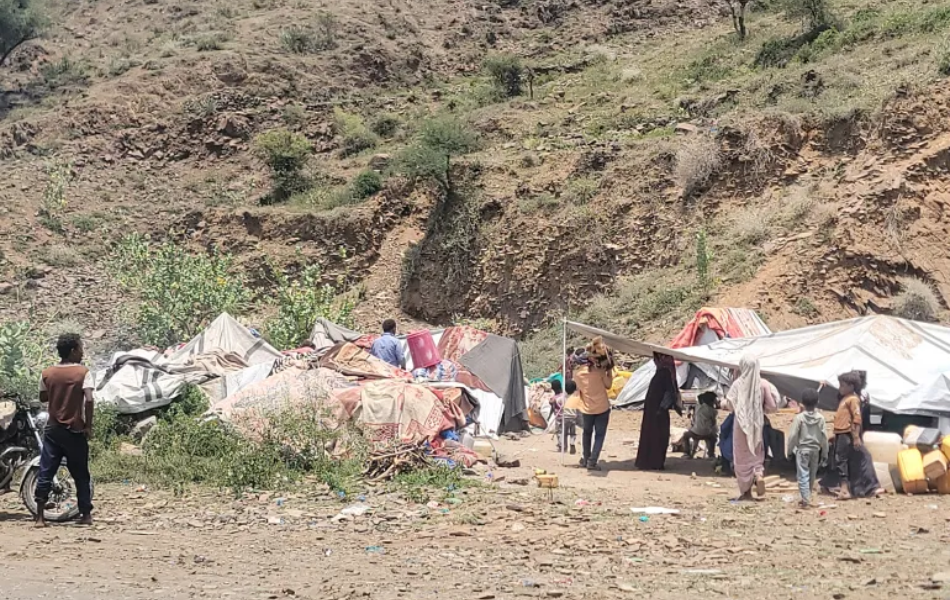
In Lahj governorate, SAM highlighted the deteriorating living conditions of displaced families staying in temporary camps that lack adequate shelter and protection from changing weather conditions.
According to a video report broadcast by Al-Saeedah TV on 31 October, Hutairah 2 camp accommodates more than 500 displaced families, including families displaced during earlier stages of the war and others who recently arrived from conflict areas.
The report included testimonies from displaced people living in tents that provide insufficient protection from winter cold and summer heat, amid shortages of blankets, mattresses, winter clothing and food, as well as difficulties in accessing medical facilities.
These accounts reveal the continuing hardship faced by families who have lost their homes and livelihoods and are forced to remain in conditions that do not meet minimum standards of adequate shelter and essential services.
SAM warned that leaving displaced families, particularly children, older people and patients, in tents unfit for winter conditions increases their exposure to illness and harsh living conditions.
The organization called for an urgent humanitarian response to improve shelter and provide food, blankets, winter supplies, water and healthcare, ensuring that families living outside officially designated camps are also included.
SAM said that continuing restrictions on transport in Taiz have aggravated a serious environmental and public health crisis, as waste cannot be transported to designated disposal facilities and large quantities of rubbish accumulate in residential neighbourhoods and stormwater drainage channels.
In a field report broadcast by Al Jazeera Yemen on 2 November, piles of waste were shown accumulating inside a stormwater drainage channel in a residential area of Taiz city, with smoke and foul odours causing considerable suffering among residents.
The report explained that local authorities were having difficulty transporting waste to the designated disposal site in the Saleh Gardens area because of the siege and security risks along the access road.
Footage published by Al-Masdar Online on the same day also showed waste accumulating in a stormwater drainage channel, with columns of smoke rising from the rubbish.
SAM said that the situation in Taiz demonstrates how the effects of the siege and road restrictions extend into every aspect of daily life. The harm is not limited to food, medicine and fuel but also includes disrupted waste collection and sanitation services, exposing residents to pollution and disease.
The organization warned that accumulated waste in residential areas creates conditions conducive to the spread of insects and rodents and increases the risk of water contamination. Burning rubbish also releases pollutants harmful to health, particularly for children, older people, pregnant women and people with respiratory illnesses.
SAM emphasized that continuing unlawful Houthi restrictions on transport and access to areas surrounding the city are aggravating the crisis and require roads to be opened and safe passage ensured for waste collection vehicles and sanitation workers.
The organization also stressed the responsibility of local authorities to take urgent measures to provide safe alternatives for waste collection, transportation and disposal, prevent the burning of medical and plastic waste in residential neighbourhoods, and reduce environmental and public health risks.
In another development, SAM followed a report broadcast by Saba TV on 2 November concerning Houthi members raiding and forcibly seizing homes belonging to government, political and community figures in Al-Shamayatayn district, Taiz governorate.
According to local sources cited in the report, members of the group raided and took control of the home of Minister of Water and Environment Tawfiq Al-Sharjabi in Sharjab village.
The report also stated that the raids included the home of the late political figure Dr. Qasim Sallam and that of Brigadier Abdulwahab Al-Sharjabi, as part of incidents involving the seizure of private property in the district.
SAM said that forcibly entering and seizing homes without a legitimate legal basis constitutes an infringement of the inviolability of the home and the rights of property owners. Armed groups cannot use their de facto control to dispossess civilians or deal with their property outside lawful safeguards.
The organization stressed that protecting private property is as important as protecting individuals, and that unlawful confiscation or use of homes may displace their owners and deprive families of housing and livelihoods.
SAM held the Houthi group responsible for the raids and seizures attributed to its members and called for unlawfully seized homes to be vacated and returned to their owners, with guarantees that those affected would not face threats or retaliation.
The organization also called for investigations into the incidents, the identification of those responsible, and appropriate measures to restore property and compensate owners for the damage they sustained.
SAM for Rights and Liberties considers that recent incidents, including the missile explosion in Al-Mukha’af, repeated shelling of villages in Al-Aqroud, Kahlan and Al-Najada, attacks on homes and medical facilities, injuries to children from sniper fire and landmines, and the killing of civilians by mortar shells while travelling, demonstrate the continuing exposure of residents to grave risks arising from military operations and the use of explosive weapons in populated areas.
The organization emphasizes that the Houthi group bears legal responsibility for unlawful acts committed by its forces and personnel under its command, including attacks that violate international humanitarian law, the laying of prohibited landmines, and unlawful restrictions preventing civilians from accessing humanitarian assistance and essential services.
SAM stresses that international humanitarian law requires parties to the conflict to distinguish between civilians and combatants and between military objectives and civilian objects. It prohibits attacks directed against civilians, as well as indiscriminate and disproportionate attacks, and requires feasible precautions to avoid or minimize civilian harm.
The organization emphasizes that the investigation into the Al-Mukha’af incident must examine two different possibilities raised by the sources: that the missile fell following a failed launch, or that it struck the village as part of a missile attack. Each scenario requires an independent assessment of the responsibility of the parties concerned, including the launch location, type of weapon, intended target and precautions taken to protect civilians.
SAM further stresses that parties to the conflict are required, to the maximum extent feasible, to avoid locating military objectives within or near densely populated areas and to take the necessary precautions to protect civilians under their control from the dangers resulting from military operations.
SAM emphasizes that depriving besieged villages of food, cooking supplies and services essential to survival, or maintaining unlawful restrictions that prevent humanitarian assistance from reaching residents, raises serious questions of legal responsibility, particularly when these conditions coincide with shelling and the inability to evacuate patients and injured civilians.
The organization stresses that the starvation of civilians as a method of warfare is prohibited and that objects and supplies indispensable to civilian survival are protected under international humanitarian law. Applicable rules also require parties to allow and facilitate the passage of humanitarian relief operations.
Medical facilities, healthcare workers, patients and the wounded enjoy special protection under international humanitarian law, and attacks must not be directed against protected medical facilities. Intentionally targeting such facilities may constitute a war crime when the relevant legal elements are established.
Regarding landmines, SAM emphasizes that Yemen is a party to the Anti-Personnel Mine Ban Convention, which prohibits the use of anti-personnel mines, in addition to other applicable rules protecting civilians from explosive hazards.
The organization also stresses that the seizure of homes and private property without a legitimate legal basis, their pillage or their use in a prohibited manner requires investigation, accountability and the restoration of property to its rightful owners.
SAM emphasizes that criminal responsibility may extend, subject to applicable legal requirements, to individuals who order or plan crimes and to commanders found responsible for crimes committed by their subordinates. It stresses the need for independent investigations, the preservation of evidence, and guarantees of victims’ and families’ rights to truth, justice and compensation.
SAM for Rights and Liberties calls for an independent and impartial investigation into the Al-Mukha’af incident to establish why the missile fell and which party was responsible for launching it. The investigation must examine the conflicting accounts of whether the missile exploded following a failed launch or struck the village during a missile attack, while documenting victims’ identities and establishing the final casualty toll.
The organization demands that medical and humanitarian personnel and independent investigators be granted access to the site, victims and their families. It also calls for the preservation of missile remnants and evidence concerning its origin and trajectory, and an investigation into allegations that details of the incident were concealed or access to information obstructed.
SAM emphasizes that the Houthi group must stop using populated areas as missile launch sites or locations for deploying military equipment when doing so exposes civilians to avoidable risks, and take all feasible precautions to protect residents in areas under its control.
The organization also demands an end to shelling that threatens residents of villages in Al-Aqroud, Kahlan and Al-Najada, an investigation into the nine shells that struck Dabbah village on the evening of 2 November, identification of their launch location and those responsible, and protection for civilian residents from unlawful attacks.
SAM calls for the urgent establishment of safe humanitarian access routes to besieged villages, allowing relief teams to reach affected families and deliver food, drinking water, cooking supplies, lighting equipment, medicines and first-aid materials. It also calls for the evacuation of patients in critical condition, particularly children, older people and those with chronic or serious illnesses.
The organization further calls for independent investigations into the missile attack on Al-Sulaihah village and the attack that destroyed 13 homes in Adud village, including identification of the intended targets, assessment of the damage, and the provision of shelter and necessary assistance to affected families.
SAM demands an investigation into the attack on Al-Saqiyah Health Centre in Lahj governorate, which killed five people and injured 15 others, accountability for those responsible, and effective protection for medical facilities, healthcare workers and patients.
The organization also calls for those responsible for the shooting of Majid Badr Hazza and Abduh Rashid Qasim in Al-Maqda village to be held accountable, including an investigation into the sniper’s position and the command responsible for it, and measures to protect residents from further sniper attacks.
SAM calls for an investigation into the deaths of Mutasim Ibrahim Ahmed Qasim and Ilyas Mohammed Ali Mohammed Al-Jundi, killed by a mortar shell in the Wadi Al-Arsh area of Wateer subdistrict on 14 October. It demands the identification of the launch location and those responsible for the attack, and justice and redress for the victims’ families.
The organization also calls for an investigation into the landmine explosion that injured a boy and a girl in Al-Mukaishah village, the removal of landmines and explosive devices from areas frequented by civilians, and awareness programmes, medical treatment and rehabilitation for victims.
SAM demands that the Houthi group disclose the locations of landmines laid by its forces, provide available information to specialized technical teams, and allow them to carry out surveying and clearance operations safely.
The organization calls on the Houthi group to lift unlawful restrictions on the movement of civilians and supplies into Taiz city, reopen the roads necessary for delivering food, medicines, fuel, water and humanitarian assistance, and ensure that civilians wishing to leave dangerous areas can move freely and safely.
SAM also calls for cancer patients and other patients to be guaranteed access to hospitals and treatment centres, and for medicines, treatment solutions, fuel and medical supplies to be delivered without delay, preventing the disruption of treatment sessions.
The organization demands an end to unlawful raids on homes and seizures of private property, the return of property to its rightful owners, investigations into the abuses, accountability for those responsible, and compensation for affected individuals.
SAM also calls on local authorities and humanitarian organizations to address the waste crisis in Taiz, ensure its safe collection, transportation and disposal, and protect sanitation workers and residents from health and environmental hazards.
The organization urges the United Nations and donors to expand humanitarian assistance programmes for displaced people in Taiz, Lahj and Aden, providing shelter, food, water, healthcare and protection, with priority given to children, women, patients and the most vulnerable families.
SAM calls on the Human Rights Council and relevant United Nations mechanisms to support independent investigations and evidence-gathering concerning attacks on civilians, medical facilities and homes, as well as violations associated with landmines and the siege, and to ensure that those responsible for serious crimes do not escape accountability.
SAM for Rights and Liberties emphasizes that protecting civilians requires holding armed groups and military forces accountable for the consequences of their operations, whether these involve unlawful attacks or the use of residential areas for military activities that place inhabitants at risk. A siege that leaves families without food, medicine, cooking supplies or lighting compounds humanitarian suffering and requires unlawful restrictions to be lifted immediately.
The organization stresses the need to halt violations, establish the truth about every incident involving civilian casualties, secure humanitarian access and services essential to survival for besieged villages, and hold those responsible for serious crimes accountable, ensuring justice and redress for victims and their families and preventing further violations.