

SAM: 39 children killed and 120 injured in three months, 246,110 children out of school, and approximately 347,000 deprived of measles vaccines, while the Houthi siege threatens the lives of premature babies and newborns.
Geneva – 20 November 2026
SAM stated that World Children’s Day, observed annually on 20 November, comes this year as children in Yemen’s Taiz Governorate face an extremely grave humanitarian and human rights situation. This is the result of continued attacks by the Houthi group on residential areas, the siege imposed on the city, restrictions on the delivery of food, medicine, fuel, and vaccines, and the rapidly deteriorating provision of essential healthcare and education services.
The organization explained that the consequences of Houthi violations are no longer confined to direct deaths and injuries. They have extended to undermining the very foundations of children’s survival and development by depriving hundreds of thousands of education, immunization, and healthcare; exposing premature babies and newborns to the risk of death due to shortages of oxygen and fuel; and exacerbating malnutrition, displacement, child recruitment, and the exploitation of children in military activities.
SAM emphasized that the incidents it has documented over recent months reveal the growing scale of harm inflicted on children in Taiz. Homes, markets, roads, schools, and healthcare facilities have become unsafe environments amid continuing Houthi violations and the absence of effective accountability for crimes committed against civilians.
SAM Organization for Rights and Liberties revealed that, between 10 August and 15 November 2026, it documented the killing of 39 children and the injury of 120 others in Taiz Governorate, bringing the total to 159 children killed or injured as a result of shelling, sniper fire, and shooting attacks carried out by the Houthi group against populated areas.
The documented violations included attacks on homes, residential neighborhoods, markets, public roads, and rural villages, resulting in child casualties while they were inside their homes or engaged in everyday activities, including playing, shopping, and herding livestock.
On 18 September, three children were killed in a Houthi attack on Al-Tarirah village in Al-Wazi'iyah District. They were Noureddine Yaqoub Abdu Al-Dhafari (4), Asawer Fahd Mohammed Ghanem Al-Dhafari (14), and Tala Mohammed Ahmed Al-Dhafari (2).
On 6 October, Aisha Imad Darham (6), a child with a disability, was killed alongside her grandfather and grandmother when Houthi shelling struck the family home in Al-Sarm village, Al-Aqroud subdistrict, Al-Misrakh District.
On 2 November, the Houthi group carried out a deadly attack on Al-Najd Market in Al-Makha'af village, Al-Aqroud subdistrict. According to the preliminary list issued by the Taiz Siege Affairs Office, the attack killed nine civilians, including eight children aged between 5 and 15, while they were at the market.
Two days later, on 4 November, a Houthi missile strike on the home of Ali Abdulhaq Al-Athawri in Al-Athawer village, Hayfan District, killed three of his children—Mira (7), Samaa (12), and Hayyan (3)—along with a female family member. Four others were injured, including Burhan Mithaq Abdulhaq (2½) and Alia Ali Abdulhaq (10).
On 5 and 6 November, SAM documented injuries to three children in separate attacks. Arsalan Mohammed Ahmed Mohammed (5) sustained a gunshot wound that passed through his abdomen and back in Ras Al-Naqil village, Al-Aqroud; Firas Shaker Saeed Mohammed Saeed (7) suffered a shrapnel injury to his hand in Al-Jabali area; and Aryan Yaseen Abduljalil Mohammed (2) sustained a head injury when a Houthi shell landed in Al-Dhabab area.
On 13 November, Omar Ammar Mohammed Abdulghani (12) was killed by a Houthi sniper while herding livestock in Al-Jabali village, Sabir Al-Mawadim District. Another child, aged 13, was injured on 12 November in Al-Misrakh District when a sniper’s bullet entered his chest and exited through his back.
These incidents, which represent examples from the overall toll documented by SAM, demonstrate the continued killing and serious injury of children in civilian locations that must not be targeted. They also highlight the risks of permanent disability, the loss of family members, and the psychological consequences of repeated attacks.
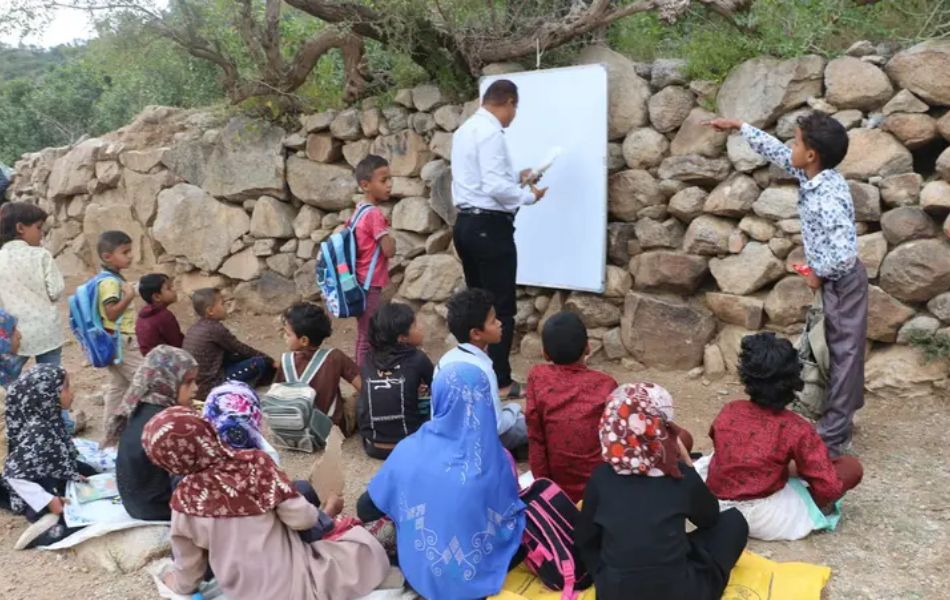
Houthi violations have also affected the education sector in Taiz. Attacks on residential areas, displacement, the seizure of educational facilities, and their use for military purposes have deprived large numbers of children of their right to regular education.
Local human rights monitoring data reviewed by SAM in its comprehensive report indicate that 246,110 children were out of educational institutions in affected areas of Taiz Governorate between 1 August and 15 October 2026.
In a related development, the Taiz Siege Affairs Office reported in October that 21 schools were being used for military purposes, reflecting the increasing encroachment on the civilian character of educational institutions and exposing students, teachers, and school buildings to the dangers of hostilities.
Across the wider areas affected by the escalation, Yemen’s Ministry of Human Rights announced on 2 October that 243 schools had ceased operating and more than 140,000 students had been affected by educational disruptions through the end of September. These figures cover an area broader than Taiz Governorate alone.
These developments have been accompanied by damage to schools caused by shelling and incursions, as well as difficulties faced by students and teachers in reaching educational institutions due to insecurity and displacement. Economic pressures have also forced families to prioritize food and shelter over their children’s continued schooling.
The prolonged disruption of education deepens learning gaps, increases the risks of school dropout, child labor, exploitation, and recruitment, and threatens to cause lasting damage to the educational, social, and economic opportunities of an entire generation.
Healthcare services for premature babies and newborns in Taiz are deteriorating severely as a result of the Houthi siege and shortages of fuel, oxygen, and medical supplies, reducing the operational capacity of facilities specializing in maternal and child healthcare.
In a report published on 26 October, Reuters revealed that the Yemeni-Swedish Hospital for Mothers and Children in Taiz had been forced to reduce the number of operational incubators from 40 to just 10 because of fuel and oxygen shortages, representing a 75% reduction in its previous operating capacity.
Field information obtained by SAM from a technical official at the hospital indicated that energy shortages had also affected oxygen production, the operation of medical services, and staff transportation. A Reuters follow-up report published on 3 November indicated that the hospital’s daily number of deliveries had fallen to approximately half its previous level.
In the same context, the United Nations Population Fund (UNFPA) reported that only five of 27 priority maternal and newborn healthcare facilities in Taiz city were partially operational, while more than 13,100 pregnant women were unable to access essential reproductive healthcare services.
These conditions mean that babies born prematurely, or those requiring ventilators, incubators, and continuous medical monitoring, face growing risks—not only because of their medical conditions, but also because life-saving services have been disrupted and essential supplies needed to operate them are increasingly difficult to obtain.
Houthi restrictions on the delivery of medical supplies and the disruption of immunization programs in Taiz have aggravated the epidemic risks facing children, particularly amid the continuing spread of measles and the declining capacity of healthcare facilities to provide preventive and curative services.
According to information released by the Taiz Public Health and Population Office on 7 November 2026, the suspension of measles and rubella vaccination campaigns had deprived approximately 347,000 children of vaccines, while around 72,500 infants under the age of one were at risk of missing essential routine immunizations because of disruptions to vaccine supplies.
In the same context, Taiz health information officer Taysir Al-Samei reported 2,738 measles cases, including 26 deaths, recorded from the beginning of 2026 through the end of October, amid the continued disruption of immunization programs and deterioration of healthcare services.
Health Office data released on 2 November also showed that 186,415 children under the age of five had been affected by the reduction or suspension of healthcare services in the areas covered by the monitoring.
The seriousness of these figures lies in the fact that measles is a highly contagious, vaccine-preventable disease. Inadequate immunization, combined with malnutrition and weakened healthcare services, increases the likelihood of severe complications and deaths, particularly among younger children.
Children’s nutritional conditions in Taiz have deteriorated as a result of the Houthi siege, disrupted supply routes, declining household incomes, and rising food costs, alongside deteriorating healthcare services and growing humanitarian needs.
According to data released by the Taiz Health Office on 2 November, 5,057 children were suffering from severe acute malnutrition, while 27,752 children were suffering from moderate acute malnutrition, bringing the combined total to 32,809 children across the two categories within the scope of the published health data.
These indicators reveal an interconnected food and health crisis. Malnutrition increases children’s susceptibility to infectious diseases, weakens their ability to recover, and raises the risk of serious health complications, particularly amid shortages of medicines, nutritional supplements, and specialized treatment services.
These risks are even greater for displaced children, children with disabilities, those living with chronic illnesses, and families that have lost their livelihoods as a result of attacks, displacement, and the disruption of economic activities.
The incidents reviewed by SAM during the reporting period included reports of child recruitment and the exploitation of children in military activities by the Houthi group, in violation of legal safeguards protecting children during armed conflicts.
At the end of September, Yemen’s Ministry of Human Rights reported documenting the deaths of at least 100 children whom it said the Houthi group had recruited and deployed in combat during September 2026, based on lists containing the victims’ names and photographs. This figure covers an area broader than Taiz Governorate and is not included in SAM’s documented toll of civilian children killed and injured in the governorate.
SAM’s briefings also included an incident in October involving a 14-year-old child injured in Jabal Habashi District following an attempt to recruit him into the group’s ranks, according to the preliminary information available about the incident.
Recruiting children and using them in combat endangers their lives and safety, deprives them of education and family protection, and causes lasting psychological and social harm, in addition to exposing them to injury, disability, or death.
Houthi attacks on villages and residential neighborhoods in Taiz have contributed to repeated waves of displacement, forcing families to abandon their homes and seek shelter in areas less exposed to shelling, amid shortages of basic services and declining access to essential necessities.
Data from the International Organization for Migration (IOM) indicate that the number of people displaced by the escalation in Yemen had exceeded 340,000 as of 13 November 2026. This nationwide figure covers several governorates, including Taiz, Lahj, and Aden, and does not represent either the number of displaced children or the number of displaced people in Taiz alone.
In Taiz Governorate, SAM documented damage to 81 homes, four schools, three mosques, and one healthcare facility in its civilian infrastructure monitoring database during the period covered by its report through 13 November, as a result of attacks and violations affecting civilian property and facilities.
This damage has caused families to lose their homes or rendered their residences less suitable for habitation, exposing children to repeated displacement, interrupted education, and difficulties accessing healthcare, food, and safe water.
Repeated attacks on residential areas are also associated with serious psychological and social consequences for children, including persistent fear, loss of a sense of security, and disruption of family life, particularly among those who have witnessed family members being killed, sustained injuries during attacks, or been forced to flee their homes.
SAM Organization for Rights and Liberties condemns in the strongest possible terms the violations committed by the Houthi group against children in Taiz Governorate. It stresses that the continued killing and injury of children, attacks on residential areas, the military use of schools, the recruitment of minors, and the imposition of unlawful restrictions on essential supplies constitute grave violations of rights protected under the Convention on the Rights of the Child and international humanitarian law.
The organization emphasizes that responsibility for these violations is not limited to those who directly carry them out. It also extends to commanders who ordered or supervised the operations, or who failed to prevent violations or punish those responsible, where the legal requirements for individual and command responsibility are met.
SAM stresses that deliberate attacks against civilians, including children, as well as indiscriminate or disproportionate attacks, may constitute war crimes under international humanitarian law. The use of children under the age of 15 to participate actively in hostilities may also constitute a war crime where the relevant legal elements are established.
In light of these violations, SAM Organization for Rights and Liberties calls for the following:
An immediate end to Houthi attacks on civilians: Cease shelling, sniper fire, and attacks on homes, markets, public roads, and schools, and adopt the necessary measures to protect children from all forms of conflict-related violence.
The unconditional lifting of the siege on Taiz: End unlawful restrictions on civilian movement and the delivery of food, fuel, medicines, oxygen, and vaccines, and ensure the safe and regular passage of humanitarian and medical supplies.
Urgent measures to save premature babies and newborns: Restore non-operational incubators at the Yemeni-Swedish Hospital, provide the fuel, oxygen, and medical supplies needed to sustain maternal and child healthcare services, and ensure that pregnant women and newborns can access life-saving care.
The resumption of immunization campaigns: Take urgent measures to supply measles and rubella vaccines and routine immunizations, reach children who have been deprived of vaccination, strengthen the epidemic response, and provide treatment for infected children.
Action to address malnutrition: Expand therapeutic feeding programs for children suffering from acute malnutrition and ensure access to food, nutritional supplements, and healthcare services for affected and displaced families.
Protection of education and an end to the military use of schools: Require the Houthi group to vacate educational institutions used for military purposes, rehabilitate damaged schools, and ensure that children can resume their education and access schools without threats or discrimination.
An end to child recruitment: Stop the recruitment of minors and their use in military activities, secure the release of children associated with armed forces and armed groups, and provide rehabilitation and family, educational, and psychological reintegration programs.
Accountability and justice for victims: Launch independent and effective investigations into violations committed against children, preserve evidence, testimonies, and medical records, identify those directly responsible and the commanders implicated, and guarantee victims and their families the rights to truth, justice, compensation, and reparation.
SAM calls on the United Nations, particularly UNICEF, the Office of the United Nations High Commissioner for Human Rights (OHCHR), and international mechanisms concerned with children and armed conflict, to take more effective measures to protect children in Taiz, strengthen independent monitoring of violations, and link the humanitarian response to concrete measures aimed at preventing further crimes and ensuring accountability.
On World Children’s Day, SAM Organization for Rights and Liberties emphasizes that the continued killing and injury of children in Taiz, and the deprivation of hundreds of thousands of children of education, vaccines, and healthcare, are not merely incidental consequences of the conflict. They constitute a human rights and humanitarian crisis requiring an urgent international response and accountability for those responsible for the violations that have caused it.
The organization stresses that protecting the children of Taiz cannot be delayed any longer. Continued impunity allows perpetrators to repeat their violations, while children pay the price with their lives, health, education, and future. World Children’s Day cannot be meaningfully observed unless international commitments are translated into concrete action to stop Houthi violations, end the siege, and guarantee children their rights to life, safety, and dignity.