

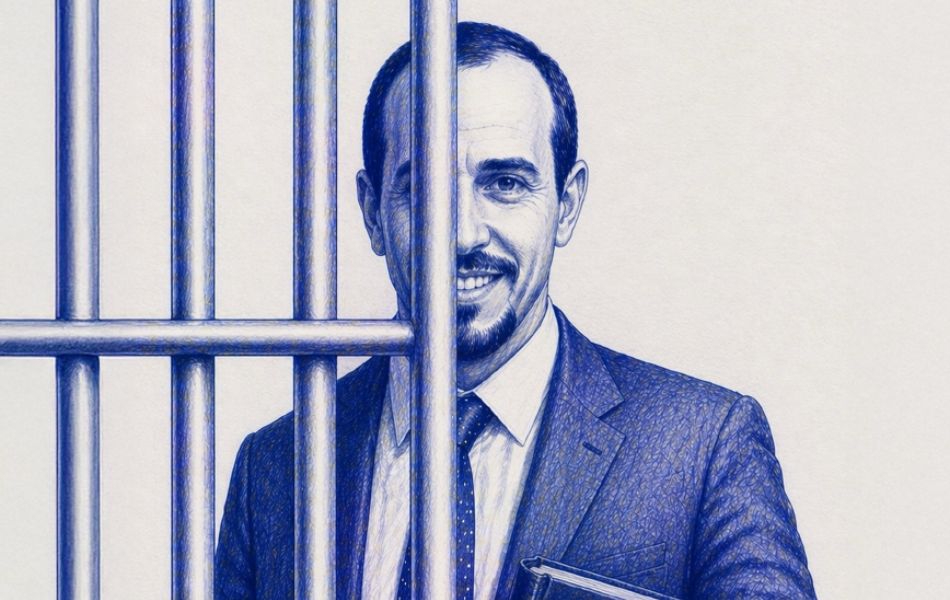
SAM for Rights and Liberties has issued an extensive human rights report titled “The Cost of Advocacy,” documenting seven months of detention of Yemeni lawyer Abdulmajid Sabrah and the profound humanitarian and legal consequences that followed. The report exposes a troubling pattern of erosion of the rule of law and the targeting of lawyers and human rights defenders in areas under Houthi control.
According to the report, Sabrah was arrested on September 25, 2025, from his office in the Shumaila area, south of the capital Sana’a, by armed individuals believed to be affiliated with the de facto authorities. He was detained without the presentation of a clear judicial warrant, without being informed of the reasons for his arrest, and without being allowed immediate contact with his lawyer or family. The report notes that his continued detention without formal charges or referral to a competent judicial authority raises serious concerns that he is being held arbitrarily and may be subjected to enforced disappearance or cruel and inhumane treatment.
The report emphasizes that Sabrah’s case is not an isolated incident but rather reflects a broader crisis affecting the legal profession and the human rights space in Yemen. Extrajudicial detention, it argues, has become a tool of coercion and control—targeting not only the individual but also the professional message carried by lawyers as defenders of victims and intermediaries between citizens and the justice system.
According to the report, Sabrah had been carrying out his professional duties normally, including defending detainees in politically and human rights–related cases, before being subjected to threats and incitement campaigns preceding his arrest. It also indicates that a comment he posted on Facebook hours before his arrest—criticizing restrictions on events commemorating the September 26 Revolution—likely contributed to his targeting.
The report includes moving testimonies from his family, including that of his daughter Asma, who witnessed the raid on his office. She recounted that the family had been preparing to celebrate her child’s first birthday, only for the day to turn into a traumatic shock when her father was taken to an unknown location. The report adds that the family spent days without knowing his whereabouts before later obtaining information indicating he was held in a facility التابعة to the Security and Intelligence Service in the Shamlan area of Sana’a, and subsequently transferred to another location in Shamlan/Sarf.
SAM confirmed that, based on documented information, Sabrah’s detention conditions included periods of solitary confinement, restrictions on communication with his family and lawyer, psychological pressure, and harsh treatment. He also reportedly went on a hunger strike in protest against his detention conditions. The organization considers these acts to constitute serious violations of fundamental safeguards for detainees, including the right to know the reasons for arrest, the right to communicate with family, the right to legal counsel, and the right to prompt appearance before an independent judicial authority.
The report states that Sabrah’s detention violates the Yemeni Constitution and the Code of Criminal Procedure, as well as Yemen’s obligations under the International Covenant on Civil and Political Rights, particularly provisions prohibiting arbitrary detention and guaranteeing fair trial rights. It further notes that his continued detention under opaque conditions and without effective judicial oversight amounts to a fundamental undermining of the rule of law and opens the door to a parallel detention system operating outside the legal framework.
SAM stressed that targeting lawyers does not only harm direct victims but strikes at the very core of justice itself. When lawyers are intimidated, victims are deprived of access to redress, and justice shifts from a mechanism of protection to a tool of control and subjugation. The organization added that Sabrah’s case reveals a structural hostility toward independent legal advocacy and a systematic attempt to weaken any voice capable of holding violations accountable or defending victims.
The report calls on the de facto authorities in Sana’a to immediately and unconditionally release lawyer Abdulmajid Sabrah, unless legally recognized criminal charges are brought against him and he is promptly presented before an independent and impartial court that guarantees full fair trial rights. SAM also demands immediate disclosure of his place of detention and his health and legal conditions, and that his family and lawyer be allowed regular, unrestricted contact with him.
The organization further calls for an independent and transparent investigation into the circumstances of his arrest and detention, and for accountability for all those involved in the violations against him, including direct perpetrators and senior officials exercising effective authority over the relevant security bodies. It also urges the Yemeni Bar Association and local and international human rights organizations to take urgent action to protect lawyers and human rights defenders, considering Sabrah’s case a real test of whether any safe space remains for independent legal work in Yemen.
SAM concluded its statement by affirming that the release of Abdulmajid Sabrah is not merely justice for a detained lawyer, but a defense of society’s right to justice, of victims’ right to legal representation, and of the fundamental principle that the law cannot endure if lawyers themselves become victims for fulfilling their professional duties.