

Violations in Detention in Areas Formerly Controlled by the Southern Transitional Council
Since the outbreak of the conflict in Yemen, human rights reports, media coverage, and testimonies from survivors and their families have referred to the existence of unofficial detention facilities in areas in the south of Yemen, particularly in governorates controlled by armed groups affiliated with the Southern Transitional Council (STC) and forces supported by the United Arab Emirates (UAE). From 2015 to 2025, reports have detailed repeated allegations of arbitrary detention, enforced disappearance, detention outside the judicial framework and torture within these facilities.
In 2016, the city of Aden experienced a significant deterioration in its security environment including a wave of attacks and assassinations. Authorities deployed widespread checkpoints, fortified barriers, and intensified security measures. During the same period, the Security Belt Forces began conducting raids and arrest campaigns, detaining and deporting hundreds of individuals from northern governorates. Since then, areas under the control of the STC in Yemen, particularly Aden, have experienced a security environment characterized by an overlap between formal counterterrorism operations, and extrajudicial detentions and abuses carried out under the pretext of maintaining security. These abuses have reportedly included regional discrimination, and forced deportations conducted outside of judicial authority.
In June 2017, Associated Press reported on the existence of unlawful detention facilities operated by UAE-backed forces in the south of Yemen, where former detainees described enforced disappearance, detention without judicial orders, and torture. AP reported that approximately 2,000 individuals had disappeared within secret detention facilities in areas under the control of the STC, a figure which likely increased in recent years though Yemeni Archive was unable to identify a more recent comprehensive estimate.
As the influence of UAE-backed forces expanded following the 2017 establishment of the STC, with those forces imposing security measures in areas under their control, secret detention facilities and detention outside judicial oversight emerged as prominent human rights concerns. This trend reportedly extended to Socotra Island, where armed elements affiliated with the STC carried out arrest campaigns targeting local officials and activists.
In this investigation, Yemeni Archive and SAM Organization for Rights and Liberties (SAM) review open-source information on violations associated with arbitrary detention campaigns in areas that were under the control of the STC, with a focus on specific detention facilities that were repeatedly referenced in human rights reports, media coverage, and testimonies. The investigation also examines a number of names mentioned in open-sources as entities or individuals allegedly responsible for these violations. This investigation forms part of a broader series by Yemeni Archive examining patterns of arrest and detention across areas controlled by different actors, with the aim of providing a broader understanding of the varying contexts of these practices across conflict-affected areas, and preserving related digital evidence.
This investigation contains graphic visual and written content, including descriptions of individuals killed and references to torture methods, as well as visuals of injured and deceased persons. Sources containing graphic audiovisual or written material may be redacted or accompanied by warning notices. To request access to an unredacted version, please email us at: requests@yemeniarchive.org.
In collaboration with SAM, Yemeni Archive conducted this investigation using a multi-stage open-source research approach, which included:
Collecting, preserving, and analyzing 366 digital records of which 195 were cited in this report, including visual materials, reports published on news websites and social media platforms, and reports issued by local and international organizations.
Geolocating selected detention sites using available online materials.
Systematically reviewing allegations related to arrests and detention, and analyzing the actors reportedly responsible.
Verifying information by cross-referencing official reports, testimonies from survivors and their families, and accounts shared by activists on social media, checking for consistency across multiple independent sources.
For more information about Yemeni Archive’s research methodology, please visit our website.
In mid-June 2015, coordinated southern resistance forces’ ground offensives, backed by a Saudi- and UAE-led coalition air campaign, led to the withdrawal of Ansar Allah (Houthi) and allied forces from their remaining positions in Aden, including the airport, the port, and various urban districts. The Internationally Recognized Government (IRG) then announced the full liberation of Aden.
The STC was formally established on 4 May 2017, as a political body with a secessionist orientation, following months of escalating political and security tensions in Aden. Its formation came in direct response to a decree issued on 27 April 2017 by IRG President Abdrabbuh Mansur Hadi, dismissing Aidarous Qassem al-Zubaidi from his post as governor of Aden and Hani bin Breik from his position as Minister of State. Those decisions sparked large-scale protests in Aden in early May 2017, with demonstrators calling for a southern leadership that would represent the aspirations of Southerners.
The council’s leadership structure includes a number of governors, local officials, and military figures from governorates in the south of Yemen, particularly those that were part of the former state of South Yemen. In April 2020, the STC declared a state of emergency and announced self-administration in the south of Yemen. A July 2020 statement by the IRG, however, rejected these claims, describing the STC’s declaration of “self-administration” as a rebellion and a violation of the Riyadh Agreement, which threatened the country’s unity.
Structurally, the STC emerged as the most influential actor within the broader Southern Movement, though it was not the only component. According to the German Institute for Global and Area Studies (GIGA), the council received substantial military and financial backing from the United Arab Emirates, including support for the formation of the Security Belt Forces and other military units operating outside the formal structure of Yemen’s Ministry of Defense. This support has provided the STC with a significant military arm, enabling it to consolidate control across Aden and other governorates in the south of Yemen. In contrast, Saudi Arabia has sought, through the Riyadh Agreement and subsequent efforts, to integrate STC-affiliated forces into formal state institutions, to curb the council’s autonomous military power and rebalance authority in the south of Yemen.
According to the Arab Center Washington DC, the relationship between the STC and the IRG was described as problematic, due to accumulated southern grievances following unification and the 1994 war. These tensions deepened after 2015, particularly amid the government’s inability to provide basic services in Aden in 2018, and the clashes of 2019. In April 2022, the STC and the IRG were brought together under a single Presidential Leadership Council, creating a temporary pragmatic arrangement in which the project of “restoring a southern state” coexisted with the frameworks of internationally recognized “legitimacy.” At this time, news reports indicated that the relationship was characterized by cooperation, with both parties participating in joint security and political arrangements.
During this period, three main armed actors came to dominate the security landscape in Aden. Among them, the Security Belt Forces emerged as one of the most prominent in terms of reach and influence and the core of the STC’s security apparatus, controlling the city’s land, sea, and air entry points, with operations extending into the governorates of al-Dhalea, Abyan, and Lahj. According to a report by Defense Line, these forces were established in 2015 with Emirati support and were later incorporated under the umbrella of the STC, maintaining an organizational structure independent from Yemen’s IRG Ministry of Interior, operating through parallel command but alongside formal state institutions. Brigadier Mohsen Abdullah al-Wali reportedly assumed command of the Security Belt Forces in 2020 as part of UAE-backed security arrangements. In January 2026, the Security Belt Forces were rebranded as the National Security Forces, accompanied by a change in insignia. This shift coincided with broader efforts to restructure certain security formations within the framework of the Ministry of Interior under the IRG. This rebranding came in the aftermath of the December 2025–January 2026 clashes.

Screenshot from the Defense Line website showing the changes to the Security Belt Forces logo over the past years. The image was captured by Yemeni Archive on 18 March 2026.
The second force was Aden Security, one of the official security bodies affiliated with the Ministry of Interior in the IRG. In 2015, Major General Shalal Ali Shaye was appointed Director of Aden Security as part of efforts to reorganize the security apparatus during that period. The mandate of Aden Security included carrying out counterterrorism operations, which later evolved into more specialized units. Over time, these functions developed further, leading to the establishment of an independent counterterrorism agency, with Shalal Shaye appointed as its head in January 2024. With the rise of STC influence, particularly after the events of August 2019 that resulted in its control over Aden, the relationship between Aden Security and STC underwent notable shifts, with both coordination and overlap in certain security areas including counterterrorism operations; alongside periods of tension and competition over influence.
The third force was the Hadrami Elite Forces, established in 2016 with support from the UAE. These forces were deployed in Hadramout Governorate, particularly in the city of Mukalla, as part of security arrangements aimed at confronting armed groups and strengthening local control. They were linked to local leadership figures, including Faraj Salmin al Bahsani, who previously served as commander of the Second Military Region and governor of Hadramout. Later, the Shabwani Elite Forces were established in Shabwa Governorate with support from the UAE, which played a central role in their training and development. The Forces assumed security and counterterrorism responsibilities across several districts in the governorate and operated as part of a broader network of UAE-backed local security formations. According to Amnesty International, these forces were also linked to the management of detention facilities in areas under their control, including sites in Mukalla and Shabwa, where allegations of arbitrary detention and abuses were documented.
An additional armed actor, the Giants Brigades, were a military formation that emerged after 2015 from fighters with Salafi affiliations, and played a prominent role in military operations along Yemen’s western coast, particularly during the battles of Bab al-Mandab and Mokha. Media reports indicate that these forces received support from the coalition, particularly the UAE, and were led by Abdulrahman al-Mahrami (Abu Zara’a), who later became a member of the Presidential Leadership Council. As of early 2026, the Giants Brigades remained an active force and were redeployed in security roles.
Decline and Restructuring of the STC
Reporting suggests that following the December 2025 / January 2026 clashes, security formations affiliated with the STC, including the Security Belt Forces and the Giants Brigades, continued to operate on the ground while undergoing attempts at restructuring and integration into state institutions. In 2026, these formations witnessed organizational changes, including the renaming of some units as part of new security arrangements in Aden. The Giants Brigades assumed security responsibilities in the city following the withdrawal of STC-affiliated forces, including securing key sites such as Ma’ashiq Palace and the Central Bank, as part of a broader redistribution of influence.

Illustrative diagram of the main forces that were affiliated with the STC. Image designed by Yemeni Archive.
During January 2026 the STC experienced unprecedented political and military decline, amid escalating tensions with the IRG and growing divisions within the regional coalition supporting it. Following attempts at military expansion across a number of governorates in the south of Yemen in December 2025, the council faced setbacks on the ground and increasing political pressure including from Saudi Arabia. This was followed by the withdrawal of its leadership from Yemen and a rise in internal divisions within its organizational structure. In early 2026, steps were announced to restructure the council and reduce its institutional presence as part of Saudi-led arrangements aimed at reconfiguring the balance of power in the south of Yemen, in preparation for a broader negotiation track within efforts toward a comprehensive political settlement in Yemen. These developments reflect the fragility of the council’s political structure; its structural dependence on external support; and its shift from a dominant actor in the south of Yemen to a party subject to regional and international recalibration within the ongoing Yemeni conflict.
United Arab Emirates’ Direct Involvement
In addition to supporting the STC and affiliated armed groups, the UAE also participated directly in the conflict. Upon joining the military coalition in Yemen in 2015, the UAE stated that its participation aimed to support the IRG, achieve stability, and contribute to counterterrorism efforts. Despite this stated position, the following years witnessed incidents in which Emirati aircraft carried out airstrikes targeting units of the Yemeni army and forces aligned with the IRG, particularly in southern areas. Among the most notable of these incidents were the strikes that took place in Aden in August 2019, which resulted in dozens of government soldiers being killed and injured. The UAE justified these strikes at the time as a response to what it described as threats from “extremist groups” within the targeted forces. On 30 December 2025, the UAE announced the withdrawal of its remaining counterterrorism teams from Yemen, citing a review of the security situation and operational requirements.
Based on media reports and content circulated on social media, certain patterns of violations during detention appear repeatedly in areas under the control of STC forces. These include detention outside judicial oversight and without clear legal warrants; enforced disappearance through the transfer of detainees to facilities not subject to prosecutorial supervision; and denial of visits and communication with families. Reports also point to ill-treatment and torture during interrogation, as well as medical neglect, which exacerbates the physical and psychological risks faced by detainees and undermines any guarantees of due process.
Night raids and home intrusions
Media and human rights documenters have reported a pattern of night raids on homes. These operations were reportedly carried out by armed forces and, according to reports by SAM Organization and Human Rights Watch, included acts described as intimidation targeting residents, such as firing weapons in residential areas. The reports claimed that these raids were accompanied by verbal and physical assaults against women, looting of personal belongings, and the use of force during arrest operations. Amnesty International also reported that witnesses described masked individuals who did not identify themselves and used excessive force during such raids.
Detentions at checkpoints and abduction of civilians from streets
Human rights organisations documented testimonies that point to a recurring pattern of arbitrary detention at security checkpoints across several governorates in the south of Yemen, particularly in Aden, Shabwa, and Hadramout. This included major checkpoints such as Al Alam checkpoint at the eastern entrance of Aden; checkpoints operated by the Hadrami Elite Forces in Hadramout; and Security Belt checkpoints spread across the outskirts of Hadramout.
According to these testimonies and open-source information, detention practices were not limited to checkpoints, but also included the abduction of civilians directly from the streets, particularly in Aden city. Reported cases frequently involved targeting travelers arriving from other governorates, or individuals on their way to or returning from Seiyun Airport or Aden Airport.
Detention outside the judicial framework
open-source information indicates that detentions in areas under the control of STC forces were, in many cases, conducted outside of any judicial process. This included the absence of formal arrest warrants, failure to bring charges, and denial of access to legal counsel or appearance before a judge. According to a detainee’s lawyer via Human Rights Watch, prosecutors had received orders from the STC and UAE officials not to release a client. Detainees were reportedly held for extended periods in facilities affiliated with the Security Belt Forces without being referred to prosecutors or the judiciary, and without access to legal assistance.
Targeting of specific social and political groups
Human rights sources and documented testimonies point to a recurring pattern of targeted arrests affecting specific social and political groups. These included lawyers, journalists, and political activists known for their criticism of the STC or the Emirati presence, as well as individuals politically affiliated with Al-Islah (Yemeni Congregation for Reform) Party.
open-source materials including published interviews indicate that detention facilities in STC-controlled areas were characterized by harsh conditions, including severe overcrowding, lack of basic hygiene, and inadequate medical care. Sources reported that detainees were held in narrow cells, with limited access to water, food and healthcare, leading to the spread of disease and deterioration of health conditions. Interviews also documented the systematic use of physical and psychological torture, as well as prolonged isolation and denial of communication with families or the outside world. Overall the available sources portray a detention environment marked by humiliation and the absence of basic humanitarian guarantees.

Two images pubished by Insan Organization (hyperlink removed for privacy of vulnerable person, but materials archived and available on request) reportedly showing signs of physical torture sustained by a detainee following their arrest at a checkpoint affiliated with the STC in Abyan Governorate. Captured by SAM on 2 February 2026.

Image (hyperlink removed for privacy of vulnerable person, but materials archived and available on request) reportedly showing signs of physical torture on the back of a detainee, allegedly sustained following their abduction by an unspecified Aden security force. Captured by SAM on 2 February 2026.
Image (hyperlink removed for privacy of vulnerable person, but materials archived and available on request) posted by journalist Adel al Hassani reportedly showing signs of physical torture on the back of a detainee, allegedly sustained while held in secret detention facilities in the city of Aden. Captured by SAM on 3 February 2026.
Since the outbreak of the conflict and the expansion of influence by military and security actors across governorates in the south of Yemen, multiple human rights and media reports have described a network of unofficial detention facilities operating outside the judicial framework, associated with allegations of arbitrary detention, enforced disappearance, torture, and other ill-treatment.
This is a longstanding issue: in June 2017 Human Rights Watch documented the existence of 11 unofficial detention sites in Aden and Hadramout Governorates - including six sites within the city of Aden alone. Also in June 2017 Associated Press published a report referring to a widespread informal detention network in the south of Yemen, where hundreds of individuals were believed to have been held in at least 18 detention sites operated or overseen by local forces supported by the UAE. More recent data from the Abductees' Mothers Association indicates that there are up to 15 illegal detention sites likely located in the city of Aden as of January 2026.
In light of the large number of sites referenced, Yemeni Archive and SAM, in this investigation, focused on three specific detention facilities: Waddah Hall detention site in Aden,and the detention facilities at Al Rayan Airport and Al Dhabba oil facility in Hadramout Governorate.
The selection of these three sites is based on several considerations, including the volume of testimonies and open-source material associated with them; their repeated mention in reports by international and local human rights organizations; and the availability of visual and geospatial information that supports their identification and analysis within an open-source investigation methodology. These sites also represent different types of unofficial detention facilities in terms of their nature as locations - a former civilian building, a military site, and a strategic economic facility - allowing for a broader understanding of how diverse sites have been used as detention centers outside the legal framework during the years of conflict.
Based on a report by Mwatana, Yemeni Archive identified the Waddah Hall detention site as located adjacent to STC headquarters and Aden Independent Channel (a satellite media channel affiliated with the STC), within the Counter Terrorism Camp in Al Tawahi district (Gold Mohur), Aden. The building was originally a venue used for public events and celebrations, and was converted into an unofficial detention facility in 2016 following the expansion of influence by STC-affiliated security formations, according to Cairo Institute for Human Rights Studies and Abductees' Mothers Association. According to Mwatana for Human Rights, Waddah Hall detention site consists of two halls located below ground level, and several rooms that were used as solitary confinement cells.
According to testimonies from survivors and reports by organizations including SAM, Abductees’ Mothers Association, and Cairo Institute, the facility was implicated in cases of severe torture, including beatings, electric shocks, prolonged sleep deprivation, sexual threats, nail removal, and suspension by the feet. Mwatana documented the detention of at least 51 individuals in this facility, of whom at least 21 were reportedly subjected to severe forms of physical and psychological torture. Mwatana also recorded at least 37 cases of lengthy enforced disappearance involving individuals transferred to this site. Testimonies from several former detainees indicate that some individuals who died inside the facility were buried within the compound itself, rather than having their bodies transferred outside or returned to their families. Journalist Adel al Hassani published a widely circulated video (warning: graphic video) showing a body claimed to be floating in the waters of the Gulf of Aden, tied with a rope and appearing to be weighted at the feet. He claimed that the body was found near Waddah Hall detention site, suggesting it may belong to a detainee who died inside the facility. Yemeni Archive could not geolocate or chronolocate this video, however the persons filmed seem to be speaking in a southern Yemeni dialect.

Screenshot from Google Earth Pro showing the vicinity of Waddah Hall detention site in Al Tawahi district (Gold Mohur), city of Aden. Captured by Yemeni Archive on 27 February 2026.
Multiple names have been cited as being associated with this detention facility. Among the most prominent individuals are Shalal Ali Shaye, Yusran Hamza Taher al Maqtari, Awad Rashad also known as “al Wahsh” (Arabic for “beast”), Farouq Mohammed Abdullah al Alabi, and Emirati officer Ali Matar al Shamsi.
Shalal Ali Shaye, former Director of Aden Security and head of the Counter Terrorism Agency, has been named in human rights reports as being linked to campaigns of arbitrary detention and enforced disappearance. He was referenced in a joint report by the Cairo Institute and Abductees’ Mothers Association as being associated with the administration of Waddah Hall detention site.
According to the report, one detainee, referred to as “Yousef,” was assaulted on 17 September 2016 by masked individuals. He was reportedly beaten until he lost consciousness, taken to an unknown location and held incommunicado. According to his family’s account, he was not involved in any political activity. After three months of detention, Yousef’s mother was able to reach Waddah Hall detention site, where she met Shalal Ali Shaye, who reportedly confirmed that her son was being held at the facility before issuing a direct threat to her. During a subsequent visit, she was denied access to him. As of the time of drafting this investigation, to Yemeni Archive’s knowledge, “Yousef”’s family continues to have no information regarding his fate, and no official statements have been issued by the IRG addressing these allegations. Shalal Ali Shaye continues to serve as head of the Counter Terrorism Agency.

A screenshot showing Shalal Ali Shaye from a Youtube video published by Aden Independent Channel. Captured by Yemeni Archive on 28 January 2026.
Human rights sources indicate the role of Yusran Hamza Taher al Maqtari, who served as commander of Counter Terrorism Forces in Aden from 2016 to mid-2021, in overseeing Waddah Hall detention site. Testimonies attribute responsibility to him for overseeing night raids as well as the transfer of detainees between detention facilities, including to undisclosed locations, in a pattern that may amount to enforced disappearance.

An image of Yusran al Maqtari from his Facebook account; the text on his jacket reads ‘Counter Terrorism Unit’. Captured by Yemeni Archive on 27 January 2026.
Emirati officer Ali Matar al Shamsi, known by the alias “Hitler,” is mentioned in reports and testimonies as playing a supervisory role in unofficial detention facilities in Aden, including Waddah Hall (warning: graphic images). Accounts describe him as a senior figure, who issued direct instructions to investigators and personnel operating within these facilities. Multiple violations are attributed to Ali Matar “Hitler,” including allegations of carrying out and directing torture against detainees.
Farouq Mohammed Abdullah al Alabi is named as one of the investigators working in Waddah Hall. Testimonies reported by media platforms, including Abnaa Aden, include allegations of his involvement in interrogations using coercive methods to extract confessions, including the use of electric shocks.
Awad Rashad, also known as “al Wahsh,” appears as one of the most prominent individuals associated with documented violations at Waddah Hall during the period between 2016 and 2018; he is also reportedly linked to another detention site, Beit Shalal. Multiple testimonies (warning: graphic descriptions) and reports indicate his direct involvement in acts of severe physical torture and violent practices against detainees, in addition to allegations (warning: graphic descriptions) of the killing of some detainees within these facilities.
Al Rayan is an international airport in the city of Mukalla, Hadramout Governorate. UAE forces converted Al Rayan Airport into an unofficial detention facility in 2015, according to Mwatana for Human Rights; Al Rayan Airport was also identified as a UAE-controlled detention site in a report by the UN Human Rights Council Group of Eminent Experts on Yemen in 2018. The airport was also allegedly used as a joint military base by UAE, US, and British forces in 2016.
Over the past years, the airport has remained prominent in media coverage and human rights reporting as one of the main sites of detention outside the judicial framework in Hadramout, with repeated accounts of arbitrary detention and enforced disappearance of detainees transferred to the facility.
With the January 2026 escalation of security tensions in Hadramout, Yemeni media outlets have again highlighted the issue of unofficial detention facilities in the governorate. According to an IRG official, secret prisons were discovered within the vicinity of Al Rayan Airport following the withdrawal of Emirati forces from the airport on 31 December 2025. Circulated video footage described solitary confinement cells and interrogation rooms.
In this context, the Minister of Information in the IRG, Muammar al-Eryani, stated in an interview with Al-Ikhbariya channel (a media channel owned by the Saudi Broadcasting Authority) that “secret prisons” had been discovered in locations previously used by UAE forces around Al Rayan International Airport. He added that “equipment and materials not associated with regular armies were found, including explosives, detonators, and components typically used by extremist groups”.
Media reports and testimonies from former detainees indicate that the detention facility at Al Rayan Airport was not a conventional prison building, but rather a network of detention sites within the military section of the airport. According to an AP investigation, detainees were reportedly held in metal shipping containers and aircraft hangars. Former detainees stated that they were kept blindfolded and restrained for extended periods while in these facilities. In a related account, journalist Sabri Salmeen bin Makhashen reported that, following the withdrawal of UAE forces, secret underground detention facilities were discovered inside the airport at a depth estimated at around 15 meters, with some corridors extending to 60-70 meters in length. These facilities were distributed across multiple locations within the airport. Video footage published on 19 January 2026 from the vicinity of Al Rayan Airport also showed shipping containers said to have been used as entrances to what were described as secret prisons around the airport.

Screenshot from Google Earth Pro showing Al Rayan Airport, dated 15 April 2023. Captured by Yemeni Archive on 22 January 2026.

Screenshot from a report by Al-Ikhbariya showing shipping containers said to serve as entrances to the secret prisons. Captured by Yemeni Archive on 22 January 2026.

Screenshot of a schematic by journalist Sabri Salmeen bin Makhashen purportedly showing an underground facility, consisting of multiple levels connected by internal staircases and horizontal passageways, with small rooms reportedly used as detention cells. Captured by Yemeni Archive on 28 January 2026.

Screenshots, from journalist Sabri Salmeen bin Makhashen, showing interior rooms, corridors, and staircases said to belong to underground detention facilities in the vicinity of Al Rayan Airport. Captured by Yemeni Archive on 28 January 2026.
Human rights reports and survivors’ interviews have named officials believed to have overseen the unofficial detention facility at Al Rayan Airport, including one Emirati officer known by the alias Abu Ahmed, whose full name may be Faisal al Kaabi. In a report by Human Rights Watch two families of detainees identified this officer as being responsible for the Al Rayan Airport detention center and for the interrogation of detainees held there. His name has also appeared in other reports including “The Long Absence” by SAM, in conjunction with allegations of arbitrary detention, enforced disappearance, and torture.
Among the interviews is Ahmed Abdullah’s, a former detainee at Al Rayan Airport, who reportedly spent one year and two months in detention. He reported being held in a small room measuring around four by four meters inside a hangar, without sanitary facilities, in harsh conditions. According to his testimony, he was subjected to multiple forms of abuse, ill-treatment, and torture. He stated that interrogators would come at night and attempt to force him to provide confessions, using electric shocks and threats involving the use of dogs. Ahmed Abdullah stated that the interrogators spoke in an Emirati dialect, and they used aliases such as “Abu Khalifa,” “Abu Ahmed,” and “al Kalbani” (it was not possible to confirm whether this ‘Abu Ahmed’ referred to the same person as Faisal al Kaabi). He was released in 2018 after being transferred to the central prison.
In a recorded interview, the wife of a former detainee recounted her husband’s arrest and detention. She stated that he was arrested on the night of 10 July 2016 by security personnel without an arrest warrant or official notification, and that the family later discovered that he was being held at Al Rayan Airport, and identified Abu Ahmed as the person in charge. According to her account, her husband spent approximately one and a half years there, where he was subjected to torture that reportedly resulted in him developing a hernia, after which he was transferred to the central prison where he underwent surgery. She added that the family was unable to determine his whereabouts until two months following his arrest, when they were allowed to make a phone call with him.
According to civil society activist and former detainee Ali Hassan Baqtiyan, guards wore masks and used aliases such as “Abu Saleh,” “the Argentine,”, and “Mehad”. There was also an individual known among detainees as “the Doctor”, as he was believed to be directly responsible for acts of torture.
Al Dhabba oil facility is located on the eastern coast of the city of Mukalla in Hadramout Governorate, and is considered one of the main oil ports in Yemen, dedicated to crude oil export. During the years of conflict in Yemen, media and human rights reports indicate that parts of the facility were used as unofficial detention sites, established during the period of UAE control, outside the judicial framework.
UAE forces took control of Al Dhabba oil port in 2016, following the military operation carried out by the Saudi/UAE-led coalition to expel Al Qaeda from the city of Mukalla and the Hadramout coast.

Screenshot from Google Earth Pro showing Al Dhabba oil port and buildings on the outskirts of the port, which are alleged to have been used as a detention site. Captured by Yemeni Archive on 24 January 2026.


Screenshots from Google Earth Pro showing facilities that may correspond to unofficial detention sites within Al Dhabba oil port, as identified by Yemeni Archive from a review of satellite imagery in the vicinity of the port. Captured by Yemeni Archive on 24 January 2026.
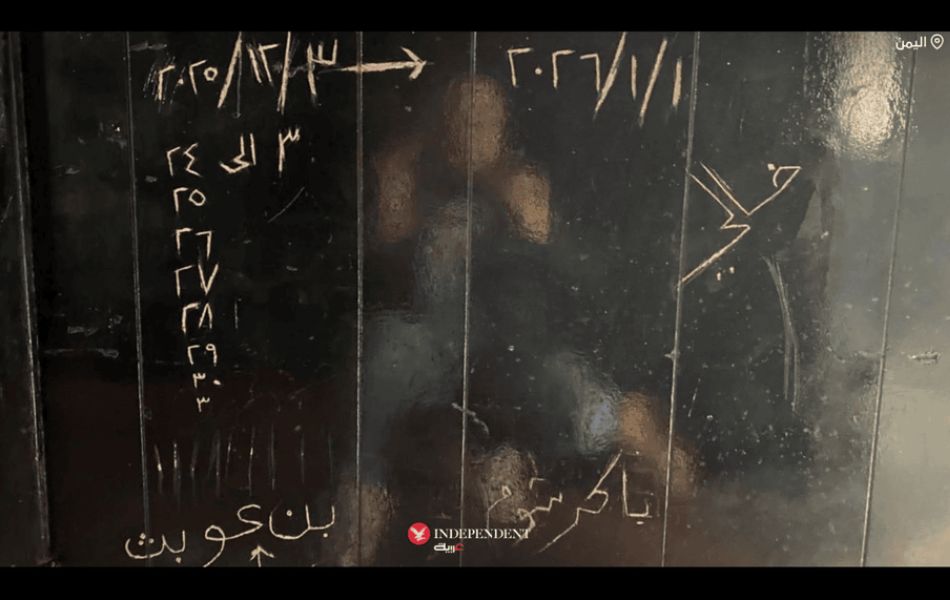
Footage filmed by Yemen Shabab news channel shows a field visit inside what are described as secret prisons previously operated by UAE forces at Al Dhabba oil port. The footage shows detention facilities described as inhumane, including narrow metal rooms and individual cells, in addition to shipping containers said to have been used to hold detainees. According to the report, one of these locations was known as the “dark prison” due to its walls being painted black. The footage and circulated images also show writings, sketches and inscriptions reportedly left by former detainees on the walls, including names, dates, and messages indicating successive periods of detention within these cells.

Screenshot from a Yemen Shabab video reportedly showing the interior of one of the cells, which is painted black. Captured by Yemeni Archive on 28 January 2026.

Image from a Facebook post by Independent Arabia reportedly showing writings and messages left by former detainees on the walls of a cell. Captured by Yemeni Archive on 26 January 2026.
In the same context, Al-Ikhbariya news channel published a report on Al Dhabba detention site in which lawyer and human rights activist Zafaran Zayed stated that the cells discovered in the facility reflect a pattern of detention that lacks the most basic humanitarian standards. She explained that detainees are unable to sit inside these cells due to the extremely limited space, forcing them to remain standing for prolonged periods. She added that the conditions inside these cells, including the absence of ventilation, insufficient access to water, and high temperatures, may result in serious health harm to detainees, with the lack of space potentially causing spinal deformities or other chronic health conditions.

Screenshot from a video by Al-Ikhbariya reportedly showing the interior of one of the narrow cells. Captured by Yemeni Archive on 26 January 2026.
Mwatana documented the detention of at least 11 individuals at Al Dhabba oil port, including five who were subjected to physical and psychological torture, and six cases of enforced disappearance. The organization noted that detainees were not held under judicial orders, and were denied communication with their families or access to legal representation. In one testimony a father of a detainee stated that his son disappeared for two months before it was discovered that he was being held in the facility. According to the son’s account, he was placed in solitary confinement in a small container unit and repeatedly taken to interrogation rooms where he was subjected to beatings, whipping, electric shocks, simulated drowning, and threats of death. He was also reportedly forced to sign and fingerprint documents that he was not allowed to read.
Salem Awad al Rubaizi recounted in an interview with Al Jazeera details of his experience during detention in secret prisons operated by UAE forces in southern Yemen. He stated that he was arrested on 10 June 2019 and transferred first to the Balhaf oil facility in Shabwa Governorate, then to Al Rayan Airport in Hadramout, and Al Dhabba oil port. He reported spending a total of two years in detention before his release. According to his account, he was subjected to multiple forms of physical and psychological torture including electric shocks, beatings including with sticks and electrical cables, forced stripping, suspension by the hands and feet for long periods, water immersion, as well as sleep deprivation and verbal abuse. He stated that these practices took place during interrogation sessions led by Emirati officers. After several interrogation sessions, he was reportedly informed that the reason for his arrest was his opposition to UAE policies in Yemen.
According to Mohammed al Omda, head of the Yemeni Network for Rights and Freedoms, these detention facilities were administered by Emirati officers including an officer known as Abu Ali. Yemeni Archive was not able to identify open-source information directly linking an officer known as Abu Ali to the detention facility at Al Dhabba oil port. The name “Abu Ali” did, however, appear in testimonies from former detainees referenced in SAM’s “The Long Absence” report, which indicate that “Abu Ali al-Emirati” was considered one of the main figures overseeing detention facilities including Waddah Hall, and supervising interrogation and torture methods. Yemeni Archive could not confirm whether the “Abu Ali” referenced in relation to Al Dhabba oil port is the same person referenced in relation to Waddah Hall.
This section presents examples of detention cases in facilities run by STC-linked forces, based on open-source information, to illustrate reported patterns of arrest and detention. These cases were highlighted to reflect the range of individuals affected, including journalists, academics, lawyers, and civil society activists.
Patterns of reported abuses included arrests carried out without judicial warrants, detention in unofficial facilities, alleged cases of enforced disappearance, and the denial of legal safeguards, alongside allegations of torture and ill-treatment.
On 16 November 2023, forces affiliated with the STC allegedly detained lawyer Sami Yassin Qaed Marsh without a judicial warrant, while he was leaving his job at the Supreme Judicial Council and the Judicial Inspection Authority in Khormaksar, Aden. According to a statement issued by SAM Organization, Marsh was subjected to ill-treatment and physical assault during his arrest.
During his detention, he was reportedly denied access to food, water, and medical care, and was prevented from practicing his profession or communicating with his clients. Following his arrest, Marsh was transferred to Al Nasr camp in Aden, an unofficial detention facility under the control of the Security Belt Forces, where he was reportedly held for approximately four months without formal charges or access to his family or legal representatives. On 6 March 2024, he was transferred to Bir Ahmed prison in Aden.
During his detention in Bir Ahmed, a leaked image emerged purportedly showing him receiving treatment in a hospital in Aden, raising concerns about his health condition. No public documentation indicates that formal charges had been filed against him or that he had appeared before an independent judicial authority during that period.
On 29 November 2023, his lawyer submitted a complaint to the Public Prosecution Office requesting an investigation into the assault and detention. However, a member of the prosecution was reportedly prevented from meeting him at Al Nasr camp. Family sources also reported that on 14 December 2023, a security force had raided Marsh’s home and office without presenting a search warrant, confiscating personal and professional files, and summoning his wife for questioning two days later.
On 24 July 2024, the Specialized Criminal Court in Aden issued an order for his release after approximately nine months of detention. According to an August 2024 statement by his family, interference by the commander of the Security Belt Forces prevented the enforcement of the release order. As of drafting this investigation, Yemeni Archive has not found any information relating to his release.

An image of lawyer Sami Yassin Qaed Marsh published by Al Masdar Online. Captured by Yemeni Archive on 17 February 2026.
On 6 August 2022, armed individuals raided the home of journalist Ahmed Maher in Dar Saad district, Aden, and reportedly took him to an unknown location before transferring him to Dar Saad police station and later to Bir Ahmed prison.
According to his accounts, during his detention Ahmed Maher was subjected to ill-treatment and physical and psychological torture. This included beatings, electric shocks, being forced to stand for prolonged periods, simulated execution, and threats of harm against his family. He stated that these abuses resulted in physical injuries including a fractured jaw and ribs, as well as a stomach injury that caused bleeding. His brother Miyas stated that Ahmed was deprived of sleep during the first 30 hours of detention.
Maher stated that he was coerced into giving recorded confessions that were later published on platforms affiliated with security actors (hyperlink removed for privacy, but material archived). The Yemeni Journalists Syndicate reportedly rejected the validity of these confessions, stating that they were extracted under torture. Maher also reported that he was forced to make confessions without the presence of a lawyer, during a period of enforced disappearance that lasted approximately one month.
The available information indicates that, following his detention, the case was referred to the prosecution and later brought before the Specialized Criminal Court. The prosecution later reopened the investigation following an appeal by his defense lawyer citing procedural violations. However, he was subsequently charged with “disturbing public order through his posts on social media”. During the course of the trial, hearings were postponed more than seven times due to the prison refusing to transport him to the court.
Maher announced a hunger strike in protest of his continued detention and his inability to attend court sessions, calling for an investigation into his treatment and for access to court. He reported that his health condition deteriorated.
In December 2024, the Specialized Criminal Court of Appeal in Aden issued a ruling acquitting him of all charges, and he was released in January 2025 after approximately 28 months in detention.

An image of journalist Ahmed Maher posted by military writer and analyst Khaled Al-Nasi. Captured by Yemeni Archive on 17 February 2026.
On 20 July 2020, forces affiliated with the STC reportedly detained academic Dr. Taher Abdullah Abduljabbar Salem al-Qubati at Al Alam checkpoint east of Aden. He was later transferred to Al Mansoura prison in Aden, where he was accused of “attempting to orchestrate a coup”.
In November 2020, his family reported his disappearance from Al Mansoura prison, describing what occurred as a forced transfer to an unknown location. According to the family’s account, a commander named Awsan al Anshali arrived at the prison accompanied by armed personnel, and al-Qubati was taken despite the Criminal Prosecution’s issuance of a release order on guarantee. The family also stated that the implementation of the release order had faced delays by the prison administration. The family’s lawyer held the prison administration responsible for his disappearance, considering that handing over a detainee to an unknown entity constitutes a legal violation. The family called on the Public Prosecutor to disclose his whereabouts.
According to a statement issued by SAM Organization, al-Qubati’s family was not allowed to visit him during his detention. The statement, citing sources close to the case, indicated that he was held in facilities affiliated with the Saudi-UAE coalition forces, where he was subjected to ill-treatment including solitary confinement, torture, and denial of communication and medical care.
On 26 January 2021, Dr. al-Qubati was released following calls and statements issued by community leaders and residents of Al Qubaita district in Lahj Governorate.

An image of academic Dr. Taher Abdullah Abduljabbar Salem al-Qubati published by Al Mushahid. Captured by Yemeni Archive on 17 February 2026.
In 2017, Mohammed Hamoud Mabkhout Dhaifallah Muharram, from Beit al Subai village in Al Radmah district, Ibb Governorate, disappeared after being detained in Aden by armed individuals affiliated with Dar Saad Security Department.
According to a statement issued by the American Center for Justice (ACJUS), Muharram worked in the construction sector, and his detention was preceded by a verbal altercation with a guard and the owner of the building where he was employed, after which he was taken by armed personnel. The director of the Dar Saad police station in 2017, Adnan Ali bin Ali, was in the same year a member of the STC's National Assembly.
According to ACJUS, Muharram was initially taken to Bir Ahmed prison. Since then, his family has reported no information regarding his place of detention or legal status. They have submitted complaints to local and international human rights bodies calling for clarification of his fate, and ACJUS has called for his release or for the disclosure of his place of detention and any procedures taken against him. In a video posted in February 2026, Muharram’s mother stated that after nearly ten years she still does not know where he is, after searching multiple prisons. She called on the government to provide information and help secure his release. Yemeni Archive has not found any available open-source information such as official statements clarifying the charges against him or indicating that he has appeared before a judicial authority.

An image of Mohammed Hamoud Mabkhout Dhaifallah Muharram published by Yemen Shabab. Captured by Yemeni Archive on 17 February 2026.
On 1 April 2025, personnel affiliated with the Security Belt Forces raided the home of political activist Sheikh Anis Saad Nasser al-Jardami in Al Buraika district, and detained him. This reportedly followed audio recordings attributed to him criticizing the STC and its president Aidarous al Zubaidi, according to local sources and posts on social media.
According to his family’s accounts, al-Jardami was taken to Al Nasr camp, a detention facility operated by Security Belt units, where he was held for more than two months without communication with his family or lawyer. The family stated that they were only permitted to visit him once.
In June 2025, al-Jardami’s health deteriorated and he was transferred to Aboud Military Hospital and later to the Modern Arab Hospital in Al Mansoura district, before his death was announced on 9 June 2025. His family attributed his death to ill-treatment, torture and medical neglect during his detention. The Security Belt Forces denied that al-Jardami had been subjected to arbitrary detention or torture; they had previously stated his detention was carried out in accordance with judicial directives, without providing further details.
In a video, his brother stated that Anis al-Jardami had been assaulted inside the detention facility, and accused the commander of the Security Belt Forces in Aden, Jalal al Rubaie, of assaulting Anis al-Jardami during the family’s only visit. He also stated that his brother had fallen into a coma before being transferred to hospital.
Sheikhs of the al-Jardami tribe issued a statement calling for legal accountability for Sheikh Anis al-Jardami’s detention and death. The General Command of the Security Belt Forces expressed condolences to al-Jardami’s family, and also called for an investigation. Human rights actors, including Women Journalists Without Chains, stated that the procedures followed in the case raise questions regarding due process guarantees.
Al-Jardami’s son, Saad Anis al-Jardami, stated that he had pursued the case before judicial authorities for several months without progress, confirming that his father had not been presented before an independent judicial authority prior to his death. He also stated that he was not allowed to see his father’s body except after submitting a formal request to the Security Belt leadership.
In November 2025 it was reported that the Public Prosecution had conducted a forensic medical examination on al-Jardami’s body, and found that he died of natural causes with no grounds for suspicion .

An image of Sheikh Anis Saad Nasser al-Jardami published by Sawt al-Asima. Captured by Yemeni Archive on 17 February 2026.
Fatima Saleh al-Qahali, a 48 year-old teacher from the capital Sana’a and a mother of three, was reportedly detained and tortured during a trip to Aden on 12 October 2021. According to an interview broadcast by Al Masirah (a media channel affiliated with the Houthis) and documented by Insan Organization for Rights and Freedoms, al-Qahali had traveled to Aden to obtain a passport in order to donate a kidney to her brother Ibrahim, who suffers from kidney failure.
She reported being abducted in front of Al Sadaqa Hospital in Aden, when a vehicle carrying armed individuals affiliated with the STC arrived and took her to the Criminal Investigation Prison in Khormaksar district. She stated that during her detention she was subjected to multiple forms of physical and psychological torture, including beatings, flogging with electrical wires, electric shocks, and threats of death, in addition to verbal abuse during interrogation. She added that the severity of torture and exhaustion caused her to lose consciousness.
Al-Qahali stated that her release came after those in charge of the detention facility contacted her family and demanded payment in exchange for her release. Her son stated that a tribal figure paid approximately 10,000 USD to secure her release. He added that when he received his mother after her release, she was in a severely deteriorated physical and psychological condition, suffering from temporary memory loss and unable to recognize him.
According to documentation by Insan, the reason for her abduction was the presence of a sticker on her bag bearing the phrase “لبيك رسول الله ” - “Labayka ya Rasul Allah” (Arabic for “Here I am at your service, O Messenger of God”). Al-Qahali also noted that she had a pre-existing bipolar disorder, and that the torture she experienced contributed to the deterioration of her health condition. After her release on 31 October 2021, she was transferred to a psychiatric facility in Sana’a, where she received treatment for the psychological and physical effects of her detention.

An image of Fatima Saleh al-Qahali published by Insan Organization, purportedly showing photos of injuries sustained during her detention. Captured by Yemeni Archive on 28 February 2026.
Ali Hassan Baqtiyan, director of a development organization in Mukalla, was reportedly detained at Al Rayan Airport for more than 100 days in 2016 following a wave of arrests targeting workers in civil institutions. He described being arrested without a warrant, held initially in an intelligence facility, and later transferred to detention sites at Al Rayan Airport, where detainees were reportedly held in metal containers under harsh conditions, including overcrowding, constant illumination, and restricted movement.
Baqtiyan described interrogation practices involving attempted coerced accusations, alongside psychological and physical abuse and other ill-treatment. He further stated that other detainees, including minors, were held under the same conditions, and that access to basic services including toilets was restricted. According to his account, he was released after a few months, but rearrested in January 2017 and detained again under similar conditions, first in Al Rayan Airport and later at the Central Prison. Despite a court ruling ordering his release in February 2018, his detention continued until March 2019.

A screenshot showing Ali Hassan Baqtiyan from a video published by Yemen Plus on YouTube. Captured by Yemeni Archive on 2 March 2026.
This report, based on open-source investigations and analyses conducted by Yemeni Archive in collaboration with SAM Organization, indicates that human rights abuses in detention facilities in areas formerly under the control of the STC do not appear limited to isolated incidents, but rather point to a recurring pattern of alleged violations. These reportedly include detention outside judicial frameworks, enforced disappearance, ill-treatment, physical and psychological torture, the denial of basic legal guarantees, and continued detention after official orders for release.
Oopen-source material indicates the use of multiple types of unofficial detention sites, including military facilities, an airport, and economic infrastructure. Analysis of case studies also indicates a pattern of disputes between official authorities and STC-affiliated armed groups that may have resulted in unlawfully prolonged detentions.
While the information available in open-sources does not always provide a complete account of all details of the cases including those responsible, it allows for the development of a preliminary and broader understanding of the nature and patterns of these violations. It also supports the identification of locations, individuals, and entities that have been repeatedly referenced across testimonies and reports. This investigation underscores the importance of continued monitoring, documentation, and verification of these allegations, in support of future efforts toward accountability and justice, and to preserve the accounts of victims, survivors, and their families from loss or denial.