

Thursday, 27 November
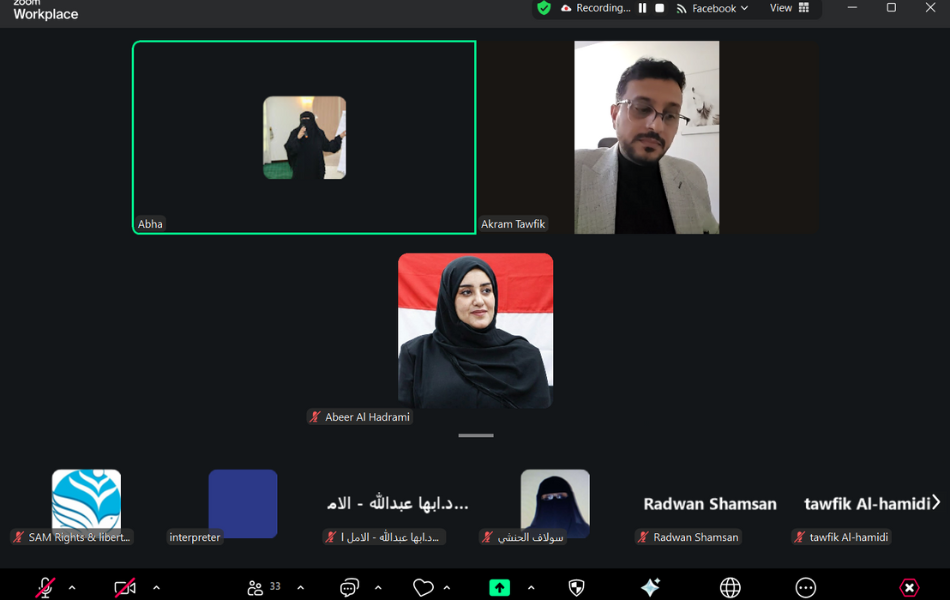
The Transitional Justice Forum—represented by SAM for Rights and Liberties, the Abductees' Mothers Association, and the DT Institute—organized an awareness webinar on Thursday, 27 November, titled “The Role of Art in Supporting Transitional Justice.” The event brought together a distinguished group of artists, intellectuals, and human rights advocates, and was moderated by Dr. Akram Tawfiq, who introduced the webinar’s context and opened the discussion for speakers and attendees.
The webinar hosted Abeer Mohammed Al-Hamiri, Director General of Culture in the Hadramout Coast region, who spoke about the importance of fine and visual arts in preserving collective memory and their role in alleviating war-related trauma. She emphasized that art is an effective human tool within the transitional justice process.
Novelist Hameed Al-Ruqaimi, winner of the 2025 Katara Prize for Arabic Novel, also participated, highlighting the role of fiction in documenting Yemenis’ suffering during the war. He stressed the importance of supporting writers and novelists to capture Yemen’s lived experiences, including diaspora stories that hold hundreds of powerful human narratives.
Dr. Abha Abdullah Awadhan, Chairwoman of Al-Amal Cultural, Social and Women’s Foundation, delivered a presentation on the experience of the song “Where Is Justice?” and the challenges faced by critical art in restrictive environments. She underscored the need to allow artistic expression to play its natural role in raising awareness, documenting realities, and supporting victims.
On behalf of Mr. Maher Al-Absi, who was unable to attend due to exceptional circumstances, Tawfiq Al-Hamidi discussed the Memory Museum initiative in Taiz, describing it as one of the pioneering artistic efforts serving transitional justice. He highlighted the documentary value of artistic works in preserving victims’ testimonies and resisting collective amnesia.
At the beginning of the webinar, SAM’s President Tawfiq Al-Hamidi welcomed the participants, emphasizing the importance of the event in fostering discussions that go beyond traditional political and legal frameworks, and in showing art as part of the human rights narrative and a space for community healing.
The webinar also featured a listening session of the song “Yemen of Justice,” produced by Al-Amal Foundation, followed by an open discussion that saw strong engagement from participants on the role of the arts in building awareness, preserving memory, and supporting truth and justice efforts.