

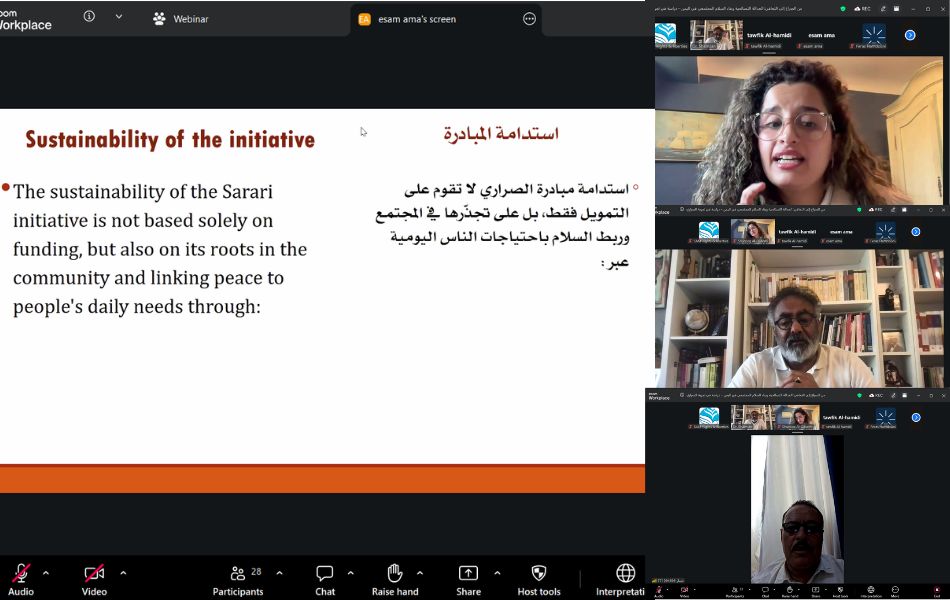
SAM Organization for Rights and Liberties, in partnership with the Abductees’ Mothers Association and the DT Institute, held a specialized seminar titled “From Conflict to Recovery: Restorative Justice and Peacebuilding in Yemen,” as part of the SPARK project supported by the DT Institute. The event was hosted by the Transitional Justice Ambassadors Forum and aimed to showcase the experience of Al-Sarari area in Taiz Governorate as a pioneering model for resolving local conflicts.
The seminar featured a policy paper titled “From Hybrid Conflict to Recovery Model in Al-Sarari Village: Toward a Roadmap for Community-Led Restorative Justice and Peacebuilding.” A distinguished group of speakers participated, including Dr. Abdulbaqi Shamshan, Professor of Political Sociology; Mr. Abdullah Jassar, Head of the Consensus and Reconciliation Committee in Taiz; and Mr. Essam Al-Sabri, SPARK Project Manager. Ms. Najla Fadel presented the policy paper on behalf of researcher Abdulghani Al-Hayajim.
Conflict Context in Al-Sarari and the Area’s Symbolism
At the outset, the seminar emphasized the complexity of the Al-Sarari case in Saber Al-Mawadem District, noting that it was addressed with great caution—not to deny facts or undermine victims’ rights, but to understand and deconstruct the roots of the conflict. The moderator highlighted that Al-Sarari represents a microcosm of Yemen’s fragmented social fabric. Its strategic military location near the besieged city of Taiz, combined with its Zaydi demographic identity, has made it a focal point of what was described as a “hybrid conflict.”
The seminar explained that this layered conflict involved overlapping horizontal sectarian divisions and vertical political and military divisions, evolving through phases of ideological polarization (2011–2014) and culminating in full militarization and armed confrontation in August 2016.
Failure of the National Project and Rise of Sub-Identities
Dr. Abdulbaqi Shamshan noted that reconciliation is deeply rooted in Yemeni and traditional societies through community and tribal mediation. However, he stressed the need to regulate such interventions so they complement transitional and judicial justice.
He identified the fundamental cause of local conflicts as the “failure of the Yemeni national project,” which led to the rise of sub-identities (region, tribe, sect) as alternatives to the state in providing protection. He added that unequal development and the state’s inability to integrate diverse identities into a unified national identity have fostered exclusion, prompting groups to express themselves through conflict, particularly when central authority weakens.
Political Investment in Historical Conflicts
Dr. Shamshan further explained that political actors—particularly the Houthi group and Ali Abdullah Saleh—have strategically invested in local conflicts to build alliances and weaken rivals. He cited an example of a conflict in 2010 rooted in grievances dating back 136 years, illustrating how historical injustices from the era of Imam Yahya were revived and instrumentalized in contemporary disputes over land and influence.
He noted that the Houthis leveraged historical grievances such as “Mazlamat Bakil” against Hashid, a pattern repeated in Al-Sarari by exploiting perceptions of marginalization or superiority and transforming local disputes over water and land into sectarian conflicts.
Conflict Mapping and the Need for Transitional Justice
Dr. Shamshan stressed Yemen’s urgent need for a “conflict map”—an analytical study of its geography to determine where disputes can be resolved through mediation and where they cannot. He revealed that earlier studies had classified Taiz as a “zero-conflict zone,” but the absence of rule of law exposed hidden tensions that erupted suddenly.
He warned that Yemen is burdened with national and personal vendettas and sectarian conflicts, necessitating transitional justice processes that require both state and group consent to cleanse collective memory. He also cautioned against the misuse of reconciliation mechanisms in corrupt environments, where mediation could be exploited for personal gain or override individual rights within coercive tribal settlements.
Experience of the Consensus and Reconciliation Committee in Taiz
Mr. Abdullah Jassar highlighted the practical experience of the Consensus and Community Reconciliation Committee in Taiz, noting that social fragmentation and rising violence created a pressing need for mechanisms to address criminal and water-related disputes.
He clarified that the committee is not a substitute for weak state institutions but a supportive mechanism. It has successfully resolved longstanding disputes in Al-Shamaytain and other districts by involving local authorities and security agencies. He also pointed to a fully successful reconciliation case in Mushara’a and Hadanan involving Bayt Al-Rumaima, which the committee seeks to replicate in Al-Sarari.
Restorative Justice as a Transitional Option
Jassar described restorative justice as the “most feasible” option under current conditions, given the difficulty of implementing transitional or criminal justice amid insecurity and the presence of fugitives. He noted that communities tend to favor this approach because it involves victims, community leaders, and elders, and delivers tangible results quickly.
However, he acknowledged major challenges, including the militarization of society, the need for psychological support for affected individuals, and political and sectarian incitement—particularly in conflict zones influenced by the Houthis.
The SPARK Initiative in Al-Sarari: Methodology and Impact
Mr. Essam Al-Sabri presented details of the restorative justice initiative in Al-Sarari, implemented between September and December 2025. The initiative adopted a participatory methodology combining dialogue and psychosocial support.
It included focus group sessions with 18 victims and displaced persons, dialogue sessions with 14 community leaders and teachers, and psychosocial support sessions for 20 women from both sides. He confirmed that the initiative helped reduce tensions, break negative stereotypes, and foster a strong willingness among participants to move beyond the past and establish a sustainable reconciliation framework.
Community Code of Honor and Challenges to Adoption
Al-Sabri noted that the initiative produced a draft “Community Code of Honor” emphasizing social cohesion and peaceful conflict resolution. However, its formal adoption was hindered by political and security sensitivities.
He explained that misinformation campaigns by actors linked to external agendas contributed to misunderstandings about the code, preventing its signing. Despite this, the initiative had a significant impact in bringing conflicting parties together. He added that the Al-Sarari experience is replicable in other conflict-affected areas, provided there is community support and backing from local authorities.
Policy Paper: The “Deadly Triangle” and Cost of Conflict
The Abductees’ Mothers Association presented a summary of the policy paper, identifying a “deadly triangle” in Al-Sarari: state collapse, economic deterioration, and sectarian polarization.
The paper highlighted that the conflict led to the forced displacement of more than 150 families, destruction of seven schools and a health unit, and systematic looting of homes. It also noted that the lack of education and employment opportunities pushed students into armed conflict.
The conflict in Al-Sarari was further politicized and militarized through proxy warfare, with the Houthi group turning the village into a military base due to its strategic location, while surrounding communities aligned against this development.
Roadmap for Recovery: Three Pathways
The policy paper proposed a “theory of change” centered on empowering local actors and integrating justice with development, outlining three pathways:
The paper emphasized key conditions for success, including genuine political will, neutralizing spoilers, and ensuring flexible, long-term donor funding.
Critical Perspectives on Sustainable Local Peace
In closing remarks, Dr. Shamshan argued that restorative justice cannot be applied to groups pursuing power restoration or ideological projects, as such conflicts transcend local grievances.
Mr. Jassar expressed concern over the risk of “fragile peace” dependent on external funding, stressing that lasting peace requires a strong state, effective security institutions, and a fair judiciary trusted by victims.
Voices from the Community
The seminar concluded with remarks by Dr. Tihani Al-Junaid, a native of Al-Sarari, who emphasized that the initiative did not fail despite the unsigned code of honor. She noted that bringing conflicting parties to the same table—once nearly impossible—was itself a major success.
She added that the primary goal is to support families currently residing in the village by ensuring access to education, healthcare, and sustainable livelihoods, بعيدًا عن تجاذبات أطراف الصراع.
The moderator concluded by noting that such discussions open new avenues for testing theoretical concepts in practical contexts to advance sustainable peacebuilding in Yemen.