

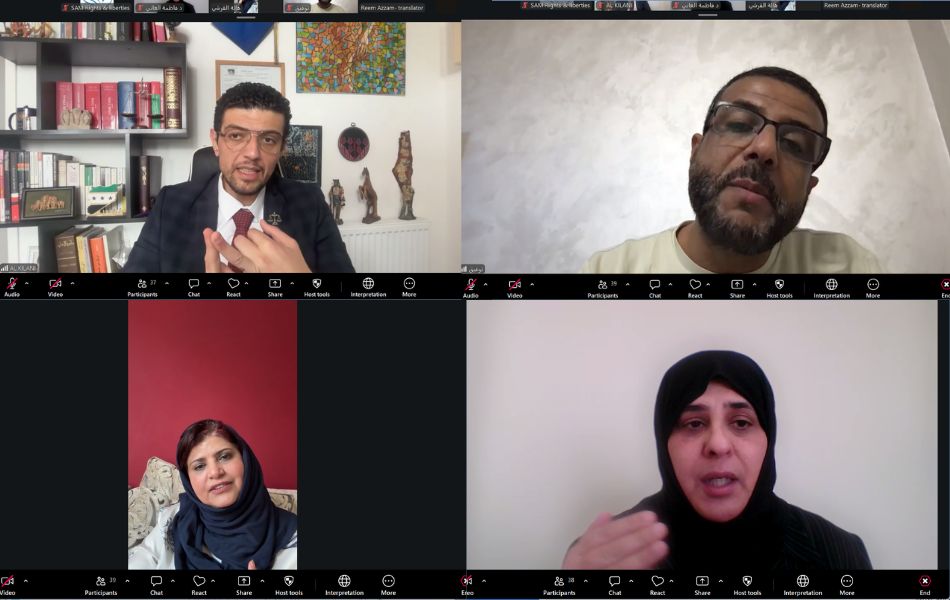
SAM Organization for Rights and Liberties, in cooperation with the Association of Mothers of the Abducted, held a seminar on Tuesday, April 28, titled: “Lessons from Iraq and Syria for Building Peace in Yemen: How Politicization and Division Threaten Transitional Justice.” The seminar was part of the SPARK project supported by DT Institute.
The seminar opened with remarks by Tawfiq Al-Humaidi, President of SAM, who explained that although transitional justice in Yemen may appear to be a postponed issue, it is in fact a necessary condition for moving beyond war toward peace.
Al-Humaidi emphasized that transitional justice is not merely trials, compensation lists, or technical procedures detached from society. Rather, it is a comprehensive process involving accountability, institutional reform, and guarantees of non-repetition, ultimately aimed at rebuilding trust between citizens and the state, as well as among communities fractured by war and division.
He noted that regional experiences show how this process can be derailed when reduced to revenge, manipulated as a political tool, used to exclude opponents, or managed through dominance rather than fairness.
He clarified that the seminar does not present Iraq or Syria as ready-made models for Yemen, but rather as critical mirrors that help identify risks before they occur. The key question, he said, is not only how to manage consequences, but how to build a form of justice that prevents future violations, restores victims’ dignity, preserves society’s right to truth, and prevents memory from becoming fuel for further conflict.
He added that the seminar seeks to collectively reflect on a Yemeni model of transitional justice that is independent, inclusive, and non-selective—one that is not imposed over victims but built with them, and that serves truth, peace, and the rule of law rather than political interests.
The seminar featured Judge Hala Sultan Al-Qurashi, a Yemeni judge with experience in the Ministry of Justice, particularly in women’s affairs and child protection, as well as in justice system reform projects. She has served as a primary court judge, is a founding member of the Association of the Families of the Disappeared, and a member of Yemen’s Supreme Commission for Elections and Referendum.
Also speaking was Mutasim Al-Kilani, a Syrian lawyer specializing in international criminal law and human rights since 2012. He has contributed to documenting war crimes in Syria and preparing legal cases used in European courts under universal jurisdiction. He is also active in media, research, and training across Syria, Somalia, Sudan, and other countries.
Fatima Al-Ani from Iraq, an advisor at the Iraqi Center for Documentation and War Crimes, also participated. She is a human rights activist who has worked on documenting war crimes against civilians and engaging with international bodies to help stop such violations.
The discussion began with Yemen, addressing Judge Al-Qurashi on how to conceptualize a transitional justice process amid political division, multiple power centers, and low trust—one that places victims at the center and balances accountability with reconciliation without becoming a tool for politicization or exclusion.
Judge Al-Qurashi responded that transitional justice is a personal demand for her, as she is herself a victim of her father’s enforced disappearance. She noted that several attempts since 2010 led to a draft transitional justice law, but it faced politicization because those responsible for past violations remained in power.
She highlighted the immunity granted to former president Ali Abdullah Saleh, describing it as a purely political decision that ignored victims’ suffering and their right to truth. As a result, transitional justice efforts concerning the period from 1962 to 2011 were effectively halted.
Judge Al-Qurashi explained that while a commission was established to investigate violations after 2011, earlier victims were largely ignored due to political pressure, since many actors involved in violations were part of the political process.
She stressed that victims did not remain silent, but the legal process stalled until the events of 2015. After that, she said, it felt as though an entire nation had been forcibly disappeared—not just individuals—prompting her to rethink transitional justice in connection with reconciliation, given the scale of violence since 2015.
When asked about overcoming these challenges, she emphasized that efforts must start from the ground up: documenting violations, listening to victims and witnesses, and building a comprehensive database. Yemen, she said, is still bleeding, and violations continue, making grassroots work essential.
She added that pre-2011 transitional justice remains completely neglected, while post-2011 victims have some recourse through courts and investigative bodies, particularly in liberated areas.
However, earlier victims—including those of burned protest sites—remain overlooked. She noted that a proposed transitional justice law had included victim representation within a dedicated commission, alongside judges, lawyers, and activists. This was a key demand during the 2011 uprising, when civil activism was strong, but parliament ultimately rejected it.
Judge Al-Qurashi highlighted the strength of civil society in Yemen, noting that many organizations host discussions on transitional justice. However, she distinguished between civil efforts and the state’s legal and political framework, which continues to delay action.
She recalled how, in 2011, victims protested, painted images of the disappeared on Sana’a’s walls, and demonstrated outside the president’s residence—pressure that led to drafting transitional justice proposals. Although the National Dialogue outcomes prioritized such laws, political divisions and fear of accountability prevented their adoption.
Nevertheless, she affirmed that civil society continues to document violations and advocate for victims, helping amplify their voices.
The discussion then turned to Iraq. Dr. Fatima Al-Ani was asked about how political division and the absence of a unified national framework have affected transitional justice since 2003.
She explained that ongoing political deadlock—such as the inability to agree on a prime minister—has hindered justice. Political parties’ deep entrenchment in state institutions, including the judiciary, has led to manipulation of justice mechanisms.
According to sources and victims, prison cases, executions, and arrests are often used as bargaining tools. Innocent and weak individuals are targeted, while those with power, party backing, or militia protection enjoy impunity.
Dr. Al-Ani stated that politicization began with organized acts of revenge against professionals, leading to the exclusion and forced displacement of skilled individuals capable of advancing justice.
She noted that members of political groups and militias were integrated into judicial and executive institutions, enabling arbitrary arrests without warrants and protecting perpetrators affiliated with these groups.
She cited an example during Prime Minister Al-Kadhimi’s tenure, where a militia member arrested for a crime was released within hours, followed by a show of force in the streets—signaling militia dominance.
She further described a climate of intimidation, violence, and assassinations targeting journalists and outspoken individuals, leading to what she termed “shadow governments” that suppress dissent and control narratives.
Syria: A Legacy of Violations and the Beginnings of Justice
The discussion then moved to Mr. Mutasim Al-Kilani from Syria, who was asked about the Syrian situation, where justice remains in its early stages despite the establishment of institutions by presidential decrees, as well as the presence of multiple actors and overlapping agendas. The question focused on key indicators that might reveal early risks of transitional justice deviating from the interests of victims and becoming selective or politicized, in addition to an evaluation of the initial phase of the justice process in Syria.
Mr. Al-Kilani stated that Syria has suffered for fifty-four years—not just fourteen—from grave violations affecting human rights and international human rights law. These violations, he noted, included torture, abduction, and extrajudicial killings. He recalled a saying in Damascus: “the walls have ears,” reflecting the climate of fear where individuals could not speak about politics without risking disappearance.
He pointed out that the Syrian revolution began peacefully, and that the former regime itself acknowledged during the first six months that there was no armed resistance. Nevertheless, approximately 12,000 people were killed during that period due to the regime’s repression of protesters. While he emphasized that, as a human rights advocate, he does not support militarization, he noted that it became understandable for Syrians to take up arms against the regime.
Al-Kilani explained that by April 2012, the conflict in Syria had evolved into a non-international armed conflict, with the former regime employing various types of weapons. He added that Russia not only used weapons in Syria but also filmed their use to market them in arms exhibitions. He also referred to Iraqi, Iranian, and Lebanese militias, describing them as sectarian in nature and used by the regime to fight the Syrian people.
He highlighted the vast number of victims, noting that Syrian human rights organizations had documented around 185,000 missing persons before the fall of the regime. Of these, only 17,000 were released following the liberation of prisons. He also referred to tens of thousands who reportedly died under torture in detention.
He stressed that this immense legacy required a genuine national strategy for transitional justice to provide redress to victims and their families, emphasizing that transitional justice efforts in many countries fail when they overlook victims’ rights.
Al-Kilani described transitional justice as the only gateway for building peace and establishing a new social contract in Syria. However, he pointed to significant delays in launching such a process, which he said had resulted in hundreds—if not thousands—of revenge killings.
He expressed skepticism about the notion that stability could be achieved without transitional justice or accountability for war crimes. He stated that he could neither convince himself nor victims’ families to forgive perpetrators in the absence of justice.
He added that since May 2025, following the establishment of the National Transitional Justice Commission by presidential decree, the process has been significantly diluted. According to him, there have been no clear or meaningful steps forward. While public pressure has pushed the Ministry of Justice to initiate accountability measures, he believes that the Commission itself has been sidelined due to this lack of direction.
He attributed this “dilution” to two main factors: weak institutional capacity within the Commission and the absence of a clear vision. He advised that Yemen, when designing its own transitional justice framework, should avoid creating bodies that are disconnected from victims, noting that in Syria the Commission remains distant from victims and merely consults them rather than involving them meaningfully.
The discussion returned to Judge Hala Al-Qurashi, who was asked about the foundations for designing a transitional justice process in which victims are central, especially in light of the large number of victims resulting from the war.
She reiterated that the draft transitional justice law submitted to parliament had included a commission with representation from victims, alongside judges, lawyers, activists, and victims’ families. This was a key demand during the 2011 uprising, when civil activism was strong and victims’ voices were prominent. However, parliament rejected this proposal.
She noted that organizations such as the Association of Mothers of the Disappeared and Detainees continue to advocate for these demands, but that the ongoing conflict and political divisions currently overshadow human rights advocacy.
Dr. Fatima Al-Ani was asked about the negative impacts of politicization and division in Iraq on victims, and what Yemen could do to avoid repeating Iraq’s experience.
She responded that civil peace is inseparable from justice for victims. Given the diversity of Arab societies—comprising various sects, religions, and ethnic groups—she emphasized the need for a strong state that unites all under a common framework.
She stressed that this should not come at the expense of victims’ rights. Instead, a robust legal process must be established from the outset to document violations and ensure accountability, avoiding random acts of revenge. Crimes, she noted, should be categorized by severity, distinguishing between large-scale atrocities and lesser offenses.
She also emphasized the importance of allowing victims and their families sufficient freedom to file complaints, organizing these complaints systematically, and aligning existing laws with emerging forms of crimes—such as enforced disappearance, which many legal systems still fail to adequately define.
Dr. Al-Ani explained that Iraq ranks first globally in the number of enforced disappearances, according to her account. This has made the issue central to discussions on justice in Iraq.
She pointed out the absence of a clear legal definition and proper handling of the rights of victims of enforced disappearance. Currently, a disappeared person is recorded, and after three years, they are declared a martyr and their family receives compensation. She questioned what would happen if such a person reappeared.
She stressed the need to legally define enforced disappearance as distinct from kidnapping, explaining that it involves state actors detaining individuals whose fate remains unknown.
She called for laws addressing this crime, continued compensation for families until the fate of the disappeared is determined, and the development of institutional capacity—both judicial and societal—to handle such cases. She also emphasized the importance of reassuring victims’ families that their rights will be restored and that impunity will not be tolerated once crimes are proven.
Syrian Advice for Yemen
Regarding the strengths and weaknesses he observes in the Yemeni experience, and what Yemenis should avoid in order to build a solid transitional justice process, Al-Kilani stated that the most important point is that the concept and philosophy of transitional justice must be centered on victims and their families. He emphasized that victims are not merely the beneficiaries of reparations, but must be actively involved in all stages—planning, implementation, and outcomes.
He added that victims and their families are key actors in transitional justice and warned against accepting the formation of transitional justice bodies that do not include them or civil society organizations that have been engaged in documentation, litigation, and conveying victims’ suffering.
Al-Kilani stressed the importance of a strong legal framework, noting that any transitional justice process in Yemen must align national laws with war crimes and crimes against humanity. He cautioned against prosecuting perpetrators in ordinary courts under standard criminal charges, due to statutes of limitations.
He called for a new penal code, as well as a transitional justice law that clearly defines responsibilities, identifies those who must be held accountable, and determines who should be subject to political exclusion.
He further warned against political settlements that recycle individuals responsible for past violations, as this undermines victims and the very concept of transitional justice. At the same time, he cautioned against repeating Iraq’s experience with political exclusion, noting that the de-Ba’athification process is widely viewed as having contributed to the destruction of the Iraqi state.
He advocated for carefully targeted political exclusion of individuals who contributed to sustaining systems of abuse in Yemen.
He also highlighted the importance of developing a shared national narrative of violations, written by representatives of all segments of Yemeni society. He stressed that the judiciary is the backbone of transitional justice, and if it is corrupt, complicit in violations, or lacks capacity, transitional justice will fail.
While acknowledging that transitional justice is not limited to criminal accountability, he emphasized that holding perpetrators of war crimes and crimes against humanity accountable remains its core. He called for comprehensive judicial reform and retraining of judges in international criminal standards.
Judge Hala Al-Qurashi was asked about legal and institutional safeguards to prevent transitional justice from becoming a tool for political score-settling or legitimacy-building, especially given the return of military officials implicated in human rights reports to senior positions.
She responded that while legal frameworks are essential, passing laws is currently impossible due to the absence of a functioning parliament and political agreement. She explained that laws are top-down instruments, and issues such as enforced disappearance require international conventions and legal recognition—something Yemen lacks, as it has not signed the relevant convention.
She emphasized that any transitional justice body must be established by law to ensure its recommendations are binding, which in turn requires political stability. While civil society can draft laws and propose initiatives, these lack legal force until formally adopted.
She concluded that, given the current absence of a legislative authority, the focus must be on groundwork and preparation.
Judge Al-Qurashi shared a personal example regarding her forcibly disappeared father. She explained that when attempting to conduct legal transactions on his behalf, she is asked for a power of attorney, but when she explains his disappearance, authorities respond that such a concept does not exist legally.
She pointed out that enforced disappearance is not recognized in Yemeni civil or criminal law, and that recognition requires ratification of international conventions, which Yemen has not done.
She also referenced discussions during the National Dialogue Conference on political exclusion and noted that immunity granted to former President Ali Abdullah Saleh and his associates obstructed legal proceedings, including the “Friday of Dignity” case.
Dr. Fatima Al-Ani was asked to compare Iraqi civil society’s role in transitional justice and what lessons Yemeni civil society could draw.
She emphasized that the first principle is not to remain silent about rights. She noted that weakening society strengthens the state, and that a strong society cannot coexist with authoritarian control.
She explained that Iraqi society was weakened through restrictive laws—such as de-Ba’athification laws, laws enabling child marriage, and exclusionary legislation—along with electoral manipulation to sideline certain candidates.
This led to societal fragmentation through intimidation, erosion of education, marginalization of women, and the dismantling of leadership and professional capacity. She stressed that preserving social cohesion is essential, as the fragmentation of Iraqi society along sectarian and ethnic lines strengthened state control.
She urged Yemeni society to remain aware, resist imposed narratives, and learn from others’ experiences. She added that many Iraqi victims cannot access formal complaint mechanisms and instead turn to civil society organizations, which, despite limited results, continue to make gradual progress.
Al-Kilani highlighted the critical role of civil society in supporting victim groups, promoting transitional justice concepts, and advocating for their importance.
He noted that this role becomes even more effective when supported by a national transitional justice body that can leverage civil society’s expertise. He also pointed out similarities across Arab contexts, noting parallels between Yemen, Syria, Tunisia, Egypt, and others.
Drawing from his visits to Rwanda, South Africa, Bosnia, and Morocco, he emphasized the importance of learning from international experiences. He particularly praised Morocco’s model, where civil society organizations formed alliances, drafted laws, negotiated with the government, and helped establish transitional justice frameworks that successfully addressed victims’ grievances.
Al-Kilani warned against creating transitional justice bodies detached from victims and civil society, arguing that such institutions risk becoming politicized rather than serving victims’ needs.
He stressed that appointing individuals without ties to victims or human rights work may unintentionally serve political agendas that hinder justice.
He encouraged studying Arab experiences—especially Iraq’s failures and Morocco’s successes—and noted that if Syria’s transitional justice body had emerged from civil society and victim groups, greater progress would have been achieved.
Judge Al-Qurashi commented on Morocco’s experience, noting its success was due to strong political will. She explained that Morocco adopted a reconciliatory justice model focused on truth-telling, reparations, and institutional reform, rather than criminal prosecutions.
Victims and perpetrators alike appeared publicly to share testimonies, leading to reconciliation without extensive criminal trials. She described it as a model that could inspire Yemen, while acknowledging that each society requires a tailored approach.
In conclusion, speakers were asked to identify key principles and mistakes to avoid.
Dr. Al-Ani emphasized that all crimes must be subject to accountability, and that revenge must be avoided.
Al-Kilani highlighted the central role of victim groups and civil society in shaping transitional justice institutions, stressing the importance of excluding perpetrators of war crimes and crimes against humanity from the process. He also underscored the necessity of strong legal and judicial frameworks.
He warned against discrimination among victims, emphasizing that justice must include all victims without exception. Even if criminal justice faces limitations, at minimum all victims’ rights must be recognized and addressed.
Judge Al-Qurashi identified truth-telling as non-negotiable, followed by reparations, institutional reform, and the writing of history.
During the Q&A session, a question was raised about Iraq’s legislation on enforced disappearance, which applies only to the period from 1968 to 2003, and whether this selective timeframe complicates justice.
Another question addressed the appropriate timeframe for transitional justice in Yemen, noting differing views—ranging from 1962 to 2011—and the challenge of balancing inclusivity with political feasibility.
A participant also asked when a formal transitional justice body might be established in Yemen, recalling that in 2014 the country was close to adopting such a framework following the National Dialogue Conference.
Dr. Al-Ani explained that although Iraq has signed the convention on enforced disappearance, its domestic law has not yet been enacted and lacks a clear definition or compensation framework. The draft law remains subject to political influence.
She described the exclusion of post-2003 cases as a serious flaw, noting that failure to fully implement the law undermines justice, fuels division, and deepens feelings of injustice.
Al-Kilani argued that one of the flaws in Syria’s transitional justice framework is its limited scope, targeting only certain groups and time periods.
He advocated for a comprehensive timeframe covering all phases, actors, and violations, including external influences. He proposed that Yemen’s timeframe should extend from the rule of Ali Abdullah Saleh to the present, ensuring inclusion of all victims and incorporating safeguards for non-repetition.
Judge Al-Qurashi explained that defining the timeframe was one of the most contentious issues in drafting Yemen’s transitional justice law. Political parties pushed to shorten it to avoid accountability, ultimately limiting it to post-2011—a move she described as “farcical.”
She stressed that violations occurred not only under Saleh but across both northern and southern Yemen. For a genuine transition to a rule-of-law state, she argued, the timeframe should extend from 1962 to the present—or at the very least ensure that victims from all periods are not forgotten.