

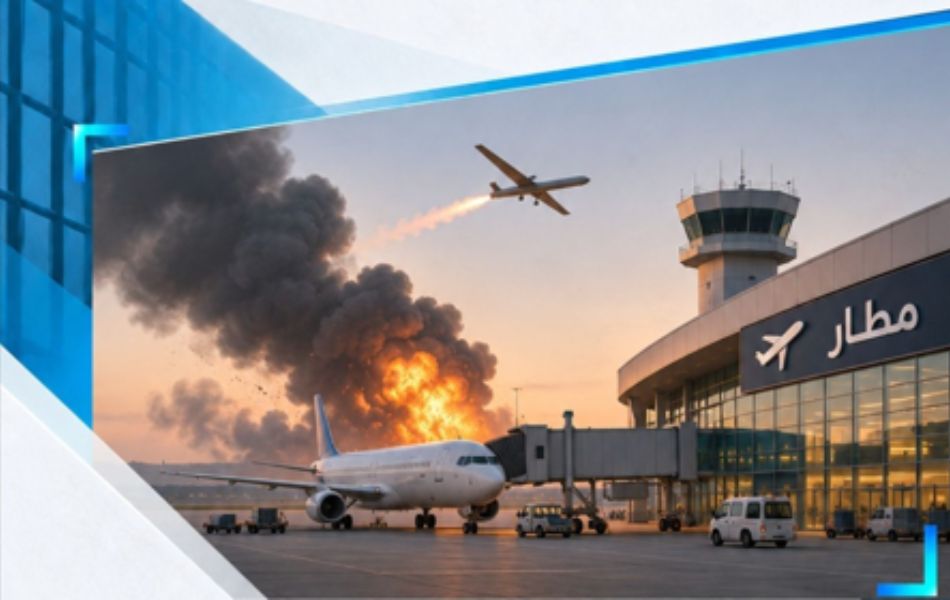
SAM Organization for Rights and Liberties has released the fourth issue of its human rights series "Witness and Impact" (Shahid wa Athar), titled "Civilian Airports Under Fire." This documentary human rights investigation monitors Houthi attacks on civilian airports in Yemen and Saudi Arabia, with a particular focus on incidents occurring in October 2026. The report examines the impact of these attacks on passengers, flight crews, and airport personnel, as well as the resulting disruption to flights and air navigation.
SAM unequivocally condemns the Houthi attacks targeting civilian airports, describing them as a dangerous escalation that has placed civilians and civil aviation in direct jeopardy. The report concludes that repeated strikes carried out while flight operations were ongoing—and while passengers were inside airport terminals and aboard aircraft—reveal a deliberate intent to inflict direct casualties. This constitutes a grave violation of international humanitarian law (IHL), particularly the principles of distinction between civilian and military targets, proportionality, and the obligation to take all feasible precautions to protect civilians.
The report tracks an escalation in the targeting of aviation facilities since July 2026, extending its documentation to the airports of Riyadh, Abha, Dammam, Jazan, and Najran in Saudi Arabia, as well as Aden and Riyan airports in Yemen. It also addresses the context preceding this escalation, including tensions surrounding the Mahan Air flight to Sana'a in July and the subsequent expansion of airport attacks in the following months, culminating in the multiple incidents recorded in October.
Regarding Aden International Airport, the report documents a projectile landing near the runway on October 7, forcing the diversion of an incoming civilian flight from Cairo. On October 16, a Yemenia Airlines aircraft preparing for takeoff was evacuated while another flight inbound from Cairo was in the air. On October 28, the airport was hit by two strikes, according to official Yemeni authorities, prompting the diversion of Aden-bound flights to Djibouti. Analyzing the timing of the strikes and the evacuation warning in that incident, the report notes that the sequence of events raises serious questions regarding the timing and effectiveness of the warning, as well as the adequacy of precautions taken to protect civilians.
In Saudi Arabia, the report presents incidents demonstrating the presence of passengers and families inside airport terminals at the time of the attacks, alongside observations of civilian aircraft during landing phases, taxiing, and takeoff preparations. In particular, it documents the killing of two people and the injury of eight others in an attack on King Fahd International Airport in Dammam on October 21. It also covers attacks or threats targeting other airports, and the accompanying flight diversions, aircraft evacuations, and suspension or cancellation of civilian flights.
The report indicates that the impact of the attacks extended beyond direct physical damage to airport facilities, affecting travel mobility, civilian safety, and the right to freedom of movement and access to essential services. It cites data showing the cancellation of a significant percentage of scheduled departing flights from Riyadh Airport between October 8 and 25, while noting that not all of these cancellations can be attributed to a single specific attack. Furthermore, it explains that airport disruptions exacerbate hardships for patients, travelers, and families, and impede medical evacuations and humanitarian travel.
SAM compiled the investigation by reviewing official statements and air traffic logs, and cross-referencing this data with eyewitness testimonies, published video footage, military statements, and warnings issued by the group. The report utilizes flight logs, aircraft trajectories, and the timing of strikes to assess whether civilian aircraft or gatherings were within the zone of danger, and the extent to which civilian harm was foreseeable.
The report affirms that a civilian airport is entitled to the legal protections afforded to civilian objects, and that the presence of military activity in one part of a facility does not automatically render all of its civilian infrastructure legitimate military targets. Even when a specific military objective is alleged, the attacking party remains bound to verify the nature of the target, assess expected incidental civilian harm, adhere to the principle of proportionality, and take all feasible precautions. Moreover, issuing an advance warning does not absolve the attacker of these obligations, nor does it grant license to target civilians or civilian objects.
Based on the documented facts, SAM asserts that the attacks attributed to the Houthi group endangered passengers, airport staff, and flight crews, violating fundamental norms of international humanitarian law. Deliberate attacks against civilians or civilian objects may amount to war crimes when their legal elements are met; however, establishing individual criminal responsibility requires investigating the intended targets, the nature of the weapons used, orders and the chain of command, and linking military announcements to technical evidence.
The organization holds the Houthi group and its leadership accountable for the attacks proven by evidence to be attributable to them, and demands an immediate and unconditional halt to all attacks on civilian airports in Yemen and Saudi Arabia. It also calls on the competent authorities in Saudi Arabia and Yemen to conduct independent and effective investigations, identify the responsibility of perpetrators, commanders, and planners, hold all those found responsible accountable, and preserve evidence—including air traffic control tower recordings, flight tracking data, ground footage, and projectile remnants and impact sites.
Finally, SAM urges the United Nations, the International Civil Aviation Organization (ICAO), and relevant international bodies to support independent technical investigations, document damages, and adopt measures to protect civilian airports, aircraft, passengers, and personnel, ensuring the safe continuation of civilian and humanitarian flights. It underscores the imperative of delivering redress to victims and their families, guaranteeing their right to truth, justice, and reparation, and preventing impunity for those responsible for these attacks.