

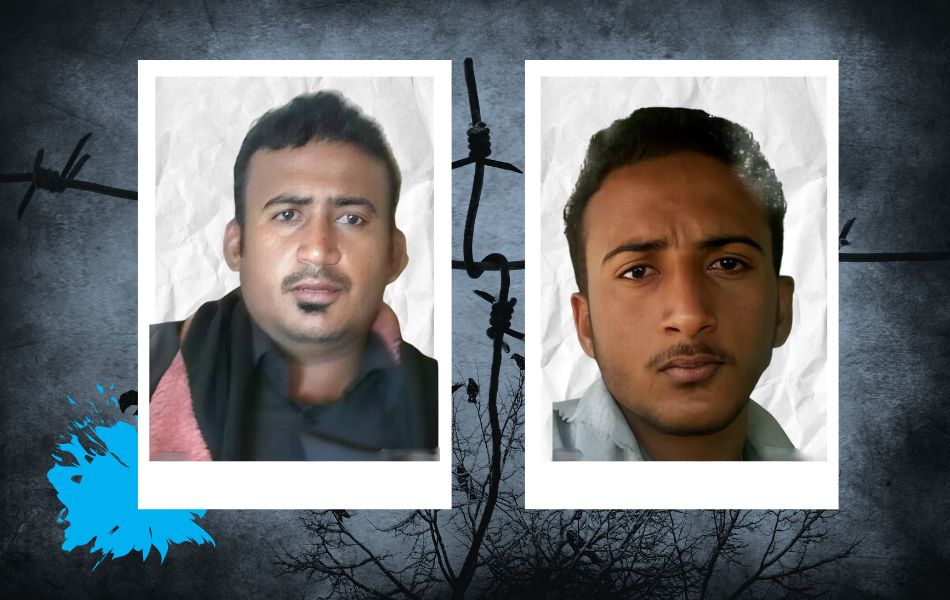
Since 2016, the family of Saeed Omar Miqdah Al-Qumayshi has entered a dark tunnel whose end remains unknown to this day. This time, the loss was not a death that could be mourned or adapted to, but a long-forced disappearance—absence without farewell, without trial, without charges, and without any information to reassure a heart or ease the agony of waiting. An entire household now goes to sleep with a single, sleepless question: Where are they?
That year, the family’s two sons were forcibly disappeared by Aden Security.
Saleh Saeed Omar Miqdah Al-Qumayshi, 24 years old at the time, was a young man at the beginning of his life—married and a family provider.
Mohammed Saeed Omar Miqdah Al-Qumayshi was a minor, no older than 17 according to his father’s statement, while a later account cited a different age—an agonizing reflection of the confusion and disorientation the family has endured for years, when truth is besieged by silence and a parent is left searching for his son amid uncertainty.
The matter did not stop there. In the same context, another minor from Hodeidah—who worked in a restaurant—was also abducted, his disappearance linked to theirs. To this day, nothing is known about him or his fate, and his family has not received a single answer to end this deadly void.
From the moment of the disappearance, all news of the two young men ceased completely. The family was not allowed to visit them, contact them, or even learn their place of detention or legal status. No letter, no call, no news—only a long silence that gnaws at hearts and turns days into endless waiting.
What deepens the tragedy is that the father is not speaking of rumors or unverified accounts. He possesses official receipts proving the detention of his sons, issued by known authorities and officials, including:
Shalal Ali Shaye’ – then Director of Aden Security
Naqib Al-Yahri – Director of Al-Mansoura Prison
Abduldaim – Deputy Director of Aden Security
Despite these documents, the fate of the two young men has remained unknown for seven full years—as if papers are not enough to reveal a human being, and as if disappearance has become a destiny for which no one is questioned.
A Plea from a Broken Heart
In a painful appeal, the father raised his voice to:
King Salman bin Abdulaziz, Custodian of the Two Holy Mosques,
Crown Prince Mohammed bin Salman,
Dr. Rashad Mohammed Al-Alimi, Chairman of the Presidential Leadership Council,
and all participants in the Riyadh Conference.
The appeal was not political, nor a search for privilege, position, or compensation. It was the plea of a simple father saying: “I ask you to stand with me to reveal my children.”
One demand only: the truth. Are his sons alive or dead?
A Family Ravaged by Illness After the Disappearance
The disappearance of the two young men left not only a psychological void, but devastated the family’s health entirely. The father, Saeed Omar Miqdah Al-Qumayshi, is a man worn down by illness and waiting. He has undergone three heart surgeries—two in Egypt and one in India—as well as brain surgery in India. He says his body can no longer endure, but the real pain is not in the body—it is in the heart that does not know the fate of its children.
As for the mother, grief exhausted her until illness settled into her body: high blood pressure, diabetes, and liver disease. The father confirms that these conditions worsened after the abduction of their sons, and that the entire family lives in a state of complete psychological collapse—as if forced disappearance did not stop at abducting the sons, but extended to abduct the health of those who remained.
This disappearance did not only take Saleh and Mohammed.
It forced the family—against its will—to give up their remaining children, one by one.
As if tearing out their own hearts piece by piece to save whatever could be saved.
Aden ceased to be a place for life.
It became a place of open fear.
Every step calculated with anxiety.
Every morning postponed, awaiting news that never comes.
The children left on perilous journeys.
They carried no heavy bags—
only their pain,
and their great question: Where are they?
One reached the United States after a long and arduous route.
Another reached Mexico, returned from the U.S. border, then later returned to Yemen.
A third reached Madagascar in Africa, then finally returned.
Thus, absence was no longer the story of the disappeared alone.
It became a bleeding wound that follows those who remained,
a fragmentation that tears the family across distant maps,
and a pain that grows heavier—burden upon burden.
The longer the wait, the heavier the pain becomes—beyond the capacity to endure.
Lives Frozen in a Single Moment
Saleh and Mohammed were not mere names in a report. They were two full lives that stopped abruptly. Mohammed was engaged, preparing to begin a new life, but disappearance froze time at that moment. His fiancée remains suspended to this day—neither a wife, nor able to close this wound and move on with her life.
Saleh was a family provider, married with four children (two sons and two daughters), one of whom is married and another still a child. His absence did not only deprive his children of a father; it left them in a harsh social and psychological void, in a waiting children cannot understand—because a child may not grasp the meaning of enforced disappearance, but understands all too well what it means to grow up without a father.
The father says, with a pain that sums it all up:
“When a person dies, we can at least console ourselves. But in this situation—we don’t know if our children are alive or dead, whether they are being tortured or forgotten. This is harsher than death.”
Between Life and Death… Endless Torment
Seven years have passed, and the question remains suspended:
Are the two young men alive?
Are they being tortured?
Were they transferred from one prison to another?
Are they still in Aden, or somewhere unknown?
This forced suspension between life and death has turned the family into a continuous victim—no complete grief they can live with, and no clear hope they can lean on. It is a suffering that renews itself every day, as if time does not move forward, but slowly collapses inside the home.
A Voice Trying to Break the Silence
The family presented its story to SAM for Rights and Liberties in a last attempt to break the wall of silence and bring this tragedy to public attention and to the relevant authorities, on the basis that enforced disappearance is a crime that does not lapse with time, and a flagrant violation of all domestic and international laws.
This story is not a number in a report, nor a name in a file. It is the pain of a father who wants to see his children—or at least know their fate. It is the cry of a mother who has waited for a knock on the door for years. It is a fiancée left in limbo. And children who grew up asking about a father who never returned.
Not the Case of One Family
The story of the Al-Qumayshi family is not an isolated case, but a stark example of the suffering of hundreds of Yemeni families—especially in the southern governorates—who endure the same pain. It is told here with all its names and details because it represents the naked truth of enforced disappearance: a crime whose effects stretch for years and destroy people while they are still alive.
To this day, the father repeats his only demand:
“I just want to know about my children… are they alive or dead?”
A simple request—but in the reality of enforced disappearance, it becomes a deferred dream and an open wound that never heals.
A Painful Absence… and a Crime That Demands Accountability
Revealing the fate of the forcibly disappeared is not a political demand; it is a humanitarian and moral duty. Justice begins with acknowledgment, and mercy begins with uncovering the truth. Between the two, the Al-Qumayshi family stands on the edge of hope, appealing to the human conscience not to leave its sons in darkness, nor leave its heart suspended forever.
In this context, SAM for Rights and Liberties calls for the immediate and clear disclosure of the fate of Saleh and Mohammed Saeed Omar Miqdah Al-Qumayshi, enabling their family to know their place of detention and legal status without delay, guaranteeing their right to communicate with their relatives, and securing their immediate release.
The organization also stresses the need to open an independent and transparent investigation into the crime of enforced disappearance they have suffered since 2016, to hold all those responsible accountable—regardless of their positions—and to ensure they do not enjoy impunity.
SAM affirms that enforced disappearance is a grave crime and a flagrant violation of international human rights law, and calls on the concerned authorities to honor their legal and humanitarian commitments, put an end to the family’s suffering that has persisted for years between fear and waiting, and ensure that such violations are never repeated against any human being.