

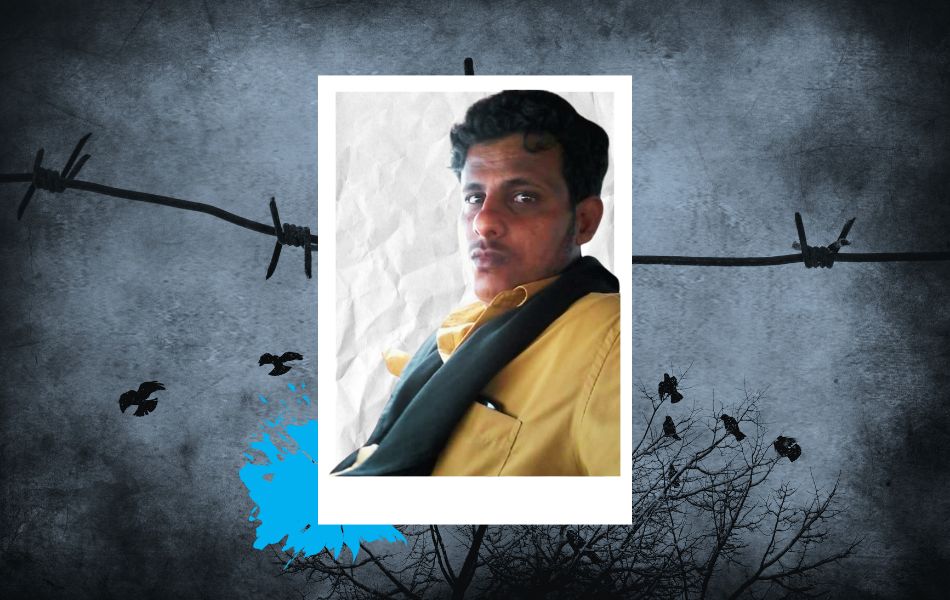
The case of Hatem Ali Juaim Al-Awlaki represents a documented example of the crime of enforced disappearance in Yemen. Hatem has been forcibly disappeared since October 2016, with no information available regarding his fate or place of detention. This constitutes a grave violation of fundamental human rights and international law.
Hatem Ali Juaim Al-Awlaki is a Yemeni national who was 26 years old at the time of his arrest. He originates from Shabwa Governorate, Nisab District, and was residing in Aden, in the Al-Mamdarah area. Hatem worked as a bus driver to earn his daily livelihood and was also a student seeking to build a modest future, reflecting the aspirations of a broad segment of Yemeni youth.
In 2015, amid the severe security instability in Aden following the takeover of the city by the Houthi group, Hatem joined the Mansoura resistance, according to accounts from his relatives. He fought alongside local residents in defense of their neighborhoods. Hatem was neither a military commander nor a prominent political figure; rather, he was an ordinary young man who believed in his cause and defended his city.
After Aden was retaken, Hatem returned to civilian life and resumed his work as a bus driver. He married after the liberation, and his life appeared to be moving toward the stability he had long sought. However, this stability was short-lived.
Hatem was arrested on Friday, 17 October 2016 (corresponding to 27 Ramadan 1437 AH), only two months after his marriage. On that day, he was on his way to visit his family in Mansoura area – Block 36, Aden, on Governor Rimi Street, when he encountered a security campaign that was arresting several young men.
According to accounts provided by his family and relatives, Hatem was surrounded by armored vehicles and cars and forcibly taken away. He was unarmed, not involved in any confrontation, and was not attempting to flee from any crime. Testimonies indicate that the forces who carried out the arrest were affiliated with the Aden Security Administration at the time, when Shalal Ali Shaye’a was serving as Director of Security.
According to the testimony of one of Hatem’s friends, who requested anonymity, the security force raided a relative’s house and then transferred Hatem to a location locally referred to as “Shalal’s House,” a site repeatedly mentioned in testimonies related to detention practices during that period. From that moment onward, all information about Hatem’s whereabouts and fate was completely cut off.
Hatem’s family began an exhausting search for their son, initially believing that the matter involved routine questioning that would conclude through known legal procedures—official records, charges, prosecution, and judicial review. Instead, the family encountered systematic denial of Hatem’s presence in any known detention facility.
Hatem’s parents, carrying his photograph and accompanied by families of other detainees, went to Bir Ahmed detention facility. There, they managed to communicate with a detainee who confirmed that he had been held together with Hatem. He provided precise details that could only be known by someone who had met Hatem personally, including the fact that Hatem had been married for two months and that his mother suffered from a brain illness. These accurate details convinced the family that the witness had indeed encountered their son.
Despite this testimony, the witness was unable to specify Hatem’s current place of detention. He stated that Hatem and other detainees were transferred elsewhere, blindfolded during transportation, and injected in the shoulder until they lost consciousness. Such practices indicate a systematic pattern aimed at preventing detainees from identifying their places of detention.
The family reported that some parties claimed Hatem had been “taken to the Coalition,” yet officials later denied holding him when the family followed up. This contradiction between testimonies and official denials placed the family in a state of legal and humanitarian limbo, unable to determine whether their son was alive or deceased.
One of Hatem’s friends stated in his testimony:
“We went everywhere—Ministry of Human Rights, Ministry of Interior, the judicial complex—without any benefit. We found no information about Hatem. Their only response was: ‘This person was taken by the Coalition.’”
SAM for Rights and Liberties has continuously followed Hatem’s case, along with similar cases, for more than seven years. The organization has documented the details step by step and recorded the suffering of affected families through direct testimonies. SAM worked to verify accounts, collect statements, and shed light on the facts revealed by these testimonies amid an imposed wall of silence surrounding such cases.
In 2021, the organization issued a report titled “The Long Absence,” which presented a summary of several enforced disappearance cases and the ongoing suffering of families. Hatem Ali Juaim Al-Awlaki was among the prominent names included in the report, as his case remains unresolved with no known trace or official response.
The SAM team met with one of Hatem’s relatives, who described the devastating humanitarian situation endured by the family since Hatem’s disappearance. Grief has overshadowed the household: the mother suffers from a brain illness and lives under constant psychological pressure and anxiety over her son’s fate; the elderly father became homebound after falling ill; and Hatem’s wife suffered severe psychological trauma after losing her husband only two months after their marriage.
In a poignant testimony, one of Hatem’s relatives said:
“What did Hatem do to be forcibly disappeared? We are exhausted from the weekly protests, yet no one pays attention to our demands.”
Hatem’s family pursued all possible legal and administrative avenues to obtain information about his fate. In 2019, they met with former Aden Security Director Shalal Ali Shaye’a and explained the situation of their forcibly disappeared son. According to the family, he told them:
“Your son is with us… If he has done something, come receive him through the central prison… and if he has not done anything, he will return home.”
The family left the meeting hopeful that justice would move forward. However, nothing happened. They later received a response stating that all prisons denied holding Hatem, except for two facilities that provided no clear reply.
In 2021, the family met with Aidarous Qassem Al-Zubaidi as part of a delegation from Shabwa, led by Sheikh Ali Ahmed Al-Jabwani, in the presence of Shalal Ali Shaye’a. Officials referred to prisoners who were “handed over by the UAE” and others who were “transferred to the UAE,” and issued the family a letter addressed to security authorities to search detention facilities.
The family submitted the letter to the relevant authorities and met with the Aden Security Director. The document was signed and referred to the operations room; the original copy was taken, and the family was asked to return after twenty days. When they returned, they were asked to wait an additional twenty days. Later, they were told that procedures had not been completed. After that, the authorities fell completely silent, leaving the family alone with a heavy file and no result.
The family confirms that they do not know the charges against Hatem, the nature of the case, or the reason for his arrest. They continue to suspect that he is detained in facilities affiliated with the Southern Transitional Council, but without conclusive evidence or official acknowledgment.
In a deeply moving statement reflecting the family’s ongoing suffering, Hatem’s father said:
“I am the father of Hatem Al-Awlaki, who was abducted and forcibly disappeared in 2016. Every day that passes without knowing his fate is filled with anxiety and tears… We want to know Hatem’s fate, and we demand that all concerned authorities act immediately to reveal his whereabouts and hold those responsible for his abduction accountable… We will not abandon our demands and will continue to seek justice until our last breath.”
This testimony reflects the plea of a grieving father, carrying the pain of continuous loss without even an official document informing him of his son’s fate.
The enforced disappearance of Hatem Ali Juaim Al-Awlaki, as described by his family and corroborated testimonies, constitutes a serious violation of human rights guaranteed under international conventions and international human rights law. Enforced disappearance is a continuing crime as long as the victim’s fate remains unknown and their place of detention is not officially disclosed.
The impact of this crime extends beyond the victim to destroy the entire family, transforming it into a collective victim living in a state of constant anxiety and anticipation. The continuation of such practices undermines the rule of law and turns the state into an entity that fails to uphold its constitutional and legal obligations toward its citizens.
SAM for Rights and Liberties confirms that it has repeatedly communicated with the victim’s family and documented their testimonies as part of its efforts to monitor cases of prolonged disappearance and enforced disappearance in Yemen. The organization considers this crime among the most serious violations, as it places victims outside the protection of the law and leaves families hostage to endless waiting and psychological and physical exhaustion.
Ten years after Hatem’s disappearance, his family continues to demand their legitimate rights. These ten years are not merely a period of time, but a prolonged suffering endured by a mother who has aged while asking a single question about her son’s fate; by a disabled father awaiting his son’s return; by a wife who lost her dream of stability only two months after marriage; and by a household overshadowed by grief and uncertainty.
The family’s demands are clear, specific, and grounded in the most basic human rights:
To know Hatem’s fate, whether he is alive or deceased.
To disclose his place of detention, if he is still alive, and allow the family to communicate with him.
To guarantee his right to justice and a fair trial if there are charges against him, or to release him immediately if no legal charges exist.
To hold accountable those responsible for his arrest and enforced disappearance over all these years.
To put an end to this prolonged suffering, which has continued for a decade without any development or official information.
The case of Hatem Ali Juaim Al-Awlaki represents a tragic model of enforced disappearance in Yemen, where citizens vanish without any knowledge of their fate or place of detention, in blatant violation of international human rights law and international humanitarian law. Since October 2016, Hatem’s family has lived in a state of uncertainty and enduring pain, despite all legal and administrative efforts to uncover the truth.
The continuation of this case for a full decade without resolution reflects a failure of the justice system and underscores the urgent need for immediate intervention by relevant local and international actors to end the suffering of this family and others living under similar conditions. Hatem Ali Juaim Al-Awlaki remains one name among a long list of forcibly disappeared persons still waiting for justice and accountability.