

Name: Sami Noman
Arrestee: Houthi group
Date of arrest: June 21, 2018
Journalist Sami Noman remembers the day when his family's house in the village of Al-Masa'id, Ma'awiah district in Taiz, was surrounded by armed fighters from the Houthi group. He recounts his arrest incident: "There were ten armed individuals riding in a Houthi vehicle, led by Colonel Ali Alwan, known as Al-Qadhafi. They besieged our house in Al-Masa'id village, Ma'awiah district. Another vehicle - as my friends informed me - was positioned far away from the village for support and reinforcement in case of any emergency when attacking a journalist who only had a kitchen knife for cutting vegetables in his house."
My 9-year-old son, Muataz, came to wake me up. I had just gotten a chance to sleep after a long period of exhaustion, staying up late, and fasting. He told me that a Houthi vehicle was asking about me and that they had spread around the house, ready to open fire. He added:
"When they got out of the vehicle, they quickly unlocked the weapon safes."
Indeed, this is the behavior of the cowardly terrorist group: intimidating civilians through displays of force. It is a ridiculous and cowardly show to bring such a large number of individuals to confront a journalist who would have simply approached them for an interview because he has nothing to fear from them.
The armed men arrived during the preparations for Ismael, our neighbor's simple wedding. Perhaps that heightened the alertness of the brave individuals. My mother, may God bless her, went down to ask them what they wanted and informed them that I was not present, as she was unaware of my existence there. They exchanged signals of encouragement, thinking that she was trying to mislead them in an attempt to escape. They responded to her by saying, "We don't want anything, why are you afraid for your son? What's wrong with him?"
My mother came back and told me, "We told them you're not here, so don't come out." I chuckled at her attempt to reassure me and told her that I have nothing to hide from them, as I am not a criminal. So why should I be afraid? She shook her head and said, "Okay," meaning she understood my perspective.
I approached them without hesitation, with the lower half of my body wrapped in an "Izar" and wearing an unbuttoned shirt. Al-Qadhafi had positioned his rifle in a defensive stance at the front of the vehicle. When they saw me coming towards them in this manner, they perhaps momentarily felt a sense of embarrassment from the unnecessary show of force. They lowered their weapons and returned to the vicinity of the vehicle.
I asked Al-Qadhafi, "What's the matter?" He replied, "This is Abu Maher, the security supervisor for Taiz. He said you are coming as a guest for only two hours, and there is nothing to worry about." I said to him, "Well, please come in, let's have some breakfast and dinner before we go." He responded, "We are in a hurry." If he had been truthful, he would have also said they were afraid. I told them, "In the name of Allah, we trust, let's see what he has."
I attempted to ride in the back of the vehicle, but they refused and insisted that I sit next to the driver, with a young armed companion who appeared to be under 18, handsome and amiable, by my side. I didn't attempt to go back and fetch any belongings to avoid arousing suspicion, nor did I want them to ask for my phone, which contained ordinary content that militant groups could potentially use as sufficient evidence for hiding me for years and then executing me.
I had breakfast on the way, and we had lunch in As-Suwayda with the individuals. I had 3,000 riyals with me, and I tried to pay for the meal at the restaurant, telling them, "I only have this amount, please take care of the bill." However, Al-Qadhafi said, "You are our guest," and he paid the amount.
I arrived in the city of Al-Saleh around 8 PM, and they recorded my information before placing me in cell (apartment) number 33 in a building supervised by someone called "Abu Yahya." The person in charge of the cell is the cultural supervisor for the Houthi movement in Taiz, named "Abu Mustafa."
As I was climbing the stairs of the building, the young companion who had been listening to our conversation throughout the journey called out to me, "Sir, do you have qat (a stimulant plant) or not?" I replied, "By God, I don't have any." However, he insisted and gave me some of what remained in the bag hanging from his side.
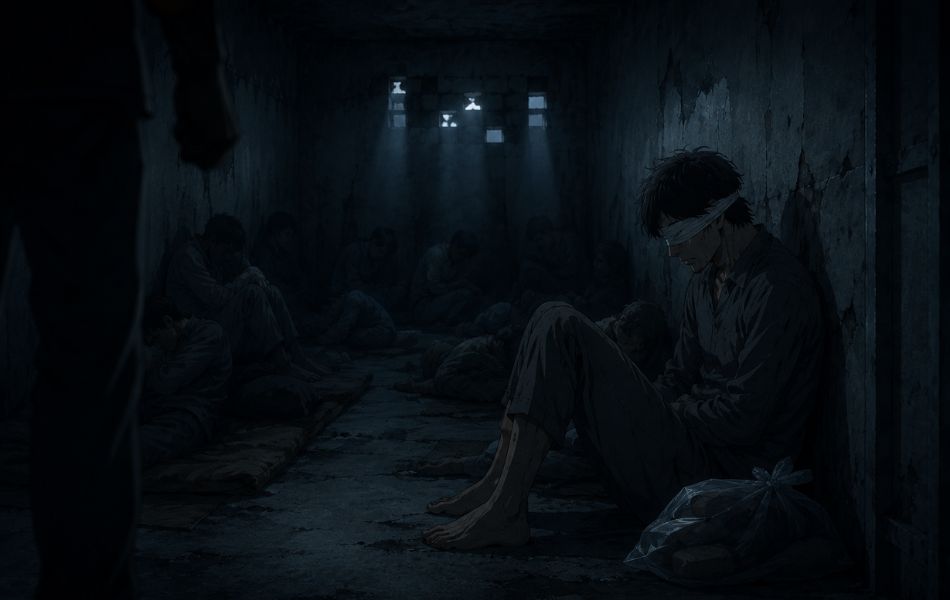
I entered cell 33 on the second or third floor, and it was dark except for dim lighting that was insufficient to discern the features of those beside or in front of me. The windows were closed with stones, and only a small opening or two, about the size of a hand, remained in each window. These are the cells they refer to as "ad-Daghata" or "the pressure cells."
As soon as I entered, a lawyer named Al-Jalal invited me to put my shoes inside a bag, claiming that I would need it as a pillow. This lawyer was detained because he had an application that automatically published legal materials on his Facebook page. Most of the detainees were held on absurd charges related to WhatsApp. Despite more than two months of imprisonment, they had not yet interrogated him.
There were around 43 individuals, including 8 who were mentally disturbed or unstable, and the rest, the majority, were unaware of the charges against them, similar to the lawyer. Among them, there were about 10 former military personnel, most of them under 45 years old. The majority of them hailed from Hajjah Governorate and were arrested on charges of attempting to join Tariq Saleh's forces.
In the adjacent cell, which I believe was number 35, the prisoners informed me that a few days ago, a person known as Al-Qabbati passed away after a hunger strike and experiencing severe mistreatment. They removed him from the cell unconscious, and they forcefully inserted needles into various parts of his body, thinking that he was pretending. However, he did not regain consciousness, and they took him away, dragging him down the stairs without his return. He died due to delayed medical treatment and complications from dehydration.
They informed me that due to his death, the conditions in the prison had slightly improved in terms of nutrition, water supply, and the installation of a dim light bulb that barely provides visibility to those nearby.
Upon entering the cell, the prisoners would gather around you, eager to know everything. They were waiting for anything new that would replace the old and worn-out information they already had. There was nothing new here except for a fresh snippet they could hear, which was their rare opportunity for knowledge. However, after a couple of days, the new captive would refrain from speaking, as doubts would arise about those around him. It is the very same prisoners who would advise him to do so.
Many of them didn't hide their familiar wit when encountering each new prisoner. They would ask questions like, "How much does a cup of tea cost outside? Are there still people and markets out there? Is the asphalt road still intact, or has it been taken by the 'Hamal' battalions? How did they bring you here, on a donkey?" This was their way of mocking the outside world and letting you know that they have spent a lifetime here, akin to the people of the cave in the story.
In those rooms, you would sleep on the floor tiles, and if you were lucky, you might have a piece of "shualat" (a type of mat) that they bring with the food rations. Blankets and mattresses, in the absence of proper ventilation, would be infested with dust and lice. They were generally scarce, only available to a few individuals whose relatives brought them.
I spent some time with them, and each time someone from a neighboring room would come and repeat the same question, I would give the same answer. The rest of them enjoyed the repetition and found amusement in it.
After about an hour and a half to two hours before half past ten, they called me for questioning, amidst the astonishment of the majority of the others who had spent weeks and months without being interrogated. Then, the sensible person in the cell, a young and respectable military man from Hajjah, held me by the shoulder and said:
"Brother, be confident in yourself and don't worry. The most important thing is to remain calm. And if they ask you about your affiliation with any party, be cautious, especially regarding Al-Islah."
I jokingly replied, "I'll say I'm a socialist."
We shared a moment of laughter, and then I proceeded to the interrogation session, keeping his advice in mind.
He shouted at me, saying, "Neither you nor your grandmother have anything to do with any party. The rest of the questions are for you to answer."
The escort who takes the prisoners to the interrogator asked me to take the "blindfold." I informed him that I didn't have one, and he called out to give me one to blindfold my eyes halfway up the stairs before the fourth floor, where the interrogator was located.
They took me for five hours of interrogation, and I may not remember exactly how long it took. What matters is that I returned to the cell, and within minutes, the first call to Fajr (dawn) prayer was announced.
I returned to the cell at that time to explain once again what happened with the interrogator. Some of them winked at me, indicating to be cautious about what I say, as some of the weaker prisoners are coerced into spying and tempted with false promises of release. I always responded to them that whatever I say to the interrogator is the same as what I say among them because I have nothing to hide.
On that morning, which happened to be a Friday, they called out to dozens of detainees from various cells and buildings, asking them to come out and move to an undisclosed destination. Some of them were optimistic, thinking it might be a release, while others speculated that they were being transferred to the military prison, and a third group expected to be forcibly taken to the frontlines in Hodeidah. Later, I learned that they were transported by trucks to the Community College detention center in Dhamar, to be included in the list of individuals wanted for a prisoner exchange. These individuals had been gathered from checkpoints, streets, and localities, allowing them to communicate with their acquaintances. Those who desired freedom had to seek an exchange with a Houthi prisoner held on the frontlines.
On the following day, I was transferred to the adjacent cell, known as the "pressure cell" or "Cell 44." It was then that I understood that they wanted to separate those who had been interrogated from those who hadn't into different cells or apartments. I was informed that those who hadn't been interrogated would be placed in another apartment. However, to my surprise, I found individuals in the other apartment who also hadn't been interrogated.
*The journalist Sami Noman wrote an article about his arrest in June 2019, and he currently resides in the city of Taiz.