

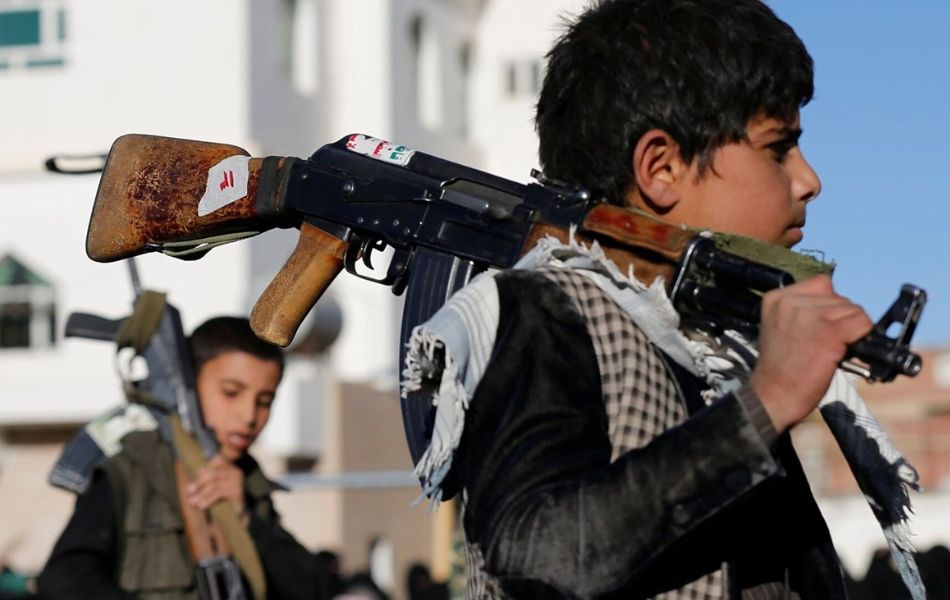
Geneva – The Justice4Yemen Pact stated that the recruitment, use, and exploitation of children in armed conflicts in Yemen constitute a grave and unjustifiable violation that undermines children’s rights to life, education, and protection. It turns childhood into fuel for war through recruitment patterns that exploit poverty, school dropout, propaganda, and incitement, thereby necessitating urgent and unified action to end these practices, hold those responsible accountable, rescue affected children, and ensure their rehabilitation and reintegration into society.
The Pact reported that its field investigations on child recruitment in Yemen concluded that the phenomenon is not comprised of “isolated cases,” but rather represents a widespread and recurring pattern. The organization documented the recruitment of 11,310 children across 19 governorates since 2014 up to February 2023, including 6,269 children aged 8–11, 580 aged 12–14, and 4,461 aged 15–17, highlighting the expansion of early targeting of children prior to adolescence and the high proportion of younger age groups among those recruited.
SAM added that its reports demonstrate a direct link between child recruitment and economic vulnerability. They show that 6,126 recruited children come from households with no income, 3,194 from low-income households, and 1,990 from middle-income households, confirming that poverty and the collapse of livelihoods are exploited as leverage to draw children into frontlines or auxiliary roles.
SAM further affirmed that estimates regarding the scale of recruitment vary due to lack of access and deliberate concealment; nevertheless, its reports documented the multiplicity of “recruitment channels” and cited estimates attributed to official bodies as well as media and human rights sources that point to wide-ranging recruitment throughout the years of war. This reflects the difficulty of precise enumeration in the absence of independent, transparent national mechanisms for monitoring and verification.
SAM indicated that its reports and victims’ testimonies highlight the direct humanitarian impact of this crime on families, including cases in which children are lured under the pretext of education or work and then transferred to training sites or combat frontlines. Such patterns appear in documented narratives within SAM’s human rights reports addressing recruitment motives, pathways of indoctrination and enlistment, and the suffering of mothers and families.
SAM Organization for Rights and Liberties stated that international monitoring evidence confirms the continued recruitment and use of children in the Yemeni conflict as a grave and systematic violation. Watchlist documented 564 cases of child recruitment and use during the period from 1 January 2021 to 31 December 2023, within 5,539 grave violations against 2,422 children, entrenching recruitment as one of the ongoing “six grave violations” against children.
The Watchlist update (November 2025) further indicated the continued listing of conflict parties in the annexes of the 2025 annual report due to child recruitment and use, noting that in 2024 alone the United Nations verified 182 cases of recruitment and use among 583 grave violations against 504 children, with 59 children participating in combat roles. This confirms that recruitment has remained active despite changes in the dynamics of fighting.
SAM noted that independent reports and analyses have documented the use of “summer camps” as a central recruitment channel. A report by the Justice for Yemen Pact (May 2025) indicated that “summer camps” in areas under Houthi control are used as programs of mobilization, indoctrination, and recruitment that facilitate the gradual integration of children into war structures, threatening their right to safe education and exposing them to exploitation.
SAM also confirmed that this pattern intersects with what its reports have documented regarding the expansion of the training infrastructure linked to child recruitment. It estimated the number of camps in which children receive military training at 52 camps that “receive thousands of adolescents and children,” reflecting an organized and expansive nature of training and mobilization channels.
SAM reported that Human Rights Watch, in its report dated 13 February 2024, confirmed that activists reported the recruitment of children “some as young as 13,” alongside an escalation in mobilization campaigns since 7 October 2023—a regional and media context that, according to multiple reports, contributed to the activation of recruitment pathways in subsequent years, including 2025.
SAM added that an analysis by the Italian Institute for International Political Studies (ISPI) (December 2024) indicated that recruitment in Yemen “continued” despite adherence to a ceasefire on the ground, and that its drivers are fueled by economic, ideological, local, and regional factors. The analysis noted a shift in mobilization from limited recruitment to widespread recruitment over the years of war, reinforcing the understanding of recruitment as a structural phenomenon not tied solely to the outbreak of a particular battle.
SAM also pointed out that the Global Institute for International Criminal Justice (GICJ), in an article published on 20 August 2025, addressed child recruitment in Yemen as a war crime when it involves the recruitment of children under the age of 15, linking poverty, indoctrination, and a deteriorated educational environment as factors pushing children toward battlefields. This underscores the need to strengthen protection tools, legal enforcement, and the prosecution of recruitment networks and intermediaries.
SAM emphasized that child recruitment cannot be separated from the broader environment of violence in which children are killed and injured. The Civilian Impact Monitoring Project (CIMP) documented in 2025 361 child casualties (108 deaths and 253 injuries) within a civilian toll of 2,653 killed and injured during the year. SAM added that Save the Children supported this trend through its analysis of CIMP data, reflecting escalating risks facing children in an environment that also facilitates exploitation and recruitment.
SAM Organization for Rights and Liberties stressed that ending child recruitment in Yemen requires specific and immediate measures, including: the immediate and unconditional cessation of the recruitment and use of children in any combat or auxiliary roles; the release of all children associated with armed forces and groups and their handover to competent civilian child-protection authorities; the opening of independent investigations into recruitment networks, intermediaries, financing lines, and incitement; the guarantee of comprehensive rehabilitation programs (psychological, educational, and social) and long-term reintegration; and ensuring safe access for protection and monitoring organizations to victims and witnesses without intimidation or retaliation.
Finally, SAM called on the international community, the United Nations, and influential states to intensify diplomatic and procedural pressure to ensure compliance with relevant UN action plans, activate accountability mechanisms, direct funding toward child protection and reintegration programs, and prevent funding shortfalls or access restrictions from becoming a “cover” for the continued recruitment and exploitation of children.